Archaeology and architecture
National Museum of Anthropology Audio Guide (Museo Nacional de Antropología)
A museum promised in 1910 and built in nineteen months, where almost every piece was once buried, hidden, torn away or stolen, and an immense roof hangs from a single column down which water pours.
- 120 min of audio
- Mexica and Maya art
The institution was born in 1825 and changed home several times before reaching Chapultepec. Pedro Ramírez Vázquez's building opened on 17 September 1964 with all its halls installed: Adolfo López Mateos commissioned it so that Mexicans would leave it proud to be Mexican, and in 30,000 square metres of exhibition space it brings together the Sun Stone, the Coatlicue and the tomb of Pakal.
On the Reforma, a seven-metre stone colossus greets visitors with a plaque speaking of a generous donation. In San Miguel Coatlinchán, the village it left in 1964, a different story is remembered: slashed tyres, soil in petrol tanks and the army occupying its streets for nearly a month.
Highlights
- Tlaloc monolith: seven metres and 167 tonnes brought from Coatlinchán in 1964
- The courtyard umbrella: about 54 by 82 metres hung from 80 cables and a bronze column that rains
- Sun Stone: 3.6 metres of basalt that spent some 200 years underground
- Pakal's tomb and jade mask, stolen on Christmas Eve 1985 and recovered in 1989
- Ethnographic halls with dwellings built by Indigenous hands and about 6,000 objects
The story of the National Museum of Anthropology begins long before its building. In 1825, by decree of President Guadalupe Victoria and on the proposal of Lucas Alamán, the Mexican National Museum was born; in 1865 Maximilian of Habsburg installed it in the old Mint, at Calle de Moneda 13, and in 1940 it took the name it keeps today. The great museum in Chapultepec, by contrast, was a promise postponed for half a century: Justo Sierra offered it at the Congress of Americanists in 1910, the Revolution buried it in oblivion and only in 1962 did the commitment return to the table.
What came next reads like a race against the clock. Work began in February 1963 and the museum opened nineteen months later, at a declared cost of 160 million pesos. But the architecture of the National Museum of Anthropology is only the frame for a stranger idea: almost everything it holds was, at some point, buried, hidden, torn away or stolen. This 120-minute audio guide, documented, researched and checked against historical sources, goes through those hidden lives piece by piece, from the pavement of the Reforma to the halls of today’s Indigenous peoples.
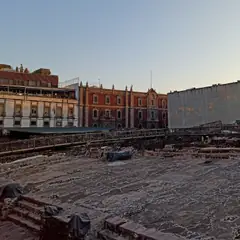
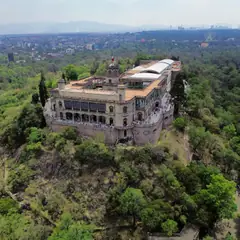
The Sun Stone reappeared in 1790 beneath the Plaza Mayor, beside the sacred precinct now visited at the Templo Mayor. At the top of the same park, Chapultepec Castle houses the National Museum of History.
The god Coatlinchán did not want to hand over
Tlaloc monolith
Summary of this stop
On the corner of Reforma and Grutas stands a stone colossus of about seven metres and 167 tonnes. The museum identifies it as Tlaloc, the reading most accepted among scholars, although since José María Velasco painted it in 1889 as Chalchiuhtlicue, a female water deity, its identity has remained disputed. At its feet, a plaque states that the people of San Miguel Coatlinchán donated it generously in 1964.
The village tells another story. The villagers dismantled the platform, slashed the tyres of the trailers and threw soil into the petrol tanks; the army occupied Coatlinchán for nearly a month, and in that time a health centre and the primary school were built. At three in the morning on 16 April 1964, the stone set off, dragged along at five kilometres an hour; in the capital, power and telephone cables had to be cut as it passed, and a storm flooded the city while more than 60,000 people cheered it.
There, from grandparents to grandchildren, an even older tradition is handed down: when the Spanish were destroying everything that smelled of the old religion, the village’s ancestors are said to have hidden their god on the mountain and buried him completely. That one monolith should survive two farewells takes on a different weight when its story is heard in front of it.
A roof hung from a column that rains
Courtyard umbrella
Summary of this stop
The central courtyard is the heart of the building by Pedro Ramírez Vázquez, with the collaboration of Rafael Mijares and Jorge Campuzano. Above it floats a concrete canopy of about 54 by 82 metres that seems to rest on a single column. The impression is deceptive: the umbrella hangs from 80 cables anchored to the central mast.
The column, of bronze and more than ten metres tall, is wrapped in the relief «Image of Mexico», carved by the brothers Tomás and José Chávez Morado from an idea by Jaime Torres Bodet. And from its rim a curtain of water falls without pause. What is admired today as a poetic gesture was born of a very earthly problem to do with the leaf litter of Chapultepec park.
At the back, facing the Mexica Hall, a pond reflects the bronze conch «El Sol del Viento», by Iker Larrauri, and on the upper floor runs Felguérez’s aluminium lattice, a geometrised serpent in the Puuc manner. How a museum built in nineteen months solved with ingenuity what might have been a disaster is one of the most revealing moments of the route.
The Sun Stone that was never a calendar
Sun Stone
Summary of this stop
At the back of the Mexica Hall, in the place of honour, rests a basalt disc of 3.6 metres and about 24.5 tonnes: the Sun Stone. The name «Aztec Calendar» was given to it by Antonio de León y Gama in 1792, but the piece was meant to lie horizontally, bears the glyph of Moctezuma II and, according to the current reading, more probably served as an altar or ceremonial vessel than as an astronomical instrument. The ring of the twenty days keeps the debate alive.
Its biography is that of a survivor. Archbishop Alonso de Montúfar had it turned over and buried, and so it spent some 200 years until it reappeared on 17 December 1790 during works in the Plaza Mayor. Afterwards it was set into the west tower of the Cathedral until 1885, in the open air. It is said that foreign soldiers used its face as a target, although there is no evidence of impacts and many attribute the wear to time; what is recorded is that General Winfield Scott considered taking it to Washington as a war trophy.
Very close stands the Coatlicue, 2.52 metres tall with her skirt of serpents, which appeared in 1790 and was buried again because it attracted worship. It was dug up in 1803 only so that Alexander von Humboldt could draw it, and went back underground. In 1964, the Sun Stone was bid farewell at the old museum with «Las golondrinas»; what its central face hides is discovered by listening to it in front of her.
Pakal’s mask and the Christmas Eve robbery
Tomb of Pakal
Summary of this stop
In the Maya Hall, the burial chamber of the Temple of the Inscriptions at Palenque is reproduced, with Pakal’s jade mask. The piece has a past out of a crime novel: in the early hours of 25 December 1985, while the guards were celebrating Christmas, two veterinary students, Carlos Perches Treviño and Ramón Sardina García, entered through the air-conditioning ducts and took 124 pieces from the Maya, Mixtec and Mexica halls, according to the museum’s catalogue; the initial complaint spoke of 140.
According to the chronicle of the case, before the heist they spent at least six months visiting the museum almost daily to learn the guards’ routines. On 10 June 1989 the police recovered 111 pieces in a closet of the Perches family home in Ciudad Satélite; four never turned up. Gabriel García Márquez attended the return ceremony, drawn by the mystery, and in 2018 the story reached the cinema with «Museo», by Alonso Ruizpalacios.
Between the night of the robbery and that closet lies an unexpected path that passes through Acapulco and a Guadalajara prison, and which the narration reconstructs beside the tomb.
Houses built by those who live in them
Upper-floor ethnographic halls
Summary of this stop
The upper floor changes tone: from what is buried we pass to what is alive. The ethnographic halls show today’s Indigenous peoples, and for the 1964 installation Indigenous people from different regions built replicas of their own dwellings with their own hands. After the renovation begun in 2020 and reopened in 2024 and 2025, they bring together about 6,000 objects with the work of 300 craftswomen and craftsmen, among houses, textiles and festival objects, with views over the courtyard and Chapultepec park.
Getting here also has its logic. The building is designed to force rest: on the ground floor, after going through two halls, the visitor has to step out into the courtyard before entering another. Of the 45,000 square metres built, 30,000 are exhibition space, the equivalent of a 5.5-kilometre route, and that forced pause is as much a part of the design as the umbrella. The audio guide’s close, in these halls, gives meaning back to everything before it.