Heart of Tenochtitlan
Templo Mayor Audio Guide
The double pyramid of Huitzilopochtli and Tlaloc was the centre of the Mexica world, dismantled stone by stone after the conquest. For centuries it slept beneath the streets, until a cable trench brought it back to light in 1978.
- 90 min of audio
- Mexica archaeology
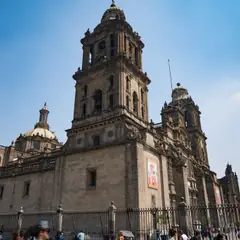
The Templo Mayor does not impress by height, but by depth. It began to be raised after 1325 and was rebuilt six times: each new stage completely enveloped the previous one, so the building grew like an onion. After the fall of Tenochtitlan in 1521 it was dismantled and its stones ended up in the foundations of the viceregal city, with the Cathedral rising over the western half of the sacred precinct.
The paradox is that nobody has seen standing the temple the conquistadors beheld: of that seventh stage barely the floor remains. Everything that now shows between the walkways belongs to older temples that lay hidden inside, down to an intact summit with its Chac Mool and its sacrificial stone.
Highlights
- Seven superimposed stages — an onion-temple explored layer by layer
- Twin shrines of Stage II — the oldest summit, with Chac Mool and sacrificial stone
- Eight stone standard-bearers — guardians of the staircase of around 1431
- House of the Eagles — benches painted with processions of warriors
- Coyolxauhqui and Tlaltecuhtli — the disc found in 1978 and the largest Mexica monolith known
A few steps from the Metropolitan Cathedral, in the very centre of Mexico City, a gap opens in the city that is also a time machine. The story of the Templo Mayor starts after 1325, when the Mexica raised a first sanctuary that they rebuilt six times, always on top of the previous one. The double pyramid, consecrated to Huitzilopochtli and Tlaloc, was the axis of Tenochtitlan until 1521; afterwards, the victors dismantled it to lay the foundations of the new capital and its memory lay buried for more than four centuries.
What is walked today along walkways is the result of a long search full of mistakes, capped by a stroke of luck in 1978. The architecture of the Templo Mayor reads in layers, from the most recent stage to the oldest, and each keeps its own episode: myths turned to stone, unsettling offerings, original colour and colossal monoliths. It is a place that gains a great deal when each stratum is understood on the ground, and the audio guide, researched and checked against historical sources, unpicks them stop by stop.
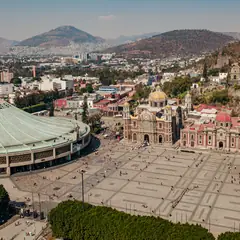
Over the western half of the sacred precinct now stands the Metropolitan Cathedral, and the Sun Stone, which reappeared in 1790 beneath the Plaza Mayor, waits in the National Museum of Anthropology. To the north, on Tepeyac hill, where according to Sahagún there was a temple to Tonantzin, stands the Basilica of Guadalupe.
A pyramid sought in the wrong place
Plaza Manuel Gamio
Summary of this stop
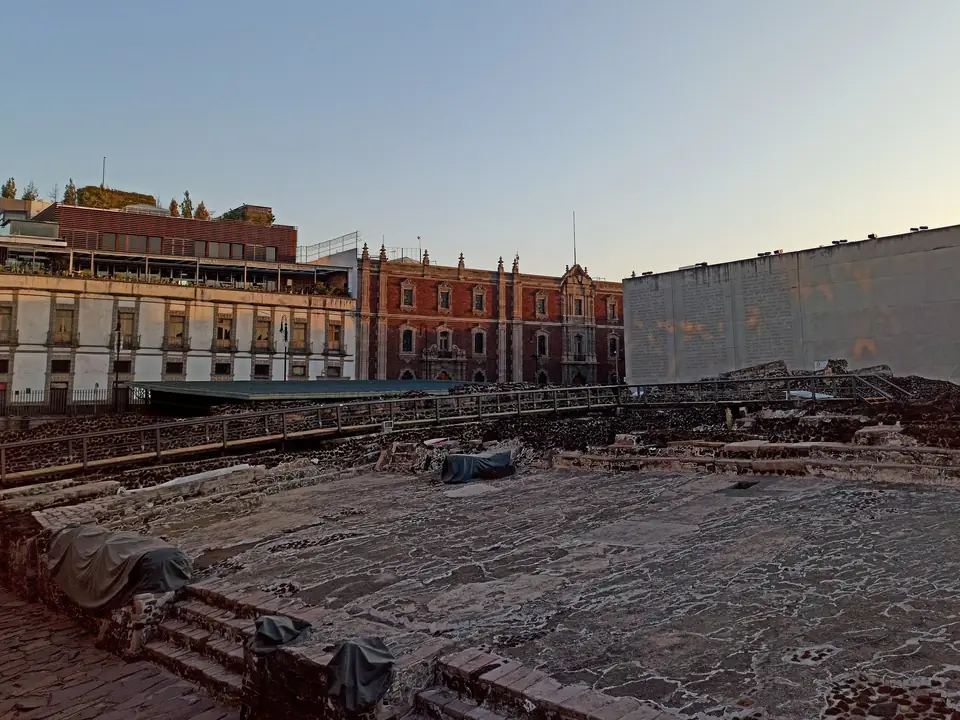
The route begins at Plaza Manuel Gamio, facing the ruins. From here one grasps something that surprises almost everyone: the most sacred temple of the Mexica is not sought upward, but downward. Around 1900, Leopoldo Batres chased it beneath the Cathedral, convinced that it stood over its remains; in fact it lay to the northeast, and in his works on Calle Escalerillas he even cut through part of the Templo Mayor without recognising it.
In May 1914, Manuel Gamio found the southwest corner of Stage III at the crossing of Seminario and Santa Teresa, today República de Guatemala, and confirmed where the ceremonial precinct was. The excavations stopped in January 1915 because the residents refused to leave their homes. Decades later, to bring the temple to light, by decision of President José López Portillo 13 buildings of the block were demolished, a decision that still divides opinion: some discount the historical value of what was torn down and others recall that the conquistadors’ first houses stood there.
Meanwhile, beside the plaza, dancers in feathered headdresses go on dancing to the beat of the drum and fumigating with copal whoever approaches. Many take it for a limpia, a cleansing; they call it a fire bath and choose this corner because they consider it a great energy centre. What lies behind that ritual, and why it happens right here, is discovered by listening to the narration on the spot.
The temple nobody has seen standing
Flagstone floor of Stage VII
Summary of this stop
Facing the west façade stretches a paving that at first sight draws no attention. It is, however, the only thing left of Stage VII, raised between 1500 and 1521: the temple the conquistadors saw. Everything rising in front belongs to earlier stages that lay buried inside it.
That floor was the scene of one of the gravest episodes of the conquest. On 22 May 1520, during the festival of Tóxcatl, Pedro de Alvarado’s troops closed the exits of the courtyard and killed hundreds of unarmed people who were dancing and singing. The massacre unleashed open war, although its reading remains contested: Nahua accounts describe it as premeditated murder and Spanish authors denied it, played it down or presented it as a pre-emptive attack.
A year later, Tenochtitlan fell and the temple was dismantled; its stones became the foundations of the viceregal city and the church that would give way to the Cathedral occupied the western half of the precinct. Absence is the protagonist here, and the audio guide gives voice to what is no longer there.
Coatepec, the hill turned staircase
Serpents and braziers of Stage IV
Summary of this stop
On the south side, the platform of Stage IV keeps heads of undulating serpents and braziers with the face of Tlaloc. But what makes this point more than architecture is the myth it staged. According to the Mexica account, Coatlicue became pregnant with Huitzilopochtli at the summit of Coatepec hill; her children, led by Coyolxauhqui, climbed up to kill her, and the god was born already armed, beheaded his sister and threw her body down the slope, where it broke into pieces.
The southern half of the temple represented that hill, and around 1481, during the reign of Axayácatl, the disc of the dismembered Coyolxauhqui was placed at its foot. Documented tradition tells that, at the festival of Panquetzaliztli, the bodies of captives sacrificed at the summit were thrown down the staircase to that stone, repeating the myth with real bodies.
Stage VI, the work of Ahuízotl, was reconsecrated on 19 December 1487 with four days of mass sacrifices and a wall of serpent heads closing the sacred precinct. How many died then is still debated: the chronicles give figures so far apart that many authors consider the highest ones exaggerated. How myth, stone and ceremony fit together is revealed by listening in front of the platform.
The intact summit that slept inside
Twin shrines of Stage II
Summary of this stop
Under a protective roof appears the clearest proof that the temple grew like an onion. Stage II, earlier than 1428, is the only one that keeps its summit: two twin shrines, with a Chac Mool in front of the one to Tlaloc and a sacrificial stone, the téchcatl, in front of the one to Huitzilopochtli. In the rain sanctuary traces of mural painting can still be made out.
A little lower down, the staircase of Stage III, raised between 1427 and 1440 under Itzcóatl, keeps eight stone standard-bearers and a glyph with the year 4 Reed, which corresponds to 1431. They are the guardians who watched over the access to the shrines.
The Tlaloc side also hides one of the most harrowing finds of the archaeological project: Offering 48, with the remains of at least 42 children offered to the rain gods in a time of great drought, in the mid-fifteenth century. What the analyses revealed about those children, and about the hunger the city was living through, completely changes the way one looks at the rain god; the audio guide tells it calmly, in the place where it happened.
Original colour in the House of the Eagles
House of the Eagles
Summary of this stop
North of the temple, protected under cover, lies the House of the Eagles, an L-shaped building from the fourth stage, around 1469. It was excavated in 1981 and 1982 by José Francisco Hinojosa and is one of the few corners of the precinct where colour has survived.
Its painted benches show friezes of serpents and processions of warriors that imitate those of the Burnt Palace at Tula. It is no minor decorative detail: it is a political statement, that of an empire that wanted to present itself as heir to a glorious past. Why the Mexica copied the Toltecs, and what that said about their power, is better understood by listening beside the benches.
A trench, a disc and a goddess
Templo Mayor Museum
Summary of this stop
The route ends at the site museum, and its origin has something of a novel about it. One early morning in February 1978, workers of the Compañía de Luz y Fuerza del Centro digging beneath the streets of Guatemala and Argentina struck a great stone disc more than three metres across: the Coyolxauhqui relief. The details of that moment vary depending on who tells it, but the find changed the city centre for ever.
The excitement was enormous: the find was opened to the public on Saturday mornings and the queues seemed endless. The museum, inaugurated on 12 October 1987, surpassed on opening the daily visits of the National Museum of Anthropology. In its lobby the Tlaltecuhtli monolith, found on 2 October 2006, now greets the visitor: it measures 4.17 by 3.62 metres, weighs some 12 tonnes spread over four fragments and is the largest Mexica monolith known, bigger even than the Sun Stone.
It still keeps traces of its polychromy, a reminder that the Templo Mayor is not a closed story, but a site that keeps coming to light. The most unexpected gesture of those first visits in 1978 is left for the end of the audio guide.