Opera and ballet facing the Kremlin
Bolshoi Theatre Audio Guide (Bolshoy teatr)
It burned in 1805 and 1853, sank into a swamp and saw the Soviet Union born: behind eight calm columns, Russia's most famous theatre is a stubborn survivor that Moscow refuses to let fall.
- 30 min of audio
- Opera and ballet
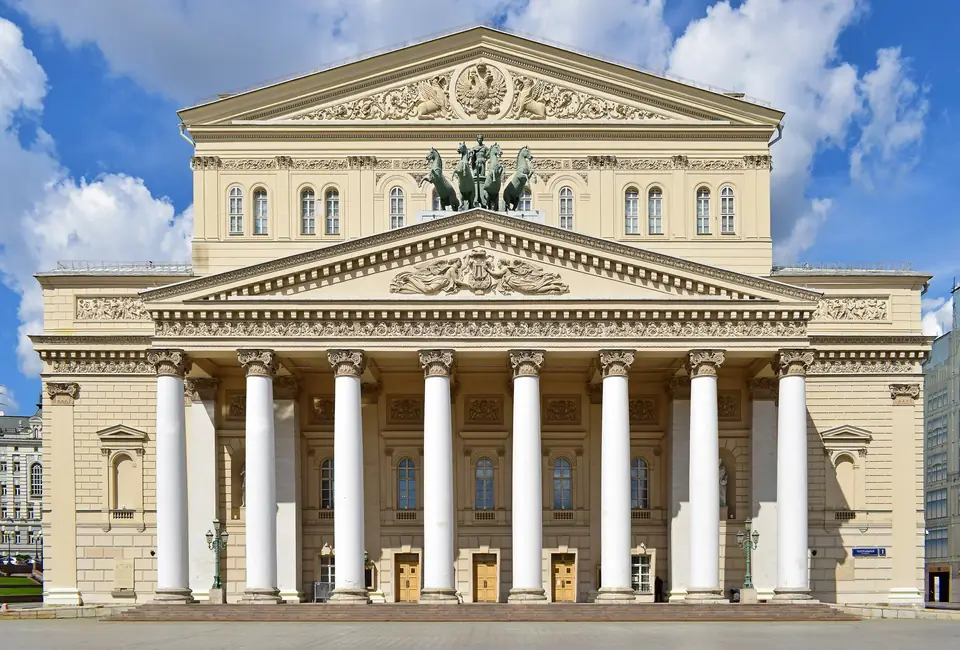
The history of the Bolshoi Theatre begins on 28 March 1776, when Catherine II granted Prince Pyotr Urusov the privilege of organising performances, balls and masquerades in Moscow. The present building is the work of several hands: Osip Bove raised it in 1825 and turned it towards the Kremlin, Albert Cavos rebuilt it after the fire of 1853 and crowned it with the quadriga of Apollo, and between 2005 and 2011 a reconstruction gutted its interior and added six floors underground.
Beneath Russia's most solemn stage runs the buried Neglinnaya river. The theatre stands on marshy ground, on wooden piles that ended up rotten: in 1902, in the middle of a performance, the wall of the auditorium sank so much that the doors of the central boxes jammed. In 2010, Mayor Yuri Luzhkov assured everyone the river did not threaten the foundations and added that he had seen white cockroaches about ten centimetres long in it.
Highlights
- Quadriga of Apollo — the group on the 100-rouble note, camouflaged in 1943 and wearing a fig leaf
- Bove's portico — eight columns of white sandstone that survived the fire of 1853
- Teatralnaya Square — the façade Osip Bove turned towards the Kremlin
- Pediment coat of arms — Cavos's double-headed eagle, recreated in the 2005–2011 reconstruction
- New Stage — the neighbouring building that housed the whole repertoire during six years of works
The history of the Bolshoi Theatre is that of a building that refuses to disappear. It was born as an imperial privilege in 1776, burned in 1780 in its first home on Znamenka Street, burned again in 1805 and once more in 1853, and each time rose again larger. At the start of 1922 it came close to closing for economic reasons: Lenin’s role in that debate is still disputed, because a letter of his of 12 January that year asked to keep only a few dozen artists, and it was the Presidium of the VTsIK that on 6 February ruled that closing it was economically inadvisable. That same December, its hall approved the creation of the Soviet Union.
Inside, the six-tier auditorium in red and gold keeps a ceiling painting of Apollo and the muses made under the direction of Alexey Titov for the reopening of 1856. According to a documented tradition, Titov left out Polyhymnia, the muse of sacred hymns, and painted in her place a muse of painting who does not exist in mythology. But the audio guide’s route runs outside, from Teatralnaya Square to the New Stage, and it is there, in front of the stone, that the history and architecture of the Bolshoi Theatre are truly understood.
A few minutes’ walk away lies Red Square, and the Soviet Union that was approved in this building in 1922 has its great showcase in VDNKh.
A façade turned towards the Kremlin
Teatralnaya Square
Summary of this stop
The route starts in the garden of Teatralnaya Square, and the whole square works as a stage set. After the Znamenka theatre burned in 1780, the Englishman Michael Maddox, a tightrope walker and mechanic associated with Prince Urusov, built the Petrovsky Theatre on Petrovka Street in only five months, when the privilege gave him five years, and spent 130,000 roubles against the 80,000 planned. That building burned on 22 October 1805.
Its successor changed course, literally. Osip Bove reworked Andrey Mikhailov’s project, lowered the planned height from 41 to 37 metres after Alexander I wrote on the plans “Do not build higher”, turned the theatre from Petrovka towards the Kremlin and laid out this rectangular void in front so the façade could be seen in full. The new Bolshoi Petrovsky Theatre opened on 18 January 1825.
The garden’s benches also have their own ritual. From the postwar years, every 9 May, Second World War veterans came here from all over the USSR to find their unit comrades, with signboards, front-line photos and homemade banners. Why they chose precisely this place nobody knows for sure, and what remains today of that gathering is told in the narration, in the same garden.
The camouflaged Apollo of the banknote
Quadriga of Apollo
Summary of this stop
At the foot of the staircase, the gaze rises to the bronze group on the pediment: Apollo with his lyre guiding four horses, the same one that appears on the 100-rouble note. It is not the original. Above Bove’s portico there was an alabaster Apollo driving a troika, by Stepan Pimenov, which burned in 1853; Cavos replaced it with this quadriga, made after a model attributed to Baron Pyotr Klodt, author of the horse tamers on Saint Petersburg’s Anichkov Bridge. Klodt did not include it in the list of his works, and probably only made the maquette.
The quadriga is also a mended war wound. In 1941 a bomb struck the theatre and shrapnel damaged the horses and Apollo’s head; in 1943 restorers repaired it and painted it with a casein-glue camouflage paint so it would not gleam in the sun before the bombers.
Between the autumn of 2009 and 4 August 2010 it was restored without taking it down from the pediment, and today Apollo wears a fig leaf. Whether it is a recent addition or the recovery of a piece lost a century ago is something the sources dispute. In 2014 a deputy asked for the naked Apollo to be removed from the banknote, and the Central Bank’s reply is part of what is heard right there, with the quadriga overhead.
Eight columns that survived the fire
Portico columns
Summary of this stop
Under the portico, the eight columns of white sandstone are the only thing still standing of Bove’s building. The fire of 11 March 1853 lasted three days and exposed its fire-fighting system: the water tanks installed above the ceiling of the auditorium boiled and the steam tore off the roof. Of the theatre of 1825 only the burnt stone walls and these columns were left.
Albert Cavos, chief architect of the Imperial Theatres, rebuilt it against the clock because it was needed for Alexander II’s coronation: some sources speak of 16 months of work and others count the three years from the fire to the reopening. He raised the building by a floor, redid the façades, conceived the auditorium as a great violin with resonance panels of spruce, and the theatre reopened on 20 August 1856 with Bellini’s “I puritani”.
Moscow has its own explanation for so much fire. Legend has it that the theatre stands on the swamp where, during the plague of 1603, a false doctor was thrown who was forced to drink the poison with which he had killed a merchant family, and that before each fire the staff saw a tall figure in a cloak and hood in the cellars. Who that hooded figure was and why at the Bolshoi it is said that firefighters are the most important people after the artists is reserved for the audio guide, in the shade of the columns.
From Swan Lake to the USSR
New Stage of the Bolshoi Theatre
Summary of this stop
Facing the New Stage, opened on 29 November 2002 at 4 Bolshaya Dmitrovka, one can take in at a glance the setting of three decisive episodes. On 4 March 1877 the Bolshoi ballet premiered Tchaikovsky’s “Swan Lake” here, with choreography by Julius Reisinger, who had set aside numbers of the score as “undanceable”: the premiere was a failure and the ballet triumphed later. On 30 December 1922, the First Congress of Soviets of the USSR approved in this building the creation of the Soviet Union, with 1,727 delegates from Russia, 364 from Ukraine, 91 from Transcaucasia and 34 from Belarus.
Before that came a dark episode. In July 1918, while the Fifth Congress of Soviets met at the Bolshoi, the Left Socialist Revolutionaries assassinated the German ambassador, and the Cheka turned the hall into a mousetrap: according to Jacob Peters’s memoirs, only the Communists were allowed out, and some 450 delegates from other parties spent the night inside the theatre while fighting went on in the streets.
The neighbouring building also has its role. The historic stage closed on 1 July 2005 and did not reopen until 28 October 2011: only three load-bearing walls remained, a pit of more than 30 metres was dug, the theatre gained six floors underground and the capacity fell from 2,155 to 1,740 seats. During those six years the entire repertoire took refuge in the New Stage, and how that night in 1918 ended among the boxes is the last tale of the route.