Park and viewpoint beside the Kremlin
Zaryadye Park Audio Guide
At the foot of the Kremlin, Russia's tundra, steppe, forest and wetland step down in terraces to the Moskva. Beneath them sleep a medieval merchants' quarter, the foundations of the skyscraper Stalin never finished and the hollow of the largest hotel in the world.
- 60 min of audio
- Landscape and contemporary architecture
Zaryadye Park opened on 9 September 2017, on the 870th anniversary of Moscow, on one of the sites with the most history in the city. Zaryadye, first mentioned in 1365, owes its name to lying “behind the rows” of stalls of the Lower Markets. Its design came from an international competition entered by 420 firms from 27 countries and won in 2013 by the New York studio Diller Scofidio + Renfro, with Hargreaves Associates and Citymakers.
What looks like an untouched landscape is really a roof: beneath the terraces of 752 trees and 120 plant species lie 14,000 square metres of halls, a semi-buried concert hall and an underground museum with the white-stone base of a 16th-century wall. Of the Rossiya Hotel, which occupied the site for almost forty years, not a trace remains in view.
Highlights
- Floating Bridge — a concrete V 244 metres long that flies 70 metres over the Moskva without a single support
- Terraces of tundra, steppe, forest and wetland — four Russian landscapes with views of the Kremlin
- Underground museum — the white-stone base of the 16th-century Kitay-gorod wall
- Great Amphitheatre and the glass “crust” — above the concert hall that succeeded the Rossiya Hotel
- Varvarka Street — the English Court of 1555 and the row of churches that survived the demolitions
Few corners of Moscow have been filled and emptied so many times as this one. There were merchants here from the 12th century and a district, Zaryadye, documented since 1365. In the 1930s its centre was torn down for a commissariat that was never built; in 1947 Stalin’s eighth skyscraper began to rise, and stayed at the foundations; between 1964 and 1967 the Rossiya Hotel grew on top of them, the largest in the world until 1980, and in 2006 its demolition began, piece by piece. On 20 January 2012 Vladimir Putin visited the empty site and proposed to Sergey Sobyanin that it be turned into a park.
The result opened to the public on 11 September 2017: four Russian landscapes in terraces, a bridge that flies over the river and halls hidden beneath the grass. The first days were so crowded that the glass dome and the multimedia centre were damaged, thousands of plants were destroyed and the city council had to impose 15-minute intervals between groups of visitors. The history and architecture of Zaryadye Park are best understood by walking down from Varvarka Street to the tip of the Floating Bridge, which is exactly the route the audio guide proposes.
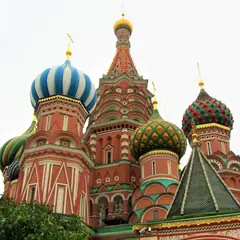
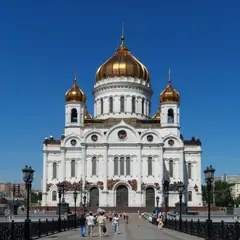
The park is a step from St Basil’s Cathedral and the Moscow Kremlin; upstream, the Cathedral of Christ the Saviour tells another story of demolitions and of Soviet projects that were never finished.
Varvarka, the street that survived Zaryadye
Varvarka Street
Summary of this stop
The northern edge of the park is marked by Varvarka Street, with its row of survivors: St Barbara, St Maxim the Blessed, St George on Pskov Hill, the cathedral of the Znamensky Monastery and the palace of the Romanov boyars. Among them stands the English Court, built in 1555, when Ivan the Terrible granted the English duty-free trade, and one of the oldest civil stone buildings in Moscow. The restorer Pyotr Baranovsky found its remains beneath later additions during the demolitions of the 20th century, and in 1994 Queen Elizabeth II opened a museum there.
This street is the Zaryadye that remains standing, that of the merchants “from behind the rows”, but also that of a darker chapter: between 1828 and 1856 the Glebovskoye podvorye operated here, the only place in Moscow where Jewish merchants could lodge, men only and with no right to go out at night into the rest of the city. After the expulsion of some 20,000 Jewish families in 1891–1892, the district sank into a shanty suburb in the middle of the centre.
One of the churches in the row also holds a legend recorded by tradition: that of Maxim the Blessed, Moscow’s first holy fool, who according to his life walked these streets almost naked in the dead of winter and mocked false piety. His most famous sayings, and why Moscow venerates him as a patron, are heard in front of his church.
A 16th-century wall turned into a vegetable patch
White-stone base of the Kitay-gorod wall
Summary of this stop
Underground, on the way to the embankment, the underground museum displays the park’s centrepiece: the white-stone base of the Kitay-gorod wall, built in the 16th century (1535–1537 according to the municipal chronicle of the excavations). That wall cut off from the river Velikaya Street, Zaryadye’s main artery, which joined a Kremlin gate to the Moskva landing stage; the excavations of 2015 brought to light three levels of its wooden pavement.
Those same works turned up a find out of a film. In September 2015, in the log cellars of a late 16th-century estate, a hoard of up to 43,000 silver coins appeared in three clay pots, weighing 20.675 kg. The latest pieces date from 1615–1616 and the whole came to 380 roubles, the salary of a streltsy colonel for seven to ten years. Today it is in the Museum of Moscow.
The solemnity of the display cases contrasts with what this stone was for decades. After the fire of 1812, tenement houses for textile workers stood so close to the wall that residents stuck an arm out of the window to plant flowers and vegetables on it. How a merchants’ quarter ended up like that, poor and foul-smelling, is told by the narration in front of the wall.
A concert while the Rossiya burned
Great Amphitheatre and glass crust
Summary of this stop
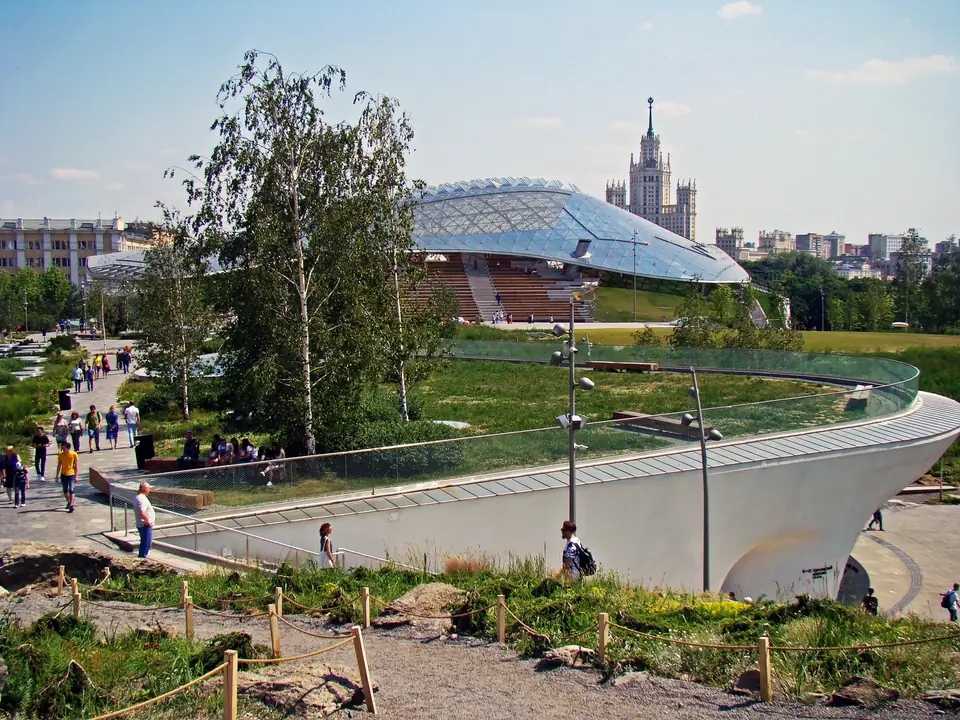
At the top of the Great Amphitheatre, the tiers descend towards a stage with the Kremlin and St Basil’s behind. Beneath the hill lies the Zaryadye concert hall, opened on 8 September 2018, covered by a glass “crust” that keeps it at about 18 °C when it is 0 °C outside. It takes up the function of the 2,500-seat hall that the Rossiya Hotel opened in 1971.
That hotel was a closed rectangle of 250 by 150 metres, with four 12-storey blocks and a 23-storey north tower. It received some ten million guests, among them Mikhail Gorbachev, George H. W. Bush and Mike Tyson. On the night of 25 February 1977, a fire in the north tower killed 42 people. While floors 4 to 17 burned, the management asked Arkady Raikin, who was performing before 2,500 spectators, to stretch out the show, and he kept them an hour and a half longer so as not to hinder the firefighters, whose 30-metre ladders did not reach beyond the seventh floor.
What started the fire was never established with certainty: the commission pointed to a welder who left a tool plugged in at the radio node, but admitted it could not state this categorically, and another version speaks of arson. Who ended up paying for those deaths is one of the episodes the audio guide reserves for this spot.
A forest over Stalin’s foundations
Tundra, steppe, forest and wetland terraces
Summary of this stop
The terraces reproduce four Russian landscapes, tundra, steppe, forest and wetland, stepping down from north-east to south-west, with 752 trees, 7,000 shrubs and 120 plant species. The paths do not mark a fixed route, and among the birches it is hard to imagine that everything is a roof: beneath lie 14,000 square metres of enclosed space and a car park for 430 cars.
Lower still is the most ambitious layer of the site. In 1947 Dmitry Chechulin began here the eighth Stalinist skyscraper, of 32 storeys and 275 metres, for which almost everything left of the district was levelled except the monuments of Varvarka. In the spring of 1953 the foundations and the stylobate were ready; in 1954, after Stalin’s death, the government halted the work. On that stylobate the Rossiya would be built, which on closing on 1 January 2006 could not be blown up because of the Kremlin’s proximity: it was dismantled with tower cranes and its blocks of more than eight tonnes left on barges along the Moskva. What may have remained underground after that dismantling is part of the mystery unveiled on the terraces.
A bridge that does not cross the river
Floating Bridge
Summary of this stop
The route ends at the Floating Bridge, a viewpoint of prestressed concrete in the shape of a V, 244 metres long and weighing 3,700 tonnes, whose tip juts 70 metres over the Moskva without a single support. The deck is larch, the railings glass, and from the end you can see St Basil’s Cathedral, the Spasskaya Tower and the Ivan the Great Bell Tower. It does not cross the river: it leaves the left bank and returns to it, a detail its critics turned into the “bridge to nowhere”.
Its origin has something of a political paradox. The American team won the competition on 11 November 2013, in the midst of tension between Washington and Moscow over the asylum granted to Edward Snowden, with a design that also defied the brief, which expressly forbade spaces where large crowds could gather: the park has open lawns and two amphitheatres. How that design ended up being built in the shadow of the Kremlin is the closing note of the narration, suspended over the river.