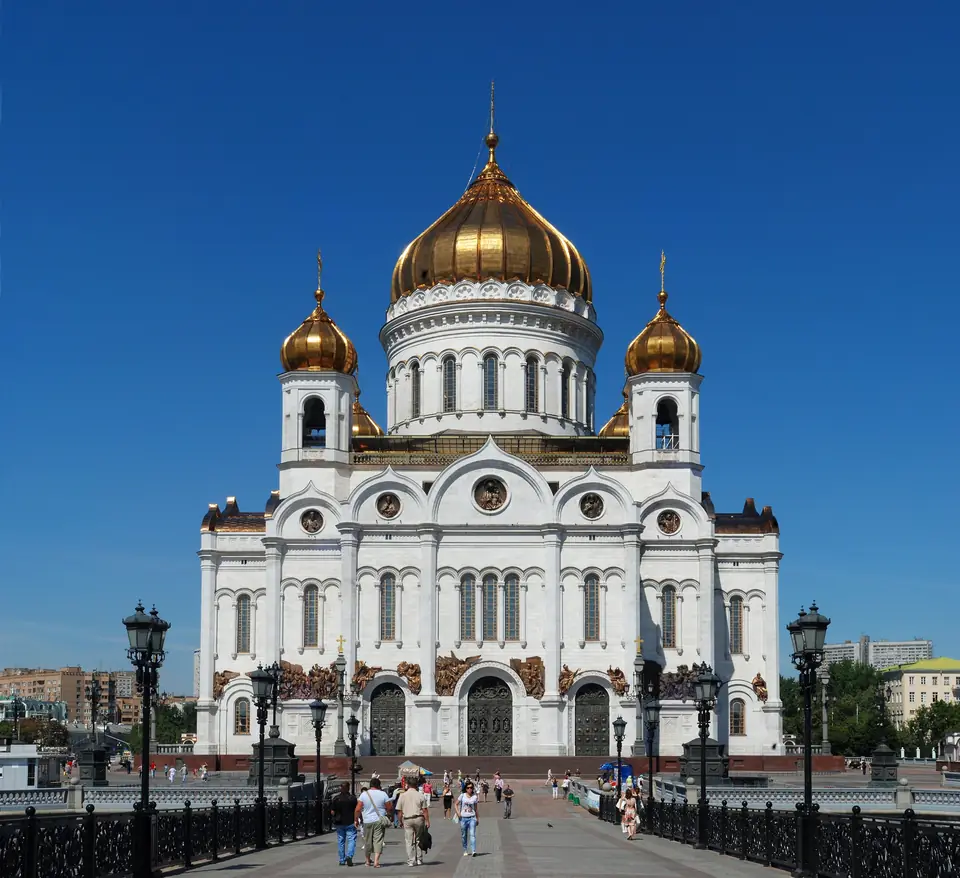
Votive church of 1812
Cathedral of Christ the Saviour Audio Guide (Khram Khrista Spasitelya)
Promised after Napoleon's defeat, dynamited in 1931, turned into the largest open-air swimming pool in the world and raised again in 2000: beside the Moskva, a single site sums up the Russian 20th century.
- 45 min of audio
- 20th-century history
On 25 December 1812, with Napoleon in retreat, Alexander I signed the manifesto announcing a church to Christ the Saviour in thanksgiving for the salvation of Russia. After a failed first project on Sparrow Hills, Konstantin Thon's church was consecrated on Volkhonka hill on 7 June 1883: at 103.5 metres it was the tallest building in Moscow and the largest church in the country, with room for 7,200 worshippers.
On 5 December 1931 the first explosion was not enough to bring it down and a second was needed. In its place the Palace of the Soviets was to rise, 415 metres high and crowned by a Lenin of 100, which never got beyond the foundations; on them the Moskva swimming pool steamed for decades. The church that today dominates the river was consecrated in 2000, in concrete, with bronze reliefs and domes of titanium nitride.
Highlights
- Patriarshy Bridge — the view of the church and the Kremlin over the site of the old Moskva pool
- Domes and bell towers — today's golden gleam is titanium nitride, not gold leaf
- Bronze high reliefs — two rows of saints and scenes that replace the original marbles
- Corridor of the 1812 plaques — 71 battles in Russia and 87 abroad, with their fallen officers
- “Otechestvo” dome — God the Father with the Child in a painting covering some 22,000 m² of the interior
The Cathedral of Christ the Saviour looks as solid as if it had stood for centuries on the banks of the Moskva, and yet it is a copy raised over a void. Its history begins on 25 December 1812, when Alexander I, with Napoleon’s army in retreat, signed the manifesto promising Moscow a church dedicated to Christ the Saviour in thanksgiving for the salvation of Russia. It took 44 years to rise: the first project foundered on Sparrow Hills, Nicholas I moved the work to Volkhonka hill in 1839 and Konstantin Thon’s church was not consecrated until 7 June 1883, before Alexander III.
At 103.5 metres it was the tallest building in Moscow and the largest church in the country. It lasted less than half a century: in 1931 it was blown up to make room for the Palace of the Soviets, which was never finished, and a public swimming pool opened on its foundations. Reconstruction began in 1994 and the new church was consecrated on 19 August 2000. The history and architecture of the Cathedral of Christ the Saviour are best understood in the order the audio guide proposes: from the Patriarshy Bridge to the façade and the esplanade, and from there to the interior, among the 1812 plaques and under the great dome.
Downstream, a little over a kilometre away, are the Moscow Kremlin and Zaryadye Park, also built over the foundations of an unfinished Stalinist project; the Soviet Moscow that was built shines in VDNKh.
A steaming pool where domes now stand
Patriarshy Bridge
Summary of this stop
From the middle of the Patriarshy Bridge, the pedestrian footbridge opened in 2004 over the Moskva, the whole church can be taken in, with the Kremlin behind. It is the best spot to dismantle the first impression. On this site the Palace of the Soviets was to rise, a tower 415 metres high topped by a statue of Lenin of 100. When war broke out in 1941, part of its steel structure was melted down into anti-tank hedgehogs to defend Moscow, and the project was definitively abandoned in 1956.
On those foundations the Moskva swimming pool operated until the early 1990s, the largest open-air pool of its kind in the world: 130 metres in diameter, 13,000 m² of heated water, up to 20,000 bathers a day and open all year, even at −20 °C. Its steam made it hard to watch over the swimmers and the neighbouring Pushkin Museum complained of the damp. The sources do not even agree on when it opened and when it closed.
Muscovites summed it up in a saying of three words that rhyme in Russian: first there was a church, then rubbish and now a disgrace. What each one is, and why that rhyme serves as the key to the whole route, is heard with the river in front of you.
Twenty tonnes of gold that are no longer there
Bronze high reliefs of the façade
Summary of this stop
Facing the façade that looks onto the river, the church appears as Konstantin Thon wanted it: five domes in the Russian-Byzantine style, four bell towers and two rows of high reliefs with saints and religious and historical scenes on the portals, corners and above the cornice. The original did not please all its contemporaries: the painter Vasily Vereshchagin called Thon a “rather mediocre architect” and the building earned the nickname “samovar”, although other authors place it in European historicism, alongside the Sacré-Cœur in Paris.
On 24 February 1930, the economic department of the OGPU asked for the gilded domes to be removed: by its calculation they contained more than 20 tonnes of gold that could serve industrialisation. That gold is no longer there. In the reconstruction, directed by Zurab Tsereteli after the departure of the architect Alexey Denisov, the white marble medallions and reliefs were remade in bronze and the domes were covered in titanium nitride.
The fidelity of that copy remains debated: some critics hold that the concrete church does not recover the volume or lightness of the original, while the interior is considered more faithful. Looking for the original inside the copy is the game this stop proposes.
A cursed hill, blown up twice
Esplanade and raised plinth
Summary of this stop
The esplanade sits on a raised plinth that hides more than it seems. To build the church here, Nicholas I ordered the Alexeyevsky Convent demolished, and on 10 September 1839 a stone brought from the unfinished church on Sparrow Hills was laid as the foundation stone, as a sign of continuity. Legend has it that the spot already had a bad reputation, that it was called the “devil’s stream” and that the convent’s abbess, forcibly removed after chaining herself to an oak, uttered a curse: that this place should stand empty.
On 5 December 1931, after the decision to hand the site over to the Palace of the Soviets, the church was blown up. The first explosion, at midday, brought down domes and upper storeys, but the body held and a second was needed.
Beneath your feet today lies the answer of the reborn church: a lower Church of the Transfiguration, consecrated in 1996, which recalls the demolished convent, the Hall of Church Councils and a two-level underground car park with 305 spaces and a car wash tunnel, in the hollow of the palace’s foundations. How the abbess’s curse fits with what came after is told on the esplanade itself.
Names from 1812 that ended up as gravel
Corridor of the 1812 plaques
Summary of this stop
The lower corridor surrounds the church like a gallery of memory. Its marble plaques describe 71 battles fought in Russia in 1812 and 87 abroad, with the troops that took part and the names of the officers killed and wounded, from the manifesto of the invasion to the capture of Paris. It is a collective cenotaph, the way Alexander I’s vow wanted to honour the fallen.
That vow first passed through an outsized dream. The painter and Freemason Karl Witberg designed on Sparrow Hills a church 240 metres high, three times the present one, with a colonnade of 600 columns. The foundation stone was laid on 12 October 1817, but the work stopped in 1825: the slope was giving way because of groundwater and Witberg, accused of embezzlement, ended up exiled in Vyatka.
The fate of the original plaques is the hardest part of the route. After the demolition of 1931, their marble ended up lining the Kropotkinskaya and Okhotny Ryad metro stations, and the plaques with the names of the heroes were crushed to surface park paths; only some high reliefs were saved and are displayed in the Donskoy Monastery. What it means to read those names today in new marble is revealed among the plaques themselves.
Under the dome, from the Overture to Pussy Riot
Painting of the “Otechestvo” dome
Summary of this stop
In the centre of the nave, the gaze rises to the painting of the “Otechestvo” dome: God the Father with the Child and the Holy Spirit in the form of a dove, surrounded by angels, within a pictorial programme covering some 22,000 m² of the interior. Under this vault the Russia of every age has gathered. Tchaikovsky wrote the 1812 Overture with the completion of the church in mind, and it premiered in Moscow on 20 August 1882, with the building still unfinished; where exactly it was played that day is still disputed.
In November 1917, days after the Bolsheviks seized power, the first Russian patriarch in two centuries was chosen here by lot, according to a well-documented tradition: an elderly monk drew one of three slips before the icon of the Virgin of Vladimir. The reborn church, paid for largely with donations from around a million Muscovites, was consecrated on 19 August 2000 and the next day hosted the canonisation of the Romanov family.
On 21 February 2012, members of the group Pussy Riot burst in before the altar with their “punk prayer” against Vladimir Putin; three of them were sentenced to two years in prison for hooliganism motivated by religious hatred. What name came out of that casket in 1917, and what became of the man chosen, is left for the narration under the dome.