Votive church of Red Square
St Basil's Cathedral Audio Guide (Sobor Vasiliya Blazhennogo)
Ivan the Terrible raised it to celebrate the capture of Kazan, but the name everyone gives it is that of a naked beggar buried at its feet: nine churches on a single base that the people ended up making their own.
- 60 min of audio
- 16th-century Russian architecture
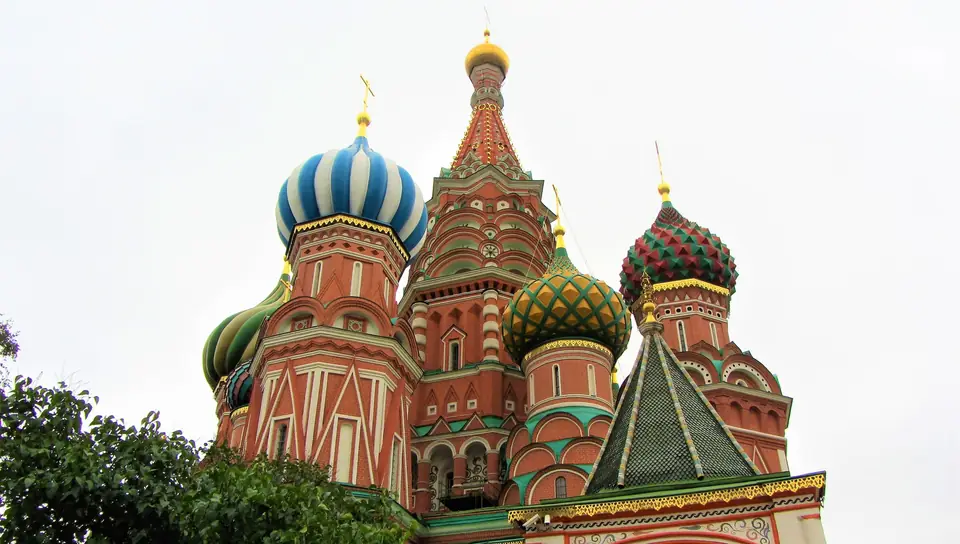
The Cathedral of the Intercession “on the Moat” was built between 1555 and 1561 on the orders of Tsar Ivan IV the Terrible to commemorate the conquest of the Khanate of Kazan. It is not a single church but nine churches on a single base, and each chapel recalls a day of that campaign. Its central tower, 47.5 metres high, made it the tallest structure in Moscow until 1600.
In 1588, after the canonisation of Basil, a holy fool who lived naked on Red Square, a low church was added over his tomb. That small chapel ended up giving its name to the whole complex: the tsar's victory monument is known today by the name of a vagrant, and it is the only part of the church with a liturgy every Sunday.
Highlights
- Tower of the Intercession — a 47.5 m octagonal spire, the only tent roof among the nine churches
- Eight onion domes — each with a different pattern of lozenges, spirals and facets
- Chapel of St Basil — the saint's shrine, an iconostasis of 1895 and a service every Sunday
- Outer gallery — the only 17th-century painting no restorer has touched
- Tent-roofed bell tower — coloured tiles and “ear” windows from the 1680s
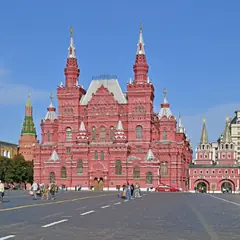
At the southern end of Red Square, where the Kremlin’s defensive moat once ran, stands the church that Ivan IV the Terrible ordered built between 1555 and 1561 to celebrate the capture of Kazan. Its official name is the Cathedral of the Intercession “on the Moat”, but Moscow knows it by another: that of Basil, a holy fool who lived naked on the square and whose tomb lay at its feet. The history of St Basil’s Cathedral is that of an emblem of the tsar’s power that, over the centuries, the people kept for themselves.
Along the way, the building has seen almost everything: altars moved from churches built on execution sites, French horses in 1812, bells melted down by Soviet power in 1929 and, in 1987, the light aircraft of a West German pilot that rolled up to its façade. Who designed it still has no definitive document: tradition names Barma and Postnik Yakovlev, and some maintain they were the same person. The architecture of St Basil’s Cathedral is best understood by walking around the outside, from the domes to the bell tower, and then entering through the saint’s chapel into the maze of galleries and the central tower, which is the route the audio guide proposes.
Behind it stretches Red Square, under the walls of the Moscow Kremlin, and down towards the Moskva waits Zaryadye Park, with its bridge that flies over the river.
A calendar of victories at the edge of the moat
Minin and Pozharsky Monument
Summary of this stop
Facing the bronze monument to Minin and Pozharsky, of 1818 and moved in 1931 closer to the church, the whole cluster of towers opens up. What looks like a whim of colours is in fact a calendar: the central church is dedicated to the Intercession (Pokrov) of the Virgin because the final assault on Kazan began on that feast, on 1 (14) October 1552, and other chapels bear saints of battle days, such as Cyprian and Justina, on 2 October, the day the city was taken.
The official surname, “on the Moat”, is not decorative either. It recalls the defensive ditch dug between 1508 and 1516 along the Kremlin wall and fed with water from the Neglinnaya River, on whose edge the church was raised. Which day of the campaign corresponds to each tower is unravelled in the narration, in front of the façade.
Onion domes: Jerusalem, gold and a suspicion
North staircase and onion domes
Summary of this stop
Looking towards the Spasskaya Tower, the eight onion domes appear, four large ones on the axes and four smaller ones on the diagonals, each with a different pattern. From the second half of the 16th century, every Palm Sunday the tsar and the patriarch led the “donkey” procession from the Dormition Cathedral in the Kremlin to the western Church of the Entry into Jerusalem, going up the north staircase, the church’s solemn entrance.
The colours are not the original ones either. In the 16th century the domes were covered in gilded tin over red and white brick walls; the present tones arrived in stages from the 1680s to 1848, and the combination of deep red and deep green was fixed by Sergey Solovyov’s restoration between 1896 and 1909.
A disputed hypothesis remains: according to a version that emerged in the early 20th century, the architect evoked the Kul Sharif mosque, destroyed in the capture of Kazan, with eight “minarets” around the central tower. There is no consensus, and not a single image or reliable description of that mosque survives. Why the suspicion is so hard to forget in front of the domes is raised by the audio guide at that very spot.
The bell tower and the layers of violence
Tent-roofed bell tower
Summary of this stop
In the south-east corner rises the tent-roofed bell tower of the 1680s, with edges of white, yellow, blue and brown tiles and “ear” windows to project the sound. Beneath its beauty, the building keeps a harsher story. In the reform of 1680 the altars of thirteen or fourteen churches that stood along the moat, built “on blood” on sites of public executions, were moved to its lower level.
In 1812 the French troops occupying Moscow used the church as a stable, with the horses below, and looted everything of value; the interior was repaired in 1813 and the exterior in 1816. Whether Napoleon ordered it blown up is, depending on who tells it, a fact or a legend with no documentary backing.
The church opened as a museum on 21 May 1923 and in 1929 services were banned and its bells taken down and melted. Since 1990 the museum has gathered 19 bells cast between 1547 and 1996. How sound returned to this tower is told at the foot of the bell tower.
The tomb that stole the tsar’s name
Chapel of St Basil
Summary of this stop
The museum’s main entrance is today the vaulted porch of the Chapel of St Basil, the low church that Tsar Feodor Ivanovich, son of Ivan IV, had added in 1588 over the tomb of the newly canonised saint. Inside await the shrine with its carved canopy, a floor of cast-iron plates from Kasli, the iconostasis of 1895 and scenes from his life painted in 1905. The church also keeps an icon from the late 16th century, held to be the first after the canonisation, which shows him completely naked, as he lived on Red Square.
According to his life, Basil was the only man Ivan the Terrible feared, and tradition says that, when he died, the tsar himself carried his bier with the boyars. Since 1991 the church has been shared between the museum and the Orthodox Church, and since 15 August 1997 this chapel again has a liturgy every Sunday and on feast days. What Basil foretold in the summer of 1547 is left for the narration before his shrine.
Under the tower: who paid for this cathedral?
Church of the Intercession
Summary of this stop
The route ends under the central Tower of the Intercession, 47.5 metres high, the tallest structure in Moscow until the Ivan the Great Bell Tower in the Kremlin was raised in 1600. Before getting there, the galleries keep another treasure: in 1680 the outer gallery, until then open, was covered with brick vaults and painted with plant motifs, and today it is the only place in the church with original 17th-century painting untouched by later restorers.
Here too falls a famous myth, that of the architects blinded by Ivan IV so they could not repeat the work: Postnik Yakovlev, the master to whom the church is attributed, received in 1555 the commission to build the walls of the Kazan Kremlin with stonemasons from Pskov and was still working there in 1561–1562. And the last question remains, the one that gives the stop its title: a Muscovite legend speaks of a madman who scattered coins on the square that no one dared touch. Where that money ended up is revealed at the end of the audio guide, with your gaze on the top of the tower.