Fortress and seat of Russian power
Moscow Kremlin Audio Guide (Moskovskiy Kreml)
The jagged silhouette that passes for Russia's emblem was drawn by Italian architects, and the red of its walls lay hidden under whitewash for more than two centuries: the Kremlin is a fortress that every power has rewritten to its own measure.
- 120 min of audio
- Italian Renaissance fortress
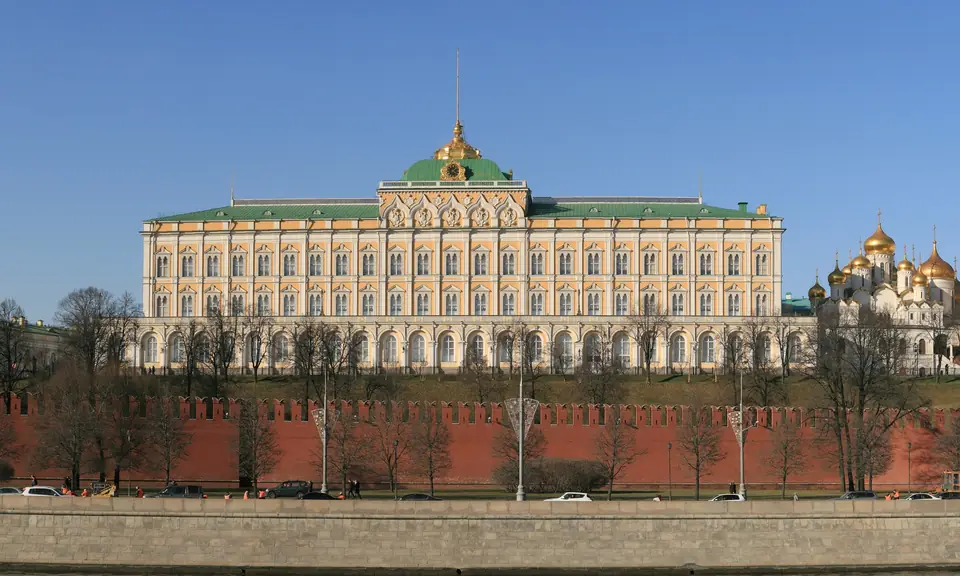
On Borovitsky Hill, between the Moskva and the old Neglinnaya, Yuri Dolgoruky founded a wooden fortress in 1156 that Dmitry Donskoy rebuilt in white stone in 1367. The present wall was raised between 1485 and 1495 by Italian masters for Ivan III: 2,235 metres of perimeter, up to 19 metres high and 20 towers enclosing coronation cathedrals, palaces and the seat of Russian power from the tsars to today.
What seems eternal in the Kremlin has been erased and put back more than once. The walls were white for almost the whole of the 18th and 19th centuries, the double-headed eagles on the towers gave way in 1935 to Soviet stars, two monasteries disappeared in 1929–1930 and the name of Boris Godunov lay covered with plaster at the top of the Ivan the Great Bell Tower until the reign of Peter I.
Highlights
- Wall of 1485–1516 — 2,235 metres, 20 towers and 1,045 swallow-tail battlements
- Tsar Bell — a bell of about 202 tonnes cracked in the fire of 1737 before it ever rang
- Tsar Cannon — a bronze cannon of 1586, 39,312 kilos, with cannonballs that do not fit it
- Ivan the Great Bell Tower — 81 metres and an inscription covered with plaster
- Dormition Cathedral — the work of Aristotele Fioravanti and the coronation church of the tsars
The history of the Moscow Kremlin begins in 1156, when Yuri Dolgoruky raised a fortress on Borovitsky Hill, in the triangle now marked by the Borovitskaya, Troitskaya and Tainitskaya gates, protected by two rivers, the Moskva and the Neglinnaya. The name “Kremlin” does not appear in a chronicle until 1331. After the fire of 1365, Prince Dmitry Donskoy replaced the oak palisade with limestone brought in winter from Myachkovo, and the first white-stone fortress of north-eastern Russia, begun in the spring of 1367, withstood the Lithuanian sieges of 1368 and 1370.
The fortress seen today is another one: the one Ivan III commissioned from a team of Italian architects between 1485 and 1495, with the moat and outer defences finished in 1516. Since then every age has left its layer: under Catherine II a stretch of wall was pulled down for Vasily Bazhenov’s palace, which was never finished, Napoleon ordered it blown up in 1812, Lenin set up his office there in 1918 and the enclosure was closed to the public until 1955. The alarm bell of the Nabatnaya Tower, which called the people out during the Plague Riot of 1771, spent some thirty years hanging without a clapper on the empress’s orders, and to this day soldiers with goshawks patrol among the cathedrals against the crows, a distant legacy of the tsars’ falconry.
What to see in the Moscow Kremlin, and in what order, has a lot to do with that history of layers: from the entrance by the Kutafya Tower to the Arsenal, from the Tsar Cannon to the archaeological windows and from there to Cathedral Square, the audio guide’s route lifts, one by one, the versions superimposed on the hill.
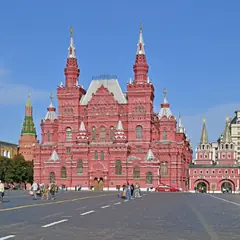
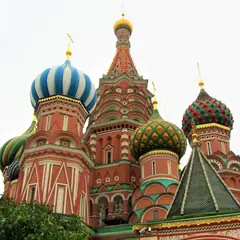
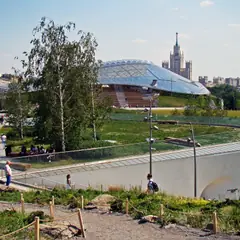
At the foot of its walls opens Red Square, with St Basil’s Cathedral at its southern end, and a step away, beside the Moskva, Zaryadye Park extends the route to the river with its V-shaped bridge.
A Lombard wall that was whitewashed
Troitskaya Tower
Summary of this stop
The visit begins on the bridge that joins the Kutafya Tower, low and set forward, with the Troitskaya, crowned by a ruby star. From here the architecture of the Moscow Kremlin makes sense: in 1485 the Italian master Antonio Gilardi, whom Muscovites called Anton Fryazin, laid the first stone of the Tainitskaya Tower, and within ten years a team that included Pietro Antonio Solari closed 2,235 metres of walls up to 19 metres high and between 3.5 and 6.5 thick, with 20 towers. The bricks of that work weigh up to 8 kilos each.
The silhouette that now passes for Russia’s emblem is, in fact, Lombard. The 1,045 swallow-tail battlements, 2 to 2.5 metres high, recall those of the Scaligeri castle in Verona and of the Sforza Castle in Milan. And the colour is not the original either: a memorial to the tsar of 7 July 1680 already proposed whitewashing the walls, which were white from the second half of the 17th century and for most of the 18th and 19th.
When the red returned is a disputed matter. One version attributes it to the lime no longer being renewed at the end of the 19th century; another to the repainting decided under Stalin during the restoration of 1946–1950, after the camouflage of the Second World War. What that doubt reveals about the image the Kremlin wants to give of itself is told right there, with the wall in front of you.
Trophies of the Grande Armée and a lost library
Kremlin Arsenal
Summary of this stop
Before the long façade of the Arsenal, Peter I’s building rebuilt after 1812, stand in line the cannons captured from Napoleon’s army. They are the answer to an order: on withdrawing from Moscow in October 1812, Napoleon ordered the Kremlin blown up. The mines destroyed the Vodovzvodnaya Tower, damaged other towers, a stretch of wall and the Arsenal itself, and razed the Uspenskaya bell tower and the Filaret annexe, but the autumn rain put out most of the fuses. The exact extent of the damage varies by source, and walls and towers were restored between 1815 and 1835.
In the background is the Senate, the triangular building by Matvey Kazakov. In March 1918 the Soviet government moved from Petrograd to Moscow, Lenin set up his office and residence there and the Kremlin was closed to the public. It did not reopen for mass visits until 1955, the same year living inside the enclosure was banned. Today the president’s official office is there.
Under the Arsenal towers people have searched for centuries for the Liberey, the library of the tsars that, it is said, arrived from Constantinople with Sophia Palaiologina’s dowry in 1472. The Senate ordered excavations in 1724 and the archaeologist Ignaty Stelletsky was still digging under the Arsenalnaya Tower in 1933 and 1934, with the Kremlin’s permission. Not a single volume has ever turned up, nor has it been proved that the library existed. What Stelletsky found instead of books is left for the audio guide.
Giants that never fulfilled their purpose
Tsar Cannon
Summary of this stop
The Tsar Cannon was cast in bronze by Andrey Chokhov in 1586 for Tsar Feodor Ivanovich: 39,312 kilos, 5.34 metres long and 890 millimetres in calibre, designed to fire stone shrapnel. Its iron carriage, of 1835, is decorative, and the four iron cannonballs of a tonne or more that accompany it are a 19th-century ornament that does not fit the gun. Whether it ever fired is disputed: it never went to war, but traces of gunpowder turned up in the restoration of 1980, while other researchers deny it and some maintain it was cast only to impress ambassadors.
A few steps away rests the Tsar Bell, of about 202 tonnes, 6.14 metres high and 6.6 in diameter, cast by Ivan and Mikhail Motorin on 25 November 1735. In the fire of 29 May 1737, guards threw cold water on it: eleven cracks opened and a piece of more than 10 tonnes broke off, which still lies propped beside it. It spent a century in its pit until Auguste de Montferrand raised it in 1836 onto its present pedestal, and for a time it served as a chapel, with the gap as its door.
Over both keeps watch the Ivan the Great Bell Tower, built by Bon Fryazin in 1505–1509 and raised in 1599–1600 on Boris Godunov’s orders with a third storey whose walls are only three bricks thick. At 81 metres it was the tallest building in Moscow; that building any higher was forbidden until the Revolution is something some assert and others consider a legend with no known decree. Why the Kremlin proudly displays a cannon without a war and a bell without a voice is the question the narration answers in front of them.
A void with foundations under glass
Ivanovskaya Square
Summary of this stop
The landscaped esplanade of Ivanovskaya Square is an absence you can see. In 1929–1930 the Chudov and Voznesensky monasteries and the Small Nicholas Palace were pulled down here, and in 1932–1934 the VTsIK Military School was built in their place, later known as the “14th building”. When its demolition began, in November 2015, remains from the 12th to 14th centuries and more than 100 burials came to light. Since 2020 the Chudov Monastery Archaeology Museum has shown them underground, and the archaeological windows in the square let you see the original foundations.
The same decade changed the symbols on the towers. Between the end of October and the beginning of November 1935 the golden double-headed eagles were removed from four towers and copper stars with Ural gemstones were put up; on 2 November 1937 they were replaced by ruby-glass stars on five towers, each weighing close to a tonne, which turn freely in the wind and have been taken down only once, in 1946, because of war damage.
Towards the Spasskaya Tower, documented tradition keeps a rule from 1648: beneath its holy gate one could not pass on horseback and men had to uncover their heads before the image of the Saviour, on pain of fifty prostrations to the ground, with no exception for foreigners, as the Spanish traveller Juan Valera noted. Tradition has it that in 1812 not even Napoleon escaped, and what happened to him beneath that gate is reserved for the narration.
The hill of coronations
Cathedral Square
Summary of this stop
Cathedral Square occupies the top of the founding hill. Its centrepiece, the Dormition Cathedral, was born of a failure: in 1474 the one the Muscovite masters Krivtsov and Myshkin had raised up to the vaults collapsed, and Ivan III summoned the Bolognese Aristotele Fioravanti, who between 1475 and 1479 built the present one, of white limestone with five golden domes, on oak piles and with iron ties. Tsars and emperors were crowned there. On the same square, the Palace of Facets shows its façade of stone cut into points, the work of Marco Ruffo and Pietro Antonio Solari in 1487–1491.
At the top of Ivan the Great, under the golden dome, runs a band of gilded copper letters with the name of Boris Godunov and his son Feodor. After Boris’s death and Feodor’s murder by False Dmitry’s mercenaries in 1605, it was covered with plaster, and not seen again until the reign of Peter I. It is perhaps the clearest lesson of the Kremlin: here power is also erased.
In the warm season, on Saturdays at midday, the square hosts the changing of the foot and mounted guards of the Presidential Regiment, with uniforms copying the model of 1909–1912 and riders tracing the “figure eight” and the “windmill” with their sabres. How the route ends on this square, between past coronations and a ritual repeated every week, is told by the last stop of the audio guide.