Soviet exhibition
VDNKh Audio Guide (Vystavka dostizheniy narodnogo khozyaystva)
Palaces, golden fountains and a full-size rocket: in northern Moscow, the USSR built its showcase city in 1939, rebuilt it entirely in 1954 and saw it turn into a flea market before it regained its name in 2014.
- 120 min of audio
- Stalinist architecture
The All-Union Agricultural Exhibition was announced in February 1935 and opened on 1 August 1939 with a speech by Vyacheslav Molotov: 136 hectares, 250 buildings, cascading ponds and experimental plots that in 86 days received more than 5 million visitors. Between 1950 and 1954 the grounds were almost entirely rebuilt in the Stalinist Empire style, under the architect Anatoly Zhukov and the sculptor Yevgeny Vuchetich, reaching 207 hectares built with 50 million bricks.
Behind the gold there are gaps. The chief architect of the first exhibition ended up exiled to Vorkuta and the commissioner and the head of construction were shot; a 25-metre statue of Stalin presided over Mechanisation Square until 1951, and in the 1990s the Kosmos pavilion sold Chinese electronics and hosted pig races.
Highlights
- Worker and Kolkhoz Woman — Vera Mukhina's steel pair made for Paris 1937, on a 34.5-metre pedestal
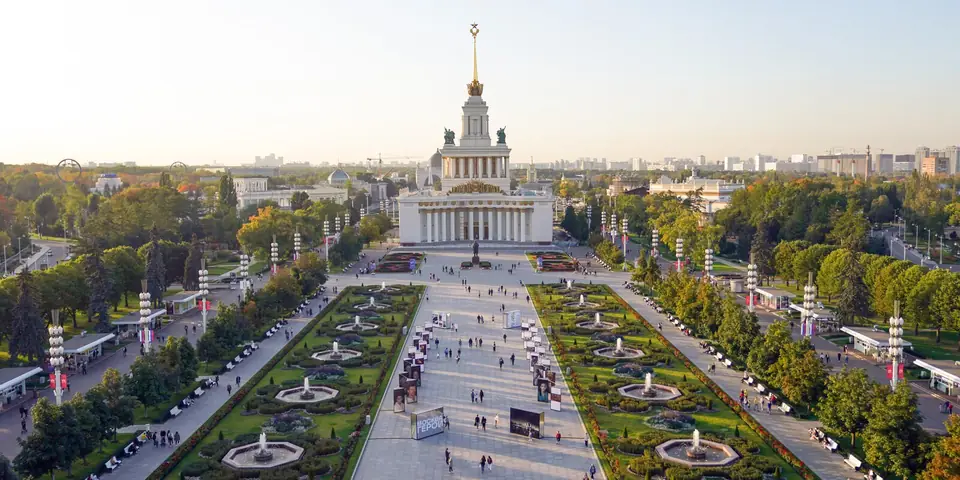
- Central Pavilion — the spire with a star at the end of the 1954 exhibition axis
- Friendship of Peoples Fountain — 16 gilded bronze maidens and a 7.4-metre copper sheaf
- Stone Flower Fountain — a colourful mosaic in front of the former Ukraine pavilion
- Kosmos Pavilion — a 36-metre glass dome and the 38-metre Vostok rocket on the square
The history of VDNKh begins at the Second Congress of Shock Kolkhoz Workers, held in Moscow in February 1935, where a great All-Union Agricultural Exhibition was announced for 1 August 1937, the twentieth anniversary of Soviet power. It arrived two years late and after a purge. It finally opened in 1939, closed on 1 July 1941, days after the German invasion, and its empty pavilions became military repair workshops, warehouses and barracks; 123 of its employees died at the front.
What is walked today is mostly the exhibition reopened on 1 August 1954: a triumphal arch facing Mira Avenue, palaces for each republic and golden fountains along a parade axis. Then came decades of change. A decree of 1963 abolished the republic pavilions; in 1992 the grounds were renamed the All-Russian Exhibition Centre and ended up turned into a market; in 2008 the prototype Tu-154 that had spent almost forty years as an open-air museum was sawn up for scrap, and in 2014, now under the Moscow government, the exhibition regained the name VDNKh.
Among its pavilions also circulate stories that are not on the signs: the rotunda of forty columns in front of the former Uzbekistan pavilion, which according to legend “moans” at night, the circular cinema Nikita Khrushchev had built in three months in 1959, or the 1980 Olympic Misha that was exhibited here and vanished without trace in the early 1990s. The history and architecture of VDNKh are best understood by following its central axis, from the steel pair at the entrance to the rocket square, which is the route the audio guide proposes.
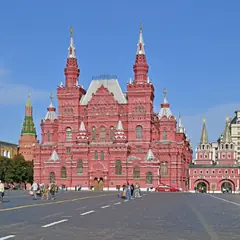
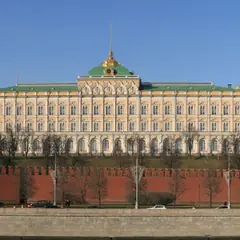
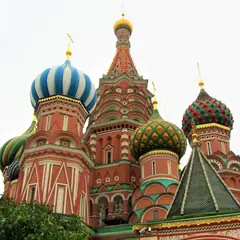
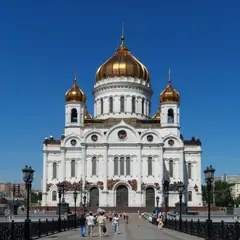
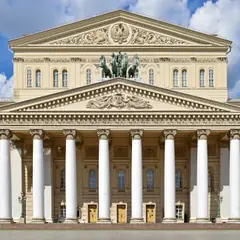
In the centre, that same Soviet Moscow has two other faces: the Bolshoi Theatre, where in 1922 the creation of the USSR was approved, and the Cathedral of Christ the Saviour, blown up in 1931 for a palace that was never finished.
The steel pair that challenged the German eagle
Worker and Kolkhoz Woman
Summary of this stop
Beside the main entrance, on a 34.5-metre pavilion-pedestal that has held it up since 2009, rises the silhouette half the world knows from the Mosfilm logo: Worker and Kolkhoz Woman, by Vera Mukhina, two figures 24.5 metres tall raising the hammer and sickle. It was made for the Soviet pavilion at the Paris Exposition of 1937, designed by Boris Iofan, and its material was no accident: half-millimetre sheets of chrome-nickel stainless steel, chosen because it reflected light better than bronze and was meant to outshine the eagle on the German pavilion and the Eiffel Tower itself.
Documented tradition adds a less solemn past. In the first design the pair was naked, in imitation of the Greek Tyrannicides, until the pavilion’s commissioner, Ivan Mezhlauk, persuaded the sculptor to dress it. An 18-year-old telephone operator, Anna Bogoyavlenskaya, posed for the woman; the man was composed from the face of a metro worker and the torso of a dancer. The commission also wanted to remove the scarf that flutters behind them, and why Mukhina flatly refused is the first secret the narration keeps at the foot of the pedestal.
The exhibition that devoured its creators
Central Pavilion
Summary of this stop
At the end of the first avenue, behind the Lenin monument, the Central Pavilion crowns the axis with its spire and its star. The scale is that of a parade, but the price of the first exhibition was very high. In July 1938 its chief architect, Vyacheslav Oltarzhevsky, was arrested as a member of an “anti-Soviet sabotage organisation” inside the exhibition itself and exiled to Vorkuta; his detractors even saw in his plan the pavilions laid out in the shape of an Orthodox cross. The commissioner Mikhail Chernov and the head of construction Isaak Korostashevsky were shot.
Even so, on 1 August 1939 the exhibition opened with full pomp: 136 hectares, 250 buildings, a cascade of ponds and experimental plots that in 86 days saw more than 5 million people pass through. Fifteen years later almost nothing of it was still standing. Between 1950 and 1954 the grounds were redone with 50 million bricks, 200,000 m³ of timber and 14,000 tonnes of metal, and grew to 207 hectares. What remains of the exhibition of the purged architects beneath the postwar set is what the audio guide unpicks in front of the pavilion.
Sixteen golden maidens and a vanished republic
Friendship of Peoples Fountain
Summary of this stop
The Friendship of Peoples Fountain, inaugurated in 1954, is the most photographed image of VDNKh: an octagonal basin of 81 × 56 metres, the work of Konstantin Topuridze and Grigory Konstantinovsky, with a 7.4-metre sheaf of embossed copper of wheat, hemp and sunflowers in the centre and sixteen gilded bronze female figures around it, each of about 2.5 tonnes and dressed in the costume of her republic. Seen from the Central Pavilion, Ukraine, Russia and Belarus are in the foreground.
Their order follows neither the position of the pavilions nor the alphabet, but that of the USSR coat of arms, based on the list of republics in the Constitution of 1947, with Moldavia and Kyrgyzstan swapped. The sixteenth maiden represents a republic that no longer exists: the Karelo-Finnish, merged into the RSFSR in 1956. Between October 2018 and April 2019 the fountain received its first comprehensive scientific restoration since 1954; the statues were scraped back to the bronze, regilded with gold leaf (between 5 and 6 kilos, depending on the source) and the sunflower of the Ukraine figure was remade from scratch.
Not everyone has admired it: the Soviet critic Vladimir Tolstoy went as far as to call it a “merchant’s trinket”, while today it is a federal monument and a symbol of the exhibition. How to read the fountain as a document of its time, figure by figure, is left for the narration on its southern edge.
Two fountains that swapped places
Stone Flower Fountain
Summary of this stop
Further on, facing the former Ukraine pavilion, the Stone Flower Fountain unfolds a concrete flower clad in coloured mosaic. According to documented tradition, that was the place planned for the main fountain. Where the Friendship of Peoples now gleams there was a children’s café and wooden pavilions, demolished in 1952 to put a monument to Stalin there; when the monument was abandoned, the great fountain was moved in front of the Central Pavilion and the Stone Flower was built on its original site. The maidens, moreover, were to be ceramic, and were made cheaper by casting them in bronze and gilding them.
Nor do the palaces flanking the axis remain as they were conceived. In 1964 the republic pavilions were converted into sectoral pavilions, around 1967 they lost almost all their coats of arms and today some bear the name of another country: the former “Siberia” belongs to Armenia and the former “Estonian SSR” to Kyrgyzstan. In the spring of 2014 about 300 temporary and illegal structures were demolished, 10,000 tonnes of rubbish were removed and façades of 1939 hidden under sheet metal reappeared. Which façades they are and where they show up is discovered with the audio guide on this stretch of the avenue.
A rocket where Stalin once stood
Kosmos Pavilion
Summary of this stop
The square before the Kosmos pavilion has been the pedestal of successive idols. In 1938–1939 a 25-metre reinforced-concrete statue of Stalin, by Sergey Merkurov and Ivan Taranov, was raised on it. It appears in all three films shot about the exhibition, although its shots were later cut from two of them, and it was demolished in 1951. Today its place is taken by a full-scale model of the Vostok launcher, 38 metres tall, surrounded by a Yak-42, an Mi-8 helicopter and an Su-27 fighter.
The pavilion itself, a hangar of 1939 devoted to mechanisation, received in 1954 a glass dome 36 metres high and 42 in diameter. At its top, Taranov hung as a lamp a genuine star from the Kremlin’s Trinity Tower, removed in 1937; it was taken down in the early 1970s and in 2017 a 4.24-metre copy was hung. In between, in the 1990s, under that same dome Chinese electronics and seedlings were sold and parties and pig races were held. The end of the route, with the full story of that star, awaits inside the Kosmos.