Historic heart of Moscow
Red Square Audio Guide (Krasnaya ploshchad)
It was a market, a platform for the tsar's decrees, a tank parade ground and a place of protest: 330 metres of cobbles between the Kremlin and GUM that change shape according to who rules Moscow.
- 45 min of audio
- Russian and Soviet history
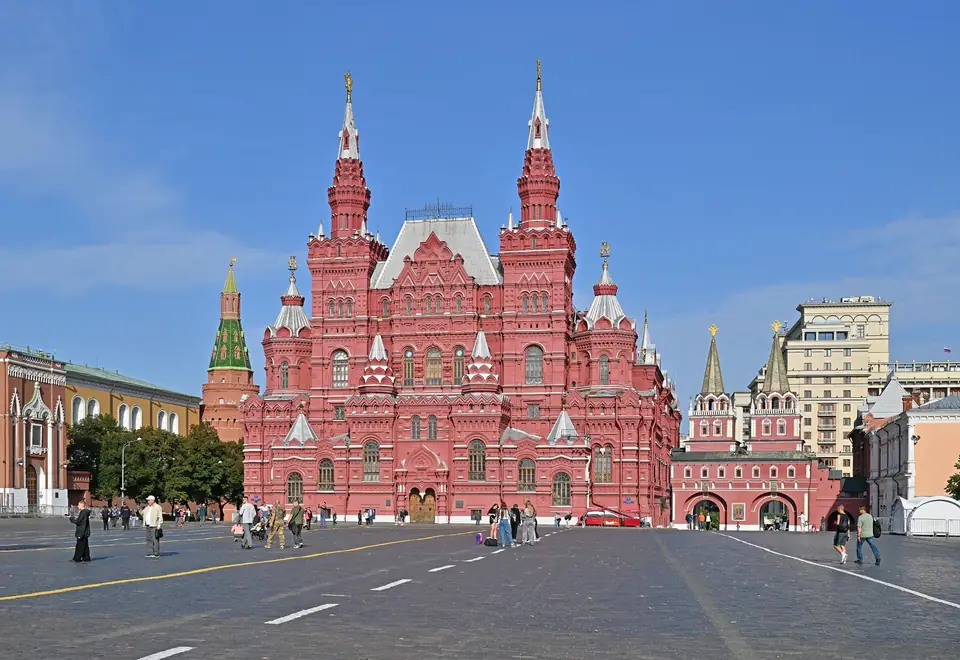
Red Square began as a market called Torg, or Pozhar, and its present name, Krasnaya ploshchad, appears for the first time in a document of 23 April 1661, under Tsar Alexis Mikhailovich. According to the traditional explanation, krasnaya meant “beautiful” in Old Russian. Between the Kremlin wall and the old trading rows, now occupied by GUM, the esplanade brings together churches and gates demolished and raised again, Lenin's Mausoleum and the Lobnoye Mesto, the stone platform of proclamations.
Almost everything that looks old has a story of going and coming back. The Kazan Church was demolished on Stalin's orders in 1936 and rebuilt in 1990-1993; the Resurrection Gate fell in 1931 to make way for the heavy vehicles of the parades and rose again in 1994-1995. Even the ground dates from 1930: cobbles of split stone, each with a different surface, able to bear 30 tonnes.
Highlights
- Lobnoye Mesto — a circular stone platform 13 metres across for reading out the tsar's decrees
- Resurrection Gate — torn down in 1931 for the parades and rebuilt in 1994-1995
- Lenin's Mausoleum — at its foot the Nazi standards were thrown down at the 1945 Victory Parade
- Church of Our Lady of Kazan — demolished in 1936 and rebuilt from scratch in 1990-1993
- 1930 paving — split-stone blocks able to bear 30 tonnes
The history of Red Square is that of an esplanade that has never stood still. In the 16th and 17th centuries it was a noisy market at the foot of the Kremlin; on 25 July 1570, at the height of the oprichnina terror, Ivan the Terrible had more than a hundred boyars accused of conspiracy executed here, the largest of the square’s public executions. In 1606 the body of the tsar known as False Dmitry was displayed in the market with a carnival mask on his chest, and tradition has it that Moscow came to believe the dead man refused to stay buried. In 1768 the landowner Darya Saltykova, who was proved to have murdered 38 of her serfs, spent an hour here chained to a post, under a sign calling her “torturer and murderer”.
The 20th century turned it into the stage of Soviet power, and also of its opposite. On the night in October 1961 when Stalin left the Mausoleum, according to accounts of that episode, the square was closed on the pretext of a parade rehearsal and the coffin went down into a pit beside the wall while armoured vehicles rolled past. On 28 May 1987 the West German amateur pilot Mathias Rust flew in from Helsinki in a Cessna, could not land on the esplanade because of the crowd and ended up touching down a step from St Basil’s; the affair cost Defence Minister Sergei Sokolov his post. The architecture and history of Red Square are best read by walking it from the Resurrection Gate to the Lobnoye Mesto, which is exactly the route the audio guide follows.
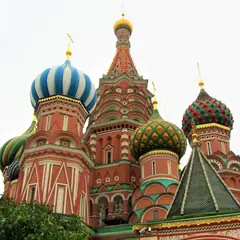
The square stretches at the foot of the walls of the Moscow Kremlin and its southern end is closed by St Basil’s Cathedral; a few minutes’ walk away, on Teatralnaya Square, stands the Bolshoi Theatre.
The gate torn down for the tanks
Resurrection Gate
Summary of this stop
The entrance to the square from Manezhnaya passes under a double arch crowned by two small towers with octagonal spires: the Resurrection Gate, a passage in the Kitay-gorod wall rebuilt in 1680. In front stands the small chapel of the Iverskaya icon. Both look old, but they were demolished in 1931 so that heavy military vehicles could pass in the parades, and rebuilt in 1994-1995 under the architect Oleg Zhurin.
Beside this gate stood the debtors’ prison called “Yama”, “the pit”, which left the Russian language the expression “dolgovaya yama”, “the debt pit”. At its foot, a bronze plaque from the mid-1990s, attributed to Alexander Rukavishnikov, marks Kilometre Zero of Russia’s roads, with animals in relief for each cardinal point.
It is also the setting of a living ritual: visitors queue to stand in the centre of the plaque, make a wish and throw a coin over their shoulder. It is said to have begun with girls who came to ask for a husband, because of the fame of the chapel of the Iverskaya Mother of God. The exact instructions for foot, hand and shoulder, and who waits for the coin to fall, are left for the narration on the spot.
A 1993 church and the “lousy” corner
Kazan Cathedral
Summary of this stop
On the north corner of the square, beside GUM, stands a small single-domed church with rows of kokoshniki: Our Lady of Kazan. It began as a wooden church paid for by Prince Dmitry Pozharsky, mentioned in 1625, and was consecrated in brick in 1636. Stalin ordered it demolished in 1936.
What is seen today is the reconstruction of 1990-1993, the first church rebuilt from scratch after the end of the USSR. A building that looks 17th-century but is in fact younger than many of those looking at it.
This same corner had an unflattering nickname: “Vshivaya”, “the lousy one”. The ground was covered in hair, and the German traveller Adam Olearius explains why with a very specific custom of the Muscovites. What it was, and on what day of the year they practised it, the audio guide tells in front of the church.
The beautiful market and the gap left by the bronze
GUM main entrance
Summary of this stop
The centre of the esplanade, opposite the main entrance of GUM, holds an absence. To understand it, imagine the square full: in the 16th and 17th centuries the market was arranged in rows by goods, of pies, of kalach rolls, of honey, of milk or of glass, up to about 150. After the fire of 1595, stone shops were built in 1596-1598 that formed the Upper, Middle and Lower Rows, on whose site the long pale stone front of GUM now stands.
The name of the square also tells that story. Until 1661 it was known as Torg, “market”, or Pozhar, and the adjective krasnaya, according to the traditional explanation, meant “beautiful”. It is not the only hypothesis: others link it to the Red Porch of the Kremlin palace or to the stretch between St Basil’s, the Spasskaya Tower and the Lobnoye Mesto, and the old Pozhar is interpreted both as “burnt place” and as “market bustle”.
Right here, on 20 February 1818, the monument to Minin and Pozharsky by Ivan Martos was unveiled, Moscow’s first sculptural monument, which arrived by water from Saint Petersburg. In the 1930s, in 1931 according to the Central Moscow Archive, it was moved next to St Basil’s because it was in the way. What exactly it was in the way of, and what that says about the square, is discovered in that empty gap.
From parade to front line, and a canvas tomb
Lenin's Mausoleum
Summary of this stop
At the foot of the Kremlin wall rises the stepped block of Lenin’s Mausoleum, in granite, black labradorite and Karelian porphyry, flanked by reviewing stands. The ground around it was designed for it: in 1930, when preparing the inauguration of the stone Mausoleum, the old cobblestone paving was replaced with setts 10 × 20 centimetres on the face and 20 thick, able to bear 30 tonnes.
On that paving, on 7 November 1941, with the Battle of Moscow under way, marched the soldiers Stalin addressed on the anniversary of the Revolution, who set off to fight right afterwards; in his speech he held up as models, among others, Minin and Pozharsky. On 24 June 1945, at the Victory Parade, the standards of the defeated Nazi armies were thrown down at the foot of the Mausoleum.
What almost nobody knows is that, for much of the war, the Mausoleum was a stage set. According to the documented account of those years, Lenin’s body left Moscow in July 1941 on a secret train bound for Siberia, and the empty building was disguised with 1,500 metres of canvas. What shape that disguise had, and what became of it on the night of the 1941 parade, is kept for the narration in front of the stand.
The platform of decrees, never a scaffold
Lobnoye Mesto
Summary of this stop
To the left of St Basil’s, opposite the Spasskaya Tower, stands a circular platform of white stone with a parapet and iron gateways: the Lobnoye Mesto, 13 metres across and 1 metre high, already mentioned in the mid-16th century. It was used to read out the tsar’s decrees and for religious ceremonies. Despite its reputation, the platform was never a place of execution: the scaffolds were set up beside it, and public executions were usually held on the Vasilyevsky Spusk, the slope that runs down behind St Basil’s towards the river.
Here, on 27 November 1612, the two processions of Kuzma Minin and Prince Dmitry Pozharsky met, after freeing the Kremlin from the Polish garrison, for a service of thanksgiving. And here, at midday on 25 August 1968, eight people sat down, among them Larisa Bogoraz, Pavel Litvinov and Natalya Gorbanevskaya, with a small Czechoslovak flag and banners against the invasion of Czechoslovakia; within minutes seven were beaten and detained by KGB agents.
Beside this stone, the painter Vasily Surikov recounts, the scene that would become “The Morning of the Execution of the Streltsy” (1881) came to him suddenly, the image many Russians associate with Red Square. It is only half true, and the difference between the painting and what really happened is the last twist of the route.