The first great capital
Heijo Palace Audio Guide (Heijō-kyū Seki)
A vast open field crossed by a train, where the imperial palace of Japan's capital stood from 710. Almost nothing that rises there is original, and that is precisely why the place is a small miracle: a palace that vanished under a thousand years of rice fields and came back to light.
- 90 min of audio
- Site and reconstruction
In 710 Empress Genmei moved the capital to Heijō-kyō, and here, at its northern end, the palace was built. After the move of 784 to Nagaoka-kyō and a brief palace of the retired Emperor Heizei, the compound was abandoned and turned into farmland; by the late 12th century almost nothing was left standing. Today no 8th-century building remains on the site: the only survivor is several kilometres away, transformed into the lecture hall of Tōshōdai-ji.
What can be seen is a piece-by-piece reconstruction, still under way. The great Suzaku-mon gate returned in 1998; the first Daigokuden, the throne hall, opened on 23 April 2010, 1,300 years after the move of the capital, and the east tower of its compound was finished in March 2026. In between, the Kintetsu Nara line has crossed the compound from east to west since 1914, when nobody yet knew where the palace was.
Highlights
- The Suzaku-mon — the rebuilt main gate, 22 metres high, stage of embassies and courtship songs
- The Kintetsu line — a train that has crossed the palace since 1914 and will keep doing so until 2060
- The first Daigokuden — the 27-metre throne hall, rebuilt in cypress between 2001 and 2010
- The second Daigokuden platform — the mound before which the gardener who saved the palace wept
- The Tōin Teien — Empress Shōtoku's banquet garden, found in 1967
The history of Heijo Palace is that of an almost complete disappearance. For a few decades in the 8th century it was the heart of Japan; then the court left, the buildings were dismantled or rotted and the site ended up under rice fields. In the mid-19th century an official drew a map that placed it, and in 1907 an architectural historian published that a small grassy mound among the fields was the platform of a throne hall. What came next was a chain of rescues: a gardener who sold his house, donors who bought the core of the palace and gave it to the State in 1921, a national campaign that stopped a train depot in the 1960s.
The excavations have returned thousands of written wooden tablets, 3,184 of them National Treasures since 2017, with details as domestic as a label tied to deer meat. And the reconstruction has its debate: the appearance of the first Daigokuden is largely hypothetical, because no painting or document of its colouring exists, and since 2012 the national park project has pitted those who want to develop the site against those who defend it as meadow and habitat.
What to see at Heijo Palace demands some imagination and good footwear: the compound lies west of the centre of Nara, apart from the temples of the park, and is toured from south to north and then east. The audio guide does so in five stops, from the main gate to the banquet pond, with documented narration checked against historical sources.
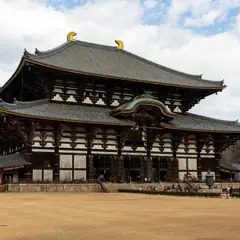
The court that resided here drove the Great Buddha of Todai-ji Temple, now in Nara Park, and Kofuku-ji Temple, the Fujiwara temple moved to the new capital, lies a little over three kilometres to the east.
Love songs and amulets against plague
Heijō Palace Suzaku-mon
Summary of this stop
The visit starts on the esplanade in front of the Suzaku-mon, the largest of the 12 gates of the walled compound and its main entrance. The present one, 25 by 10 metres and 22 high, is a reconstruction finished in 1998. In this plaza, where the start of the Suzaku avenue and of the Nijō-ōji has been recovered, foreign embassies were seen off and received, the utagaki, group courtship songs, were held, and at New Year the emperor came out as far as the gate.
The plaza also keeps a less festive memory. In 737 a great epidemic, believed to be smallpox, filled the capital with dead and took the four Fujiwara brothers, the most powerful men at court. In a rubbish pit dug into the surface of the Nijō avenue turned up a wooden amulet written against the demons of fever, together with clay horses with broken legs. What the amulet said and why those legs were broken is what the narration tells before the gate.
A train among a thousand years of rice fields
Kintetsu Nara line
Summary of this stop
Between the Suzaku-mon and the throne hall, a level crossing cuts the palace in two. The Kintetsu Nara line opened in 1914, when the surroundings were farmland and the compound had not yet been delimited, and it still crosses it from east to west; the plan presented in 2021 will divert it beneath the Ōmiya-dōri avenue, with completion of works planned for fiscal year 2060. It is the noisiest trace of the centuries when this was rice field, after the capital moved in 784.
In the early 1960s, the same company announced a train depot on the western part of the palace, then privately owned. A national protest campaign and the 1961 discovery of the palace’s first written tablets made it give up. That discovery happened on a snowy morning, with a bucket of dirty water, and its first tablet was not exactly an imperial decree. The narration reveals beside the track what it asked for.
The throne hall that went travelling
First Daigokuden of Heijō Palace
Summary of this stop
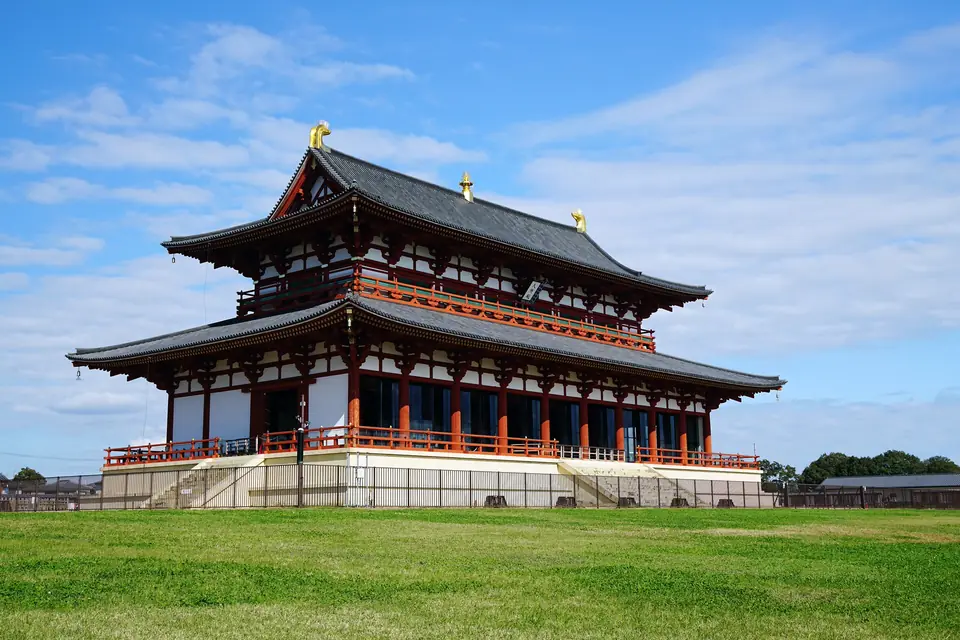
To the north rises the first Daigokuden, the palace’s largest building: 44 by 20 metres and 27 high, rebuilt in Japanese cypress between 2001 and 2010, with vermilion pillars, white walls, the Takamikura throne and, high in the interior, the signs of the Chinese zodiac painted by Uemura Atsushi. Its appearance, however, is in good part a hypothesis: the roof, the open facade and other details were taken from buildings of other centuries and other temples.
The original had a more eventful life than its solemnity suggests. When Emperor Shōmu moved the capital to Kuni in 740, the hall was dismantled and taken there, and when the court returned in 745 its site was already occupied by a new palace. Around it the work is not finished: the Daigoku-mon was rebuilt in 2022 and the east tower, from which anyone crossing the gate was watched, in March 2026, with the west one next. Where that travelling hall ended up is explained by the narration before the throne.
The mound a gardener wept over
Second Daigokuden platform
Summary of this stop
To the east rises the rebuilt platform of the second Daigokuden, now a viewpoint over the whole site. It is the grassy mound among rice fields, known as Daikokushiba, that the historian Sekino Tadashi identified in the Meiji era and published in 1907 in the Nara Shimbun; decades later it became known that Sekino did not distinguish the palace’s two phases. Earlier, in 1852, Kitaura Sadamasa, an official of the Furuichi magistrate, had already drawn a map that placed the palace.
The human side of this story has a name of its own: Tanada Kajūrō, the gardener who tended the plantations of Nara Park and who could not answer visitors who asked where the palace was. In 1896 he saw this site turned into pasture with piles of manure and wept. In 1906 he founded a society to preserve it and spent more than 2,000 yen of the time on the campaign. In 1921 the core of the palace was bought with private donations and given to the State; in 1922 it became a national historic site. How Tanada’s life ended is told by the narration on the platform.
An empress’s banquet pond
Tōin Teien garden
Summary of this stop
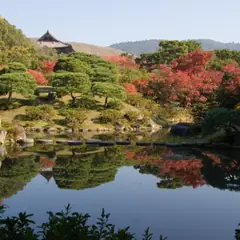
In the southeast corner of the palace, the Tōin Teien is a garden of 100 by 80 metres with a winding pond, bridge and pavilions, where Empress Shōtoku had a banquet pavilion built. It turned up in a 1967 excavation, was born in Chinese style in the early Nara period, was redone in Japanese style at the end of the same period and was rebuilt in 1998.
Here the place’s paradox closes: the palace’s only surviving building is not at the palace. The lecture hall of Tōshōdai-ji is a pavilion of the ceremonial compound raised around 710, moved and transformed, and ink marks on its bracket blocks reveal which one it was. And each spring the empty site recovers its people with the Tenpyō parade, in which Emperor Shōmu and Empress Kōmyō cross their palace again amid guards, musicians and ladies carrying replicas of the Shōsōin treasure. What that parade means for a place with no original buildings is the close of the narration.