The Fujiwara temple
Kofuku-ji Temple Audio Guide
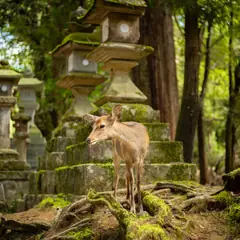
A temple without walls, with deer among its halls, that came to govern a province and burned again and again. At Kōfuku-ji every building is the answer to a fire, and what truly survived was whatever could be carried out in arms.
- 60 min of audio
- Buddhist temple
Kōfuku-ji was the family temple of the Fujiwara clan. Its origin goes back to the Yamashina-dera founded in 669 by the wife of Fujiwara no Kamatari, and in 710, with the move of the capital to Heijō-kyō, Fujiwara no Fuhito brought it to its present site and renamed it. It came to control almost all the estates of Yamato province and to bend the court of Kyoto. Its five-storey pagoda, from 1426 and 50.1 metres, is the second-tallest wooden pagoda in Japan.
No present building of Kōfuku-ji predates the fire of 1180. That of 1717 took the central golden hall, which did not recover its original size until 2018, and in 1880 the walls were torn down and the compound became part of Nara Park. Meanwhile, hollow dry-lacquer statues of 734, the Ashura among them, came through all the fires unscathed because they weighed so little that they could be carried by hand.
Highlights
- Sarusawa Pond — the postcard of the reflected pagoda, with a bloody past
- The Hokuen-dō — the octagonal hall of 1210, the temple's oldest building
- The Chū-kondō — the golden hall of 2018, with keyaki columns from Cameroon
- The five-storey pagoda — 50.1 metres, burned five times and sold for firewood, according to tradition
- The Ashura — dry lacquer of 734 that hides another scowling face beneath its serene one
The history of Kōfuku-ji is that of a temple that had an army, estates and the power of blackmail, and that paid for that power with fire. Its monks carried the sacred tree of the Kasuga shrine in procession some 70 times to pressure the court; in 1093 they thus forced a governor’s exile to Tosa. In 1180 it was the Taira army that came to collect for the monks’ support of the revolt against their clan: Nara burned, some 3,500 non-combatants died and of the temple nothing of what is seen today was left standing.
More fires followed, that of 1717 among them, and the separation of Shinto and Buddhism in 1868, which left the temple empty: its monks became priests of Kasuga, the residence of the Ichijō-in became the prefectural headquarters and the site of the Daijō-in is now the Nara Hotel. The founding itself has its debate: Fuhito’s move is dated to 710, but the first mention of the temple in the chronicles is from 720.
What to see at Kōfuku-ji fits in a stroll among deer, from Sarusawa Pond to the Ashura museum, passing through the architecture of Kōfuku-ji in its octagonal halls and its pagoda. The pagoda is under restoration from 2023 to 2031 and may appear wrapped in scaffolding. The audio guide covers it in five stops, with documented narration checked against historical sources.
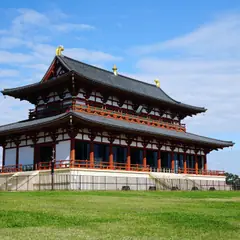
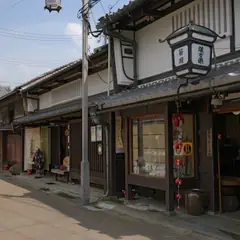
Up the hill, to the east, lies Kasuga Taisha Shrine, the shrine of the very same Fujiwara, and south of Sarusawa Pond the lanes of the Naramachi District begin, built on the site of another great temple of the capital. The year 710 of Fuhito’s move is also that of the court’s arrival at Heijo Palace, a little over three kilometres to the west.
A postcard pond with a bloody past
Sarusawa Pond
Summary of this stop
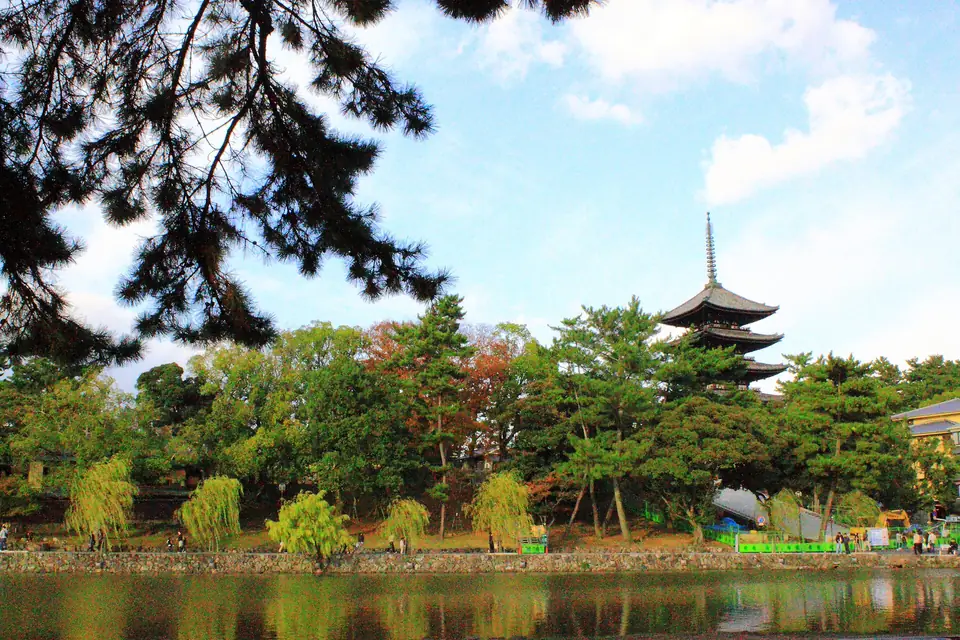
From the north shore of Sarusawa Pond, the pagoda peeks over the trees and is reflected in the water: it is the image of Nara that postcards repeat. A flight of 52 steps links the shore with the site of the vanished south gate, and the pond, dug as a ritual pond of the temple, still serves for releasing animals each April.
The postcard has a reverse. At the end of 1180, January 1181 in the Julian calendar, the army of Taira no Shigehira set fire to Nara and razed most of Kōfuku-ji and Todai-ji. The Heike monogatari tells that the punishment had a specific spark, and that this spark was lit precisely on this shore. The narration relates beside the water what the monks did with the peace envoys of Taira no Kiyomori.
The octagonal hall that dodged every fire
Hokuen-dō
Summary of this stop
In the northwest corner of the compound rises the Hokuen-dō, an octagonal hall founded in 721 on the first anniversary of Fujiwara no Fuhito’s death. Rebuilt in 1210 after the fire of 1180, it is the oldest building Kōfuku-ji preserves and it survived the great fires of 1327 and 1717. Its doors stay closed except for special openings; inside it keeps the Miroku and the monks Muchaku and Seshin by Unkei.
The hall sums up the temple’s origin as a clan house. Fuhito, son of Fujiwara no Kamatari, moved the family temple here in 710, and from that core Kōfuku-ji grew until it acted as the de facto lord of Yamato. Its most feared weapon was not the sword but a branch of sakaki: with it in procession, the monks brought the court to its knees. In front of the Hokuen-dō, the narration tells how that pressure worked.
Empty foundations and a hall of African timber
Chū-kondō
Summary of this stop
In front of the Chū-kondō, the central golden hall, the ground is full of absences: restored stone platforms of the central gate, the cloisters, the south gate and the empty site of the Saikon-dō. The fire of January 1717, started in the reading hall, destroyed all those buildings. The Saikon-dō was never rebuilt for lack of funds, and the Chū-kondō only received in 1819 a smaller provisional hall, paid for with donations from the people of Nara.
On 14 February 1880 the rammed-earth walls were torn down, trees were planted and the temple became a park, the wall-less temple that is toured today. In October 2018 the ninth Chū-kondō was consecrated, with the size and style of the original of 714, and here is the twist: in Japan there were no longer hinoki cypresses of that thickness. The narration explains in front of the hall where the timber of its columns came from.
A pagoda sold to be burned
Kōfuku-ji five-storey pagoda
Summary of this stop
Between the pagoda and the Tō-kondō is concentrated the temple’s most far-fetched story. The five-storey pagoda, first raised in 730 by order of Empress Kōmyō, Fuhito’s daughter, burned five times; the present one is from 1426 and, at 50.1 metres, only that of Tō-ji in Kyoto surpasses it in Japan. According to tradition, in early Meiji it went on sale and a buyer acquired it for 250 yen to burn it and keep its metal fittings, until the neighbours, fearing the fire would spread, prevented it; the price, the year and even the sale itself vary by account. Since 2023 it has been undergoing its first great restoration in some 120 years, due to end in 2031.
Beside it, the Tō-kondō of 1415 has its own murky past. In 1187, with the hall rebuilt but without a main image, warrior monks stormed the Yamada-dera temple in Asuka and took its bronze Yakushi triad, although the museum’s official entry speaks of a transfer without mentioning violence. Each 3 February, before this hall, the Tsuina-e pits Bishamonten against a red, a blue and a black demon amid a rain of beans. The narration reveals what became of that stolen Yakushi.
The Ashura and the head without a body
Kōfuku-ji National Treasure Museum
Summary of this stop
In the Kokuhōkan, the National Treasure Museum, built in 1959 over the remains of the refectory, the Ashura awaits: 153.4 centimetres of dry lacquer over a hollow core, from 734, commissioned by Empress Kōmyō for the vanished Saikon-dō. It is one of the eight statues of the Hachibushū, which survived all the fires because most weigh less than 10 kilos and could be carried by hand out of the burning building.
A CT scan discovered beneath the Ashura’s serene face an earlier one, with knitted brows and open mouth; why it was changed is a matter of hypothesis. In the same hall there is a bronze head cast in 685 that lost its body in a fire and spent centuries hidden where nobody looked for it, until it reappeared in 1937. Where it was and what accompanied it is the narration’s final revelation.