Borrowed-scenery garden
Isuien Garden Audio Guide
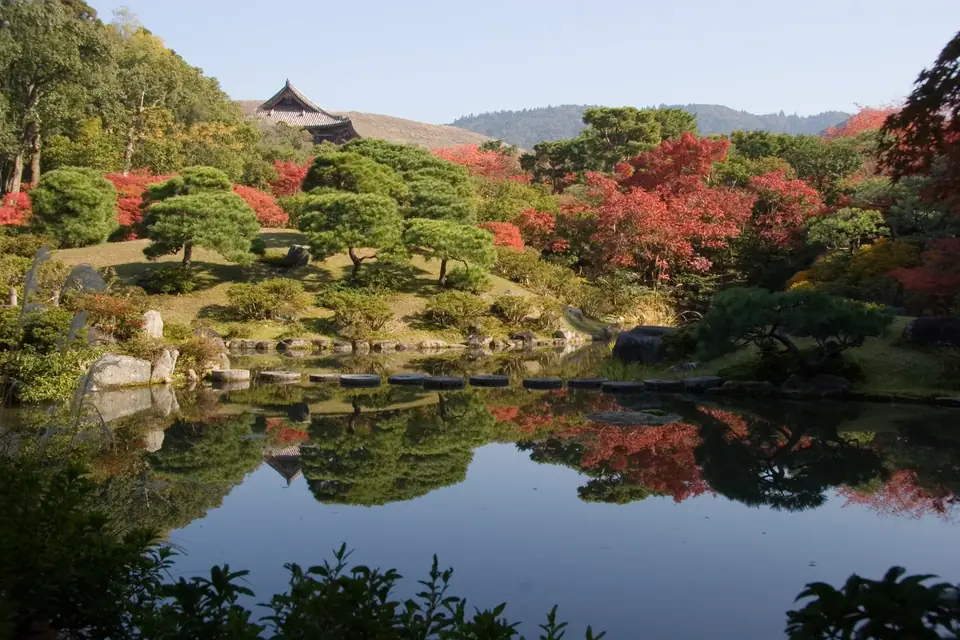
Two gardens from different eras, one secluded from the 17th century and another from the Meiji era that opens suddenly onto Todai-ji's Nandaimon and three hills. Isuien is made of borrowed pieces, and it can be strolled because a contract required it to be opened to the public.
- 45 min of audio
- Japanese garden
The front garden was born in the 1670s as a tea villa of Kiyosumi Dōsei, supplier of the fine Nara linen from which the samurai's ceremonial garments were made, on land that had belonged to a sub-temple of Kōfuku-ji. The rear one, the larger of the two, was commissioned in 1899 by Seki Tōjirō, a kimono merchant and bank president, for tea ceremonies and poetry gatherings: a pond garden with artificial hills that borrows Mount Wakakusa, Kasuga-okuyama and Mikasa.
On the shore of its pond rests a stone attributed to the base of the central pillar of Todai-ji's west pagoda, a seven-storey tower that vanished a thousand years ago. Its pavilions keep hand-blown glass from the early 20th century, so thin that it vibrates with fireworks, and 8th-century timber reused from another temple.
Highlights
- The shakkei — the rear garden borrows Todai-ji's Nandaimon and three hills
- The west pagoda stone — a fragment attributed to a seven-storey tower that burned twice
- The Hyōshintei — tea pavilion with 8th-century timber and glass that trembles
- The Seishūan — a copy of an Urasenke pavilion with a red raku-ware dragon
- The millstones — old grinding wheels turned into stepping stones to the pond island
The history of Isuien Garden is that of two merchants separated by two centuries and a shipowner who joined them. The first, Kiyosumi Dōsei, set up in the Enpō era a tea villa beside the Yoshikigawa river; the sources agree neither on the exact date nor on his trade. The second, Seki Tōjirō, built in 1899 a far more ambitious garden next door, although who designed it remains unclear: it is attributed to Yūmyōsai, twelfth master of Urasenke, to a gardener called Horitoku and, in part, to Kimura Seibei. In 1939 the shipowner Nakamura Junsaku bought the whole from the Seki family and joined the two gardens.
Not even the name has a settled explanation: it is usually translated as “garden founded on water”, because its ponds drink from the Yoshikigawa, but there are other theories, from the shape of the pond to a line by Du Fu. Within the grounds, the Neiraku Museum, in a 1969 building by Tōhata Kenzō, displays the East Asian art gathered by three generations of the Nakamura; of more than 10,000 works only some 2,000 or so remain, those that escaped the Kobe bombing of 1945.
What to see in Isuien Garden runs from the secluded garden of thatched pavilions to the great esplanade open toward Todai-ji. The audio guide covers it in five stops, with documented narration checked against historical sources.
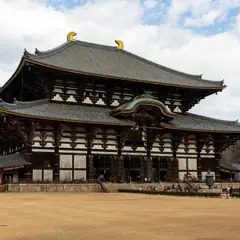
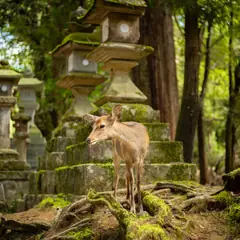
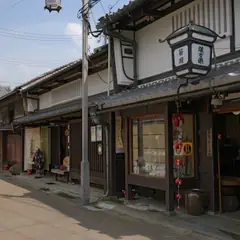
The great gate that closes the view is the Nandaimon of Todai-ji Temple; the garden is a walk from Nara Park and its deer, and a little over a kilometre to the south stretch the timber houses of the Naramachi District.
The linen merchant’s tea villa
Sanshutei
Summary of this stop
To the right of the entrance, facing the 17th-century front pond, stands the Sanshutei, a thatched pavilion of rustic air that now works as a tatami restaurant. The pond has a small island evoking the crane and the tortoise, stone lanterns on the banks and an Edo-style stone wall. Kiyosumi Dōsei, official supplier of Nara-zarashi, moved the Sanshutei here, built the Teishuken and oriented the garden toward three hills, on land that had previously been part of Manishu-in, a sub-temple of Kōfuku-ji.
The pavilion’s name speaks of three beauties, and is attributed to Mokuan, a monk of the Ōbaku Zen school who came from Ming China and in 1664 succeeded Ingen as second abbot of Manpuku-ji in Uji. The attribution is disputed, but the thread that links a Nara merchant with the Chinese masters of Uji is what the narration unravels before the Sanshutei.
Round window, shells and a red dragon
Teishuken
Summary of this stop
Southeast of the pond, the Teishuken is a small thatched pavilion with an unusual circular window and a gallery added by Seki Tōjirō. The tea path that starts here forces a slow pace, and rewards whoever looks up: over the thatched roofs polished abalone shells gleam. They shine like hawk’s eyes and scare off the crows, which tear out the thatch for their nests, and they also protect against fire as a sea offering, because abalone is one of the sacred foods of the Ise shrine.
A few steps further on, the Seishūan reproduces the Yūin, the tea pavilion of the Urasenke house declared an Important Cultural Property, and was built under Yūmyōsai’s direction. At the end of its roof peeks a red raku-ware tile with a dragon, a replica of a piece by Raku Kichizaemon XI from 1892. The narration explains beside the round window what each detail sought on a tea path.
The Nandaimon inside the garden
Rear garden's borrowed scenery
Summary of this stop
After the tea path of the Teishuken and the Seishūan, a narrow flagstone path opens onto the rear garden, and the view widens suddenly. It is the effect sought by Seki Tōjirō, born in 1864, kimono merchant and president of the Sixty-Eighth Bank, today Nanto Bank, when in 1899 he commissioned this pond garden with artificial hills.
In the background, with no fence between them, peek out the roof of Todai-ji’s Nandaimon, which borders the garden, and behind it Mounts Wakakusa, Kasuga-okuyama and Mikasa. It is the shakkei, the borrowed scenery: the garden appropriates what lies beyond its limits. Why the narrowness of the path is part of the effect is what the narration reveals at the end of the flagstones.
The stone of a pagoda that burned twice
Todai-ji west pagoda stone
Summary of this stop
On the shore of the rear pond, the Hyōshintei is a shoin-style tea pavilion built around 1900, with Tenpyō-era timber from the 8th century that had served at the Shin-Yakushi-ji temple. Its windows keep glass from the early 20th century, hand-blown and flattened by fire, so thin that it vibrates with the roar of fireworks and makes the garden seem to ripple.
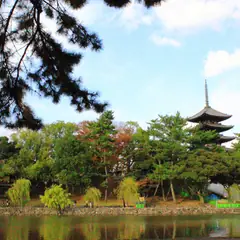
Set into the stone wall that borders the pond is the garden’s most enigmatic fragment: a stone attributed to the shinso, the base of the central pillar, of Todai-ji’s seven-storey west pagoda. According to tradition, the other fragment was taken to Osaka. At the tower’s site no stone remains in place today, and the provenance of each scattered piece rests more on tradition than on proof. Why nobody ever raised that pagoda again is what the narration tells on the shore.
Millstones, a rescued hall and a contract
Yagyūdō
Summary of this stop
The larger pond of the eastern garden draws the kanji 水, “water”, and its central island is reached by stepping on old millstones, among trimmed azaleas; at its head, a thatched hut with a water wheel turns with the current of the Yoshikigawa. To the northwest, facing Mount Mikasa, rises the Yagyūdō, a hall of the Hōtoku-ji, the family temple of the Yagyū clan founded by Yagyū Munenori in 1638. In the Meiji era it was about to be demolished; Seki Tōjirō bought it and moved it here.
The garden of rescued pieces has one last twist. In 1939 Nakamura Junsaku bought the garden from the Seki family and joined the two gardens, and from that purchase was born in 1940 the Neiraku art foundation, which gives the museum its name: it is written with an old spelling of “Nara”, but read Neiraku so as not to confuse it with the prefectural art museum. Which clause of the contract explains why anyone can stroll here today is the close the narration keeps.