The Great Buddha of Nara
Todai-ji Temple Audio Guide
A bronze Buddha of almost 15 metres cast in the 8th century to ward off a plague, burned twice and rebuilt with alms. What is seen today at Tōdai-ji is not an intact monument: it is a promise renewed over thirteen centuries.
- 90 min of audio
- 8th-century bronze
In 743 Emperor Shōmu announced by edict that he would raise a colossal Vairocana Buddha. Work began in 745 and the bronze statue was cast in eight superimposed sections until 749, with some 500 tonnes of copper, 440 kilos of gold and 2.5 tonnes of mercury. More than 2.6 million people contributed rice, timber, metal, cloth or labour. In 752, with the Buddha still ungilded, the Indian monk Bodhisena painted in its pupils before more than ten thousand attendees.
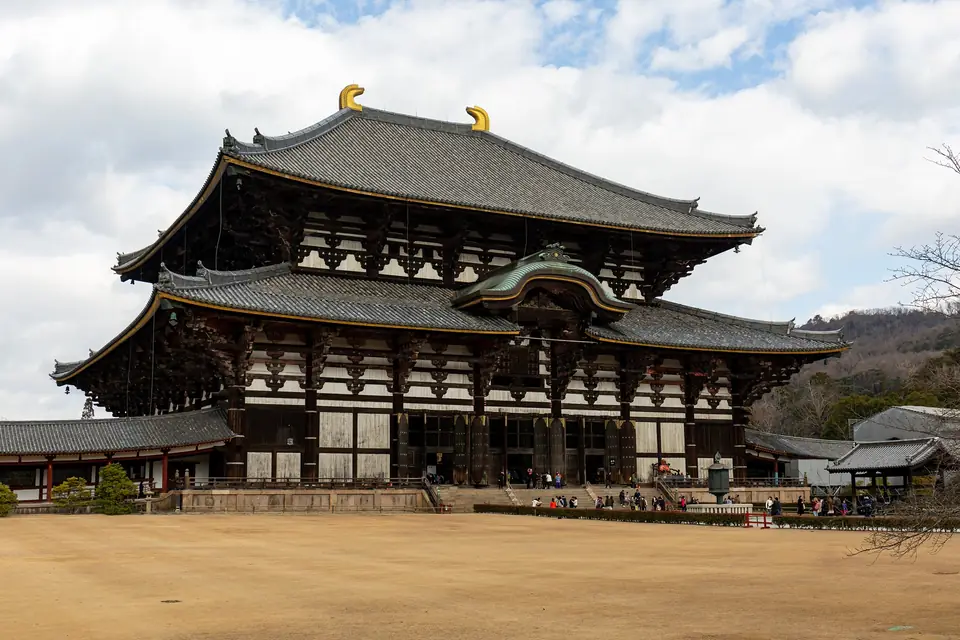
The history of Tōdai-ji is a chain of losses. The fire of 1180 reduced most of the temple to ashes and that of 1567 burned the Great Buddha hall again, leaving the statue almost a hundred years in the open air. The present hall, inaugurated in 1709 thanks to a monk who begged all over Japan for “a sheet of paper or half a cent”, is seven bays wide instead of the original eleven, and is still almost 49 metres high.
Highlights
- The Nandaimon — Japan's largest temple gate, from 1203, with pillars of more than 19 metres
- The Niō — two timber guardians of more than 8.4 metres, placed the opposite way to usual
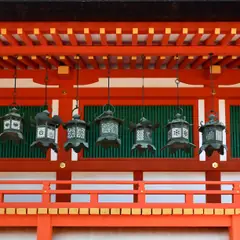
- The octagonal lantern — 8th-century bronze with celestial musicians and lions among clouds
- The Great Buddha — an Edo-period head on an 8th-century bronze belly and legs
- The pillar with a hole — a gap the size of the Buddha's nostril promising health to whoever crawls through
The history of Tōdai-ji begins with a plague. In 737 a smallpox epidemic killed one after another the four Fujiwara brothers, Muchimaro, Fusasaki, Umakai and Maro, who dominated the government; a great earthquake had come before, in 734, and afterwards years of drought and famine and the rebellion of Fujiwara no Hirotsugu in Kyushu, in 740. The documented tradition tells that Emperor Shōmu responded with temples in every province and with a colossal Buddha to protect the country. He announced it by edict in 743; in 745 work began on the grounds of the Kinshō-ji temple, and the monk Gyōki toured the provinces asking for donations.
What came out of it still astonishes by its figures. Some 350,000 people worked directly on the statue and more than 2.6 million contributed in some way. In the middle of the work, in 749, gold appeared in Mutsu province, in present-day Wakuya, and Shōmu celebrated the find by changing the name of the era. The Buddha shone entirely gold. Since then an earthquake has torn off its head and two fires have razed its hall, and each time someone raised it again: a 61-year-old monk in the 12th century, another who begged all over Japan half a cent at a time in the 17th.
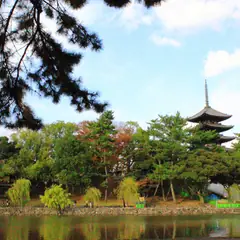
What to see at Tōdai-ji goes beyond the Great Buddha: the architecture of Tōdai-ji, from the Daibutsu style of the Nandaimon to the reduced hall of 1709, tells that story of losses better than any chronology. The audio guide covers it in five stops, from the south gate to the finial of a tower that no longer exists, with documented narration checked against historical sources.
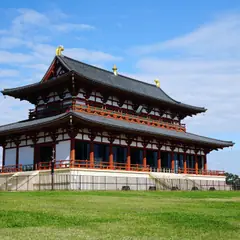
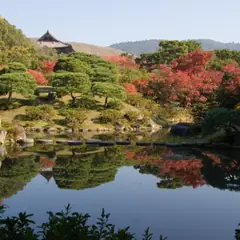
Tōdai-ji rises within Nara Park, and its Nandaimon is the borrowed backdrop of the great esplanade of the neighbouring Isuien Garden. The temple was born in the capital whose seat of government was Heijo Palace, west of the present city.
Two giants carved in sixty-nine days
Nandaimon
Summary of this stop
The entrance to Tōdai-ji is a lesson in scale. The Nandaimon, the Great South Gate, is Japan’s largest temple gate: eighteen pillars of 19.058 metres and an overall height of 25.46 metres, with the through beams of the Daibutsu style, imported from Song China, in view under the eaves. It is a child of disaster: in 1180 the troops of Taira no Shigehira burned most of the temple, and the following year the reconstruction was entrusted to the monk Chōgen, who raised the ridge beam of this gate in 1199 and finished it in 1203.
In its niches wait the two Niō, timber guardians of a little over 8.4 metres which, according to the traditional account, were carved in some 69 days of 1203 under the direction of Unkei and Kaikei. The restoration of 1988-1993 found inside sutras with the names of Chōgen and of two other sculptors, Jōkaku and Tankei, and since then the division of work among the four masters has been disputed. They are also placed the opposite way to usual, and the reason for that anomaly is what the narration raises beneath the gate.
A lantern that saw the Buddha born
Octagonal bronze lantern
Summary of this stop
In front of the Great Buddha hall stands an octagonal bronze lantern, with celestial musicians and lions running among clouds on its panels. It dates from the founding period, the 8th century: the only bronze in view that was already here when the Buddha was cast.
Its presence leads to the years of the work. The statue was cast in eight superimposed sections over three years, between 745 and 749, with some 500 tonnes of copper, 440 kilos of gold and 2.5 tonnes of mercury, the solvent used for gilding. Behind that effort was the fear of a court decimated by smallpox, drought and rebellion. Before the lantern, the narration reconstructs how an entire country, from peasants to mendicant monks, ended up contributing rice, timber or labour to a single statue.
A Buddha with a head from another era
Great Buddha Rushana
Summary of this stop
Inside the hall, the Great Buddha Rushana sits on a lotus with the right hand raised, the gesture of fearlessness, and the left offered, that of granting wishes. Its height is given as 14.7, 14.98, about 15 or 16 metres depending on the source. It was inaugurated unfinished: at the eye-opening ceremony, on the 9th of the fourth month of 752, the Indian monk Bodhisena painted in the pupils with a brush tied to a 190-metre cord that attendees touched to join the Buddha, when the gilding would not be completed until 757 and the halo until 771. The date coincided with the bicentenary of Buddhism’s official arrival in Japan. The brush and the cord are preserved in the Shōsōin.
The statue that is seen is a collage of centuries. The head is Edo-period, recast from 1686 and consecrated in 1692; of the Buddha of 752 remain mainly the belly, the legs and the lotus petals of the pedestal, engraved with the “world of the Lotus Treasury” of the Kegon sutra, although the sources do not agree on which other parts are original. The petals are so high that a replica stands at ground level. On either side, two Edo-period timber bodhisattvas, Nyoirin Kannon and Kokūzō. And beneath the pedestal slept a 1,250-year-old secret, imperial swords given up for lost, whose discovery the narration tells in front of the Buddha.
The monk who begged for half a cent
Pillar with a hole
Summary of this stop
Behind the Buddha, the hall tells its own defeat. In 1567 the war between the Miyoshi and Matsunaga clans burned it again; tradition blames Matsunaga Hisahide, although other versions speak of an accidental fire and there is no consensus. The provisional hall fell in a gale in 1610 and the Buddha, with a provisional head of copper plates, spent almost a hundred years in the open air. The monk Kōkei decided to rebuild it after seeing it in the rain: from 1684 he toured Japan asking for “a sheet of paper or half a cent”, gathered 11,000 ryō, won the support of the shogun Tokugawa Tsunayoshi and died in 1705, four years before the inauguration.
The lack of money shows in the facade. The halls of 752 and 1195 were eleven bays wide; that of 1709 stayed at seven, although it keeps the original height and depth: 57.012 metres wide, 50.480 deep and 48.742 high. Above the tent inside hangs the great board with the Edo elevation, still showing the eleven-bay project. The temple presents it as the largest timber structure in the world, although other sources maintain it lost the record in 1998 to modern buildings.
In one timber pillar opens a hole the size, they say, of one of the Buddha’s nostrils. Popular belief holds that whoever crawls through to the other side will have good health, or enlightenment according to another version; almost only the most agile children manage it. The narration explains beside the pillar what separates the legend from the queue of visitors.
The tower that is no more
Expo 1970 tower finial
Summary of this stop
Beside the hall stands a metal finial, a sōrin, reproduced for the Osaka Expo of 1970 and placed where one of the two seven-storey towers that flanked the approach stood. Of them only foundations and earth mounds remain; the models inside the hall, among them the one made for the Anglo-Japanese exhibition of 1909, give back their silhouette.
The building of 1709 is not entirely from Nara either: except in width, it copies almost exactly the Great Buddha hall of Hōkō-ji, in Kyoto, the rival raised by Toyotomi Hideyoshi, whose Buddha of some 19 metres surpassed Nara’s until lightning destroyed it in 1798. And once a year the hall opens outward: each 1 January, from 0 to 8 in the morning, the normally closed Chūmon is opened free of charge, along with the window under the curved pediment, so that the Buddha’s face looks out as far as the gate, something that also happens on the night of the lantern offering of 15 August. What that gaze means after thirteen centuries of fires is the close the narration reserves for the end.