Edo merchant quarter
Naramachi District Audio Guide
A district of timber shop-houses built, literally, on top of a temple: its streets bear the names of Gangō-ji's gates and from its eaves hang red monkeys that carry each neighbour's misfortunes.
- 75 min of audio
- Machiya houses
Naramachi occupies most of the old Gangō-ji compound, the temple that in 718 moved from Asuka to the new capital: a rectangle of some 440 metres north to south by 220 east to west, south of Sarusawa Pond. A peasant uprising burned almost all of the temple in 1451, and when it lost its rights over the land in the late 16th century, the stones of the burned buildings were buried to build houses and shops on top.
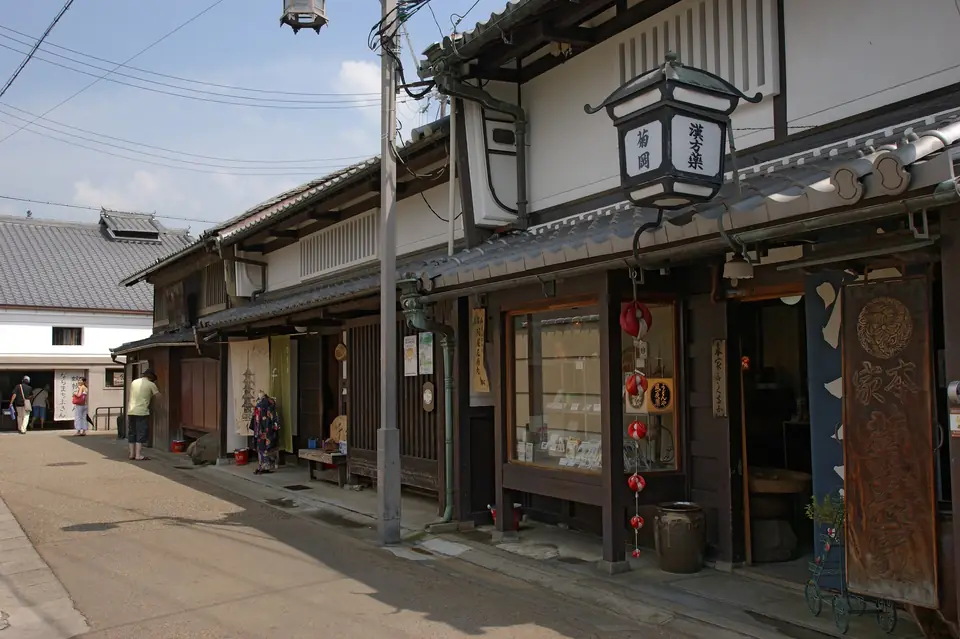
In the Edo period, Naramachi was a powerful city of trade and craft: brushes, sumi ink, mosquito nets, bleached cloth, futons, swords, sake and soy sauce, with 35,000 inhabitants according to a count of the late 17th century. It escaped the great bombings of the Second World War, and that is why it keeps its street layout and its lattice facades.
Highlights
- The migawari-zaru — strings of red cloth monkeys that take the misfortunes in the family's place
- The Kōshin-dō — the neighbourhood house of the cult that required staying up all night every 60 days
- Naramachi Koshi-no-ie — a visitable lattice machiya, with the shop in front and the home at the back
- The Gangō-ji pagoda base — 17 stones of the 8th century among private houses
- The Imanishi-ke Shoin — Muromachi-era rooms beside the same family's sake brewery
The history of Naramachi is that of a district that grew over the ruins of another world. Gangō-ji was one of the great temples of the 8th-century capital; in the autumn of 1451, a peasant uprising demanding debt cancellation set fire to houses in Nara and the flames devoured almost all of the temple. A few buildings were left standing, among them a great five-storey pagoda. When Oda Nobunaga brought down the Ashikaga shogunate, the temple lost its lands, and shopkeepers gradually occupied the site: the local historian Murai Kodō, an 18th-century barber-surgeon, dated many of these neighbourhoods between 1573 and 1592, and archaeology confirmed it. Some guides move the district’s origin back to the 15th century.
Its modern survival was not automatic either. In 1984 the Nara Machizukuri Center was born here, Japan’s first citizens’ urban-planning association constituted as a think tank; a municipal attempt to declare the district a historic ensemble was withdrawn in the face of neighbourhood opposition, and in 1990 the city opted for an urban-landscape district with aid for restoring facades.
What to see in Naramachi fits in a stroll through quiet alleys a few minutes from the park: cloth monkeys, a machiya house, the stones of a vanished tower and a sake brewery. The audio guide covers it in five stops, with documented narration checked against historical sources.
North of the district, past Sarusawa Pond, begins the compound of Kofuku-ji Temple, the great temple of the Fujiwara, and a little over a kilometre away lies Isuien Garden, open to the great gate of Tōdai-ji.
The cloth house that opened in 1716
Shika Saru Kitsune Building
Summary of this stop
The tour starts in front of the Shika Saru Kitsune Building, a contemporary commercial building with restored kura storehouses, adjoining the birthplace house of Nakagawa Masashichi Shoten. This house was born in 1716 as a wholesaler of Nara-sarashi, Nara’s bleached hemp cloth, founded by Nakaya Kihei, and more than three centuries later it is still in the district.
Its longevity serves as a door into the Naramachi of Edo, a city of brushes, sumi ink, mosquito nets, Buddhist objects, swords, sake and soy sauce, which the Nara magistracy counted at the end of the 17th century at 35,000 inhabitants. Very close by, the Mochiidono shopping arcade, one of the oldest in Nara, bears a name written with the characters for “mochi”, “cooked rice” and “lord”. A popular tradition says it has to do with a giant snake and a monk of Tōdai-ji, and the narration explains it before going down into the district.
Red monkeys that carry your misfortunes
Naramachi Kōshin-dō
Summary of this stop
From the entrance to the district, strings of red cloth dolls shaped like monkeys peek out beneath the eaves. They are the migawari-zaru, the “substitute monkeys”, which take the misfortunes in place of the household’s inhabitants: the custom is to hang one for each family member, and if a wish is written on its back they become known as negai-zaru, “wish monkeys”. In Japanese, monkey, saru, sounds the same as “to drive away”.
Their origin lies in the Kōshin-dō of Nishishinya-chō, the small neighbourhood meeting house rebuilt in the Heisei era, whose interior opens only at the annual festivals. There Shōmen Kongō, the “Kōshin-san”, is venerated, tied to an Edo-period belief: three worms lived inside each person and, every 60 days, on the night of Kōshin, they left the body to report its faults to the Heavenly Emperor. Naramachi came to have seven Kōshin images with its own pilgrimage route. What the neighbours did so the worms would not speak is what the narration reveals before the Kōshin-dō.
Streets named after a temple’s gates
Naramachi Koshi-no-ie
Summary of this stop
Naramachi Koshi-no-ie is a rebuilt shop-house that reproduces a late Edo to Meiji machiya, visitable inside: narrow lattice facade, shop in front and home at the back, surprisingly deep. Like the rest of the district, it sits on the Gangō-ji compound, and the base stones of its burned buildings were left buried beneath houses like this one.
The plan of the vanished temple lives on in the street names: Imamikado-chō, Shimomikado-chō and Wakido-chō bear the names of the gates that stood there, and Tsuijinouchi-chō, “the quarter inside the wall”, lies beside what was its outer wall. From the same temple comes a 9th-century legend recorded in the Nihon Ryōiki: a boy of superhuman strength and a demon that killed the bell-tower boys every night. How the fight ended, and why perhaps from here comes the word Japanese children use for the bogeyman, is told by the narration beside the lattice.
Seventeen stones and a tower that is gone
Gangō-ji pagoda site
Summary of this stop
Wedged between private houses in Shibashinya-chō appears the base of Gangō-ji’s great pagoda: 17.7 metres on a side, 90 centimetres high and its 17 base stones of the 8th century still laid out in a square, something rare in Japan. It has been a National Historic Site since 1932 and opens only on Saturdays and Sundays. On the stones there is nothing: the gap of sky marks where a Nara-period tower of some 57 metres stood, according to the most accepted estimate, although the temple’s tradition credited it with nearly 72.
The pagoda survived the fire of 1451, but burned in 1859, together with the Kannon-dō, in a fire that started in a neighbouring house, and was never rebuilt. On the way stands the Goryō-jinja, the district’s protective shrine, whose stone lion-dogs wear red cords tied to their paws. Its origin is a dark episode of the 8th century: an empress and her son fallen from grace, a death on the same day and an emperor who ended up fearing their spirits. The narration relates it before the stones.
A medieval house that now smells of sake
Imanishi-ke Shoin
Summary of this stop
Behind a gate and a garden, the Imanishi-ke Shoin was the residence of the Fukuchiin lineage, officials of the Daijō-in of Kōfuku-ji. Its two rooms of 9 and 8 tatami opening onto the garden are of the Muromachi period and show early features of the shoin-zukuri style; it is an Important Cultural Property. Since 1924 it has belonged to the Imanishi, the family of the Harushika sake brewery, which operates in the house next door.
The house sums up the district’s fortune. Nara, a relatively small city, ranked low on the list of targets of the great bombings and the war ended before its turn came. Afterwards, it was the neighbours who decided how to preserve it: the urban-landscape district of 1990, of 48.1 hectares, was extended in 2014 to 49.3. Why they rejected the formula the city council proposed is the close the narration keeps.