Shrine of the Fujiwara
Kasuga Taisha Shrine Audio Guide
Some 3,000 lanterns donated over the centuries, a god who arrived on the back of a white deer and gates that decided who went in by which way. Beneath the vermilion cloisters of Kasuga Taisha the power of a clan can still be read, along with a Buddhist past that never quite left.
- 60 min of audio
- Shinto shrine
Kasuga Taisha was born at the foot of the sacred Mount Mikasa. The god Takemikazuchi was first venerated on its summit, and on 9 November 768, by order of Empress Shōtoku, the minister Fujiwara no Nagate raised below the four shrines that bring together the Fujiwara ancestors. Since 841 hunting and logging have been forbidden on Mount Kasuga, and the resulting forest, of some 298.6 hectares beside the city, is now a Special Natural Monument.
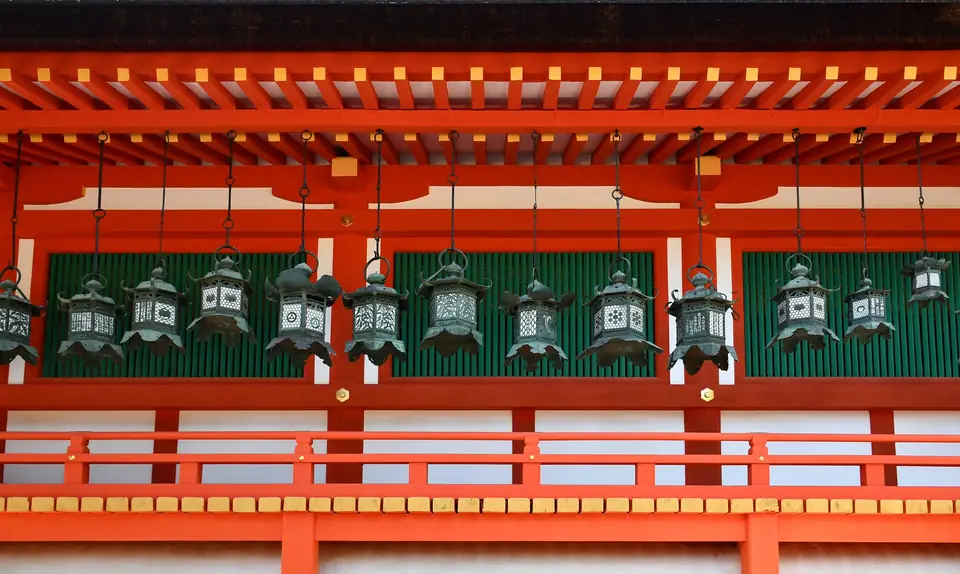
Until 1867 its nearly 3,000 lanterns were lit every night, with some 280 litres of oil paid for by the Tokugawa shogunate. Today they all burn at once only at the Setsubun of February and in mid-August. The shrine preserves, according to its own website, more than 60 % of the pre-Muromachi lanterns that exist in Japan, and was the first in the country to line a path with stone lanterns.
Highlights
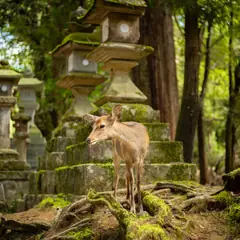
- The sandō — some 2,000 moss-covered stone lanterns, many with carved deer
- The lantern of the 800 donors — paid for by ordinary people beside the second torii
- The Nanmon and the Keiga-mon — the great gate for everyone and the small one for the Fujiwara
- The corridors — some 1,000 hanging lanterns, including those of the shogun Tokugawa Tsunayoshi
- The oaimichi — Japan's first shrine path lined with stone lanterns
The history of Kasuga Taisha is that of a shrine that was at once a family temple, a showcase of power and the stage of an unusual religious coexistence. The main god, Takemikazuchi, arrived according to myth from Kashima on the back of a white deer, and that is why the deer is a divine messenger here. His cult began on the summit of Mount Mikasa; the shrine’s tradition sets the founding of the four shrines at the foot of the mountain in 768, although other versions move the cult back to around 710 and recent excavations point to rituals on the site earlier than that date.
For centuries the shrine and the Buddhist temple of Kōfuku-ji, both of the Fujiwara, worked almost as one: monks read sutras before the Shinto gods and even carried the god out of the shrine to march with him to Kyoto. The separation of 1868 split them in two, but not entirely. The four shrines of the honden, a National Treasure, date from the reconstruction of 1863, and the shrine is renewed on the same site roughly every 20 years, with a new cypress-bark roof; the 60th renewal was held in 2015-2016.
What to see at Kasuga Taisha runs from the forest of stone lanterns to the vermilion cloisters and the path to the Wakamiya. The audio guide covers it in five stops, with documented narration checked against historical sources.
Because of that myth, the deer that roam all over Nara Park are held to be messengers of this shrine, and the neighbouring Kofuku-ji Temple is the Buddhist temple of the Fujiwara with which it shared more than a thousand years of history.
Two thousand lanterns and a pine that danced
Kasuga Taisha first torii
Summary of this stop
From the first torii, the sandō opens between some 2,000 moss-covered stone lanterns. Many bear deer as a motif and most the inscription “Kasugasha”, but about fifteen say “Kasuga Daimyōjin”. With the roughly 1,000 hanging ones of the corridors they total about 3,000, donated since the Heian era, and until the end of the Edo period they were lit every night. The proportion of old lanterns the shrine keeps varies by source: more than 60 % of those predating Muromachi in Japan, according to the official website; others speak of 70 %.
Just after the torii, on the right, an enormous stump and a young pine pass almost unnoticed. It is the Yōgō no Matsu, the “pine of the divine apparition”: according to tradition, the god of Kasuga came down here as an old man and danced the Manzairaku beneath the tree, which already appears in an illustrated scroll offered to the shrine in 1309. The great pine died in 1995. It is often repeated that it is the model for the pine painted at the back of every noh stage, although research places that idea in the late Meiji and Taishō periods, with no backing in old documents. The narration explains at the entrance how to tell the ancient myth from the modern one.
The sacred deer that cost a life
Kasuga Taisha second torii
Summary of this stop
To the right of the second torii, a stone lantern bears the name of no great lord: it was paid for by some 800 ordinary people in the late Edo period. A few steps further, the water of the purification basin flows from the statue of a reclining deer, the messenger of Takemikazuchi who in the Middle Ages starred in the “Kasuga deer mandalas”.
That veneration had a terrible reverse. Kōfuku-ji, which in practice governed Yamato province, punished with extreme severity anyone who harmed a Kasuga deer, and a temple chronicle records an episode of 1551 that shows how far that protection went. The change came with the shogunate’s magistrates: around 1672 the cutting of the males’ antlers began, which since 1929 has been done each October at the Rokuen, the shrine’s deer enclosure. What happened that year, and why the autumn ritual is its echo, is told by the narration beside the fountain.
The great gate for those who were not Fujiwara
Kasuga Taisha Nanmon
Summary of this stop
The Nanmon, the two-storey, 12-metre vermilion south gate, is the shrine’s largest and the main entrance to the cloister compound. But not everyone used it. At the Kasuga Matsuri, held each 13 March since 849, the imperial envoy enters by the small Keiga-mon if he is of the Fujiwara family; if not, he must pass through the Nanmon.
Here the clan not only had its own gate: it also had its monks. From the late 11th century, those of Kōfuku-ji pressured the court with the “shinboku dōza”: they transferred the spirit of the Kasuga god to a branch of sakaki, took it out of the shrine and marched with it toward Kyoto, by way of Kizu and Uji. Before the gate, the narration explains what a god in procession could achieve against an emperor.
Buddhist sutras before Shinto gods
Chūmon and Orō galleries
Summary of this stop
The Chūmon, the middle gate of some 10 metres with a curved pediment added in Meiji, is flanked by the Orō, a gallery of about 13 metres in the shape of wings. It is where the visitor prays today, and it was the place where the monks of Kōfuku-ji recited sutras. In 1267, at their request, the stream that runs beside the west cloister was built, and the present Seijō-mon gate was then called “Sōjō”, the monks’ gate.
In 1868 the decree separating Shinto and Buddhism forced those monks to hang up their habits and serve at Kasuga as “new priests”. The corridors lost their Buddhist names: the Nishi-no-Gorō was the “corridor of the Yuishiki lessons” and the Higashi-no-Gorō the “corridor of the Buddhist canon”. What is surprising is what happens each 2 January before these galleries, and the narration reveals it in front of the Chūmon.
Japan’s first lantern path
Kasuga Wakamiya Shrine
Summary of this stop
The oaimichi, the path linking the main shrine with the Wakamiya, was the first shrine path in Japan lined with stone lanterns, placed since the late Kamakura period; in the Edo period, temples and shrines across the country copied the custom. Around it, the forest of Mount Kasuga has grown without hunting or logging since 841, by order of Emperor Ninmyō.
Once a year this path returns to total darkness. Each 17 December at midnight, at the Kasuga Wakamiya On-matsuri, the spirit of the god leaves its shrine surrounded by priests with sakaki branches, amid torches, incense and a deep, continuous cry that clears the way; lanterns, photos and any light are forbidden. Already in the 14th century the regent Nijō Yoshimoto wrote that it made his “hair stand on end”. How that night sounds and what can be seen, or what cannot, is the ending the narration keeps.