The deer park
Nara Park Audio Guide (Nara Kōen)
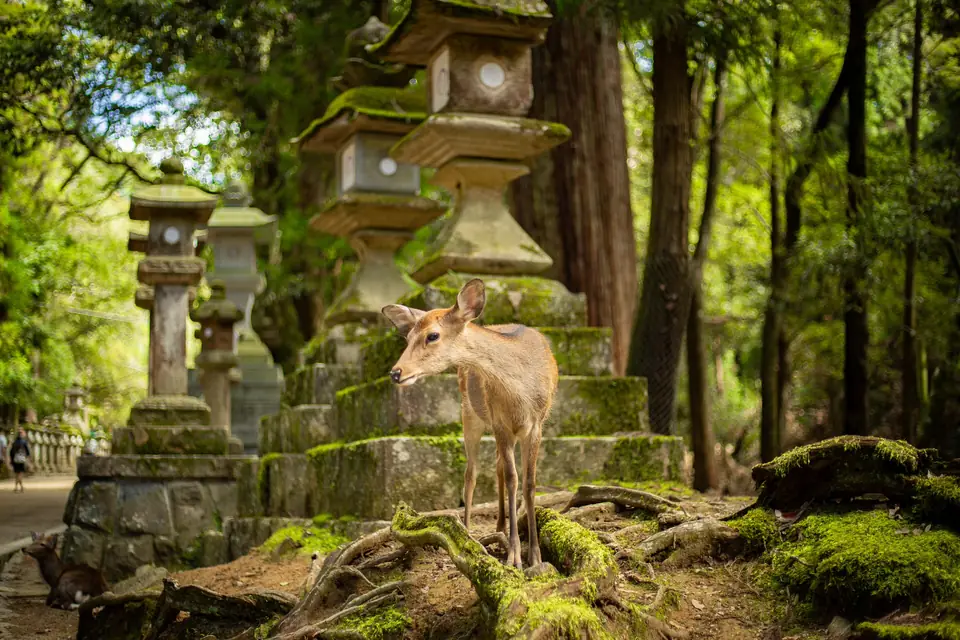
No walls, no ticket office and no owner for its more than 1,600 wild deer. Nara Park is the only place where deer bow for a biscuit, mow the lawns and have spent centuries surviving devotion, fear and near extinction.
- 60 min of audio
- Free-roaming deer
Nara Park opened on 14 February 1880 on 14 hectares of the old Kōfuku-ji compound, turned into State land, and in 1889 it grew to take in the grounds of Tōdai-ji, Kasugano and mountains such as Wakakusa. It has no walls, fences or gates, charges no admission and is open 24 hours a day. Long before, it was already a strolling landscape for the court: 86 poems of the Man'yōshū name places in the present park.
Its deer are wild animals with no owner, a Natural Monument since 1957. They carry a genetic lineage found in no other deer of the Kii peninsula, isolated for more than a thousand years thanks to human protection. In 1945 only 79 remained; the July 2026 census counted 1,687, the record since they have been counted by the same method.
Highlights
- Tobihino meadow — deer lying down and the horn call of Beethoven's Pastoral
- The bows — a gesture only Nara's deer make and pass on to their fawns
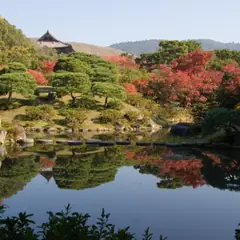
- The Ukimido — a 1916 timber pavilion that seems to float on Sagi-ike pond
- The deer line — trees with no branches below about 2 metres, as far as the deer reach
- Mount Wakakusa — 33 hectares of grass with a 5th-century burial mound, burned each January
The deer of Nara Park are neither pets nor livestock: they are wild fauna with no owner that has spent centuries living among temples, cars and visitors. For generations they were venerated as messengers of the Kasuga shrine, and that veneration came at a price in fear and punishment for the people of the city. Then came a governor who wanted to put an end to the “superstition”, a hungry postwar that left them at 79 and, in the end, a recovery that now puts them above 1,600.
What exactly the park is depends on whom you ask. The prefectural urban park measures 511.22 hectares, most of it mountain; with the grounds of Tōdai-ji, Kōfuku-ji, Kasuga Taisha and the National Museum, the Nara Park that everyone understands covers about 660. Nor is the question of who owns the deer settled, nor what happens to those that leave it: since 2017 animals have been captured in the farming areas on the outskirts, a disputed measure.
What to see in Nara Park goes beyond feeding biscuits: the park’s history can be read in the height of the branches, in a pavilion over the water and on a hill that burns each winter. The audio guide covers it in five stops, from the urban edge to the foot of Mount Wakakusa, with documented narration checked against historical sources.
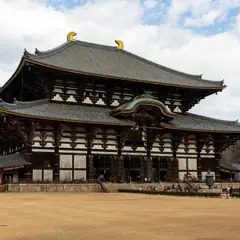
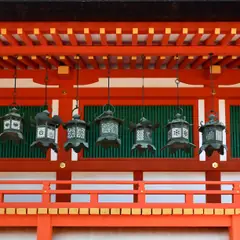
Within those hectares lie Todai-ji Temple, with its colossal Buddha, and Kasuga Taisha Shrine, whose god arrived according to myth on the back of a white deer: hence the veneration that for centuries protected the park’s deer.
A park without gates on temple lands
Noborioji lawn
Summary of this stop
The tour starts on the lawn beside Noborioji avenue, where the park merges with the city without warning: there is no wall, no ticket office, no gate. Its border is marked by traffic signs of deer crossing and the panels with the rules for giving biscuits. The park was born by decree of the Daijōkan on 14 February 1880, on 14 hectares of the old Kōfuku-ji compound, and in 1889 it reached 535 hectares.
The deer that cross paths here with pedestrians are wild and ownerless, mushubutsu in legal language, and since 18 September 1957 they have been declared a national Natural Monument as “Nara deer”, with no delimited area: the declaration covers the whole municipal territory. The narration explains at this point what it means for a natural monument to walk along the pavement.
A floating pavilion and the magistrate of the cherry trees
Ukimido
Summary of this stop
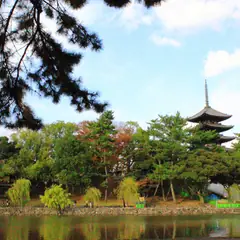
On Sagi-ike pond rises the Ukimido, a hexagonal timber pavilion of 1916, with a cypress-bark roof, joined to the shore by a wooden bridge, which seems to float on the water. The ground around it was the court’s pleasure landscape since the Nara period, and the “Eight Views of Nanto”, documented in 1465, are the first series of “eight views” chosen in Japan.
In 1850 the Nara magistrate Kawaji Toshiakira raised a stele for the planting of cherries and maples, and after the park’s opening, in 1892, several hundred more were planted in the old compounds of Kōfuku-ji and Tōdai-ji. That same magistrate ended up as a character in “Shika seidan”, a classic rakugo about a tofu seller who kills a deer by mistake, at a time when doing so could cost one’s life. How the judge contrives to save him is what the narration tells beside the pond.
Bows for a biscuit and a horn
Tobihino
Summary of this stop
On the Tobihino meadow, dotted with lying deer, the stalls sell shika-senbei in packets of 10 tied with a strip of paper. They are austere biscuits, only rice bran, wheat flour and water, with no sugar; a document of 1868 already orders their manufacture. They are the only food allowed to be given to the deer, because part of their sale pays for their protection, and even so they cover barely 2 % of their diet.
Before whoever holds a biscuit, the deer lower their heads and ears again and again. Only Nara’s deer make this bow and pass it on to their fawns; a team from Nara Women’s University counted an average of 10.2 per deer in 2016-2017 and 6.4 during the pandemic. A popular theory attributes it to the courtesy of the Fujiwara; the scientific hypothesis speaks of a learned gesture. And in this same meadow, since 1949, the staff of the protection association has called the herd with a natural horn. What melody plays and what happens when it sounds is revealed by the narration.
The enclosure where the herd almost ended
Rokuen
Summary of this stop
At the entrance to the Rokuen, the deer enclosure of the protection association, a stele records Bashō’s haiku about the deer bellowing at night. Here the antler cutting is held each autumn. Its origin is much less kind: the documented tradition tells that Shijō Takahira, first governor of the prefecture between 1872 and 1873, set out to end the veneration of the deer and in April 1873 shut more than 700 in an enclosure to curb the damage to crops. What happened next, and how from its failure was born the freedom of today’s deer, is what the narration tells at this point.
The protection had more ups and downs. In 1916 the supreme court convicted of theft of a sacred Kasuga Taisha deer a resident who had eaten one found dead outside the park; the shrine withdrew that ownership claim in the lawsuits of 1979 and 1981. The war decimated them: from 806 in 1941 to only 79 in 1945. And today’s danger is more prosaic: in 2019 nine deer died with plastic in their stomachs, and that is why there is not a single litter bin in the whole park.
The hill the deer mow and that burns
Mount Wakakusa
Summary of this stop
At the foot of Mount Wakakusa, a hill of three rises with 33 hectares of grass and a 5th-century burial mound on the summit, the landscape reveals its true gardener. The park’s trees have no branches below about 2 metres, the “deer line” as far as the deer reach, and the lawn is kept only by the cycle of grazing animals, dung beetles that bury the droppings and fertilised grass. The July 2026 census counted 1,687 deer, a record since 1953, all of a lineage separated from the rest more than a thousand years ago.
Each fourth Saturday of January, representatives of Tōdai-ji and Kōfuku-ji set fire to the dry grass of the mountain. The most repeated explanation speaks of a boundary dispute between the two temples, but there is no trace of it in their records, and another story tied to the burial mound on the summit weighs more today. What the people of Edo feared if the mountain did not burn is the narration’s last revelation.