The oldest shrine in Nikkō
Futarasan Shrine Audio Guide (Nikkō Futarasan-jinja)
Three mountains that are father, mother and son, a precinct of 3,400 hectares with peaks and waterfalls, and in a garden at the back a bronze lantern of 1292 with more than 70 sword cuts. The oldest thing in Nikkō hides behind the gold of Tōshōgū.
- 30 min of audio
- Shinto mountain shrine
Futarasan Shrine is the religious origin of Nikkō. In 767 the monk Shōdō Shōnin raised a small shrine to the god of Mount Futara, today's Nantai, beside the Daiya river, and in 782 he reached the summit and founded another there. Its kami are a family and three mountains at once: the Nantai, the Nyohō and the Tarō. The red and black haiden was donated in 1619 by the shōgun Tokugawa Hidetada, and the polychrome honden it hides behind is the oldest building of all the temples and shrines of Nikkō.
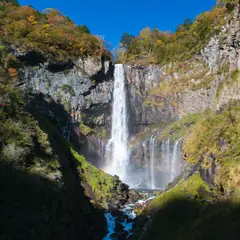
Its precinct measures 3,400 hectares, the second largest in Japan after that of Ise: it includes eight peaks, the Kegon Falls and the winding Irohazaka road, and the whole of Mount Nantai, from foot to summit, is sacred ground that can only be climbed in season. Even the town's name comes from here: Nikkō, “sunlight”, was born of reading the characters of Futara as “nikō”.
Highlights
- Fūfu-sugi and Oyako-sugi cedars — trunks joined at the root that echo the mountains' divine family
- Haiden — the sober red and black pavilion given by the shōgun Tokugawa Hidetada in 1619
- Bakedōrō — the ghost lantern of 1292, with more than 70 sword nicks
- Honden — the oldest building in Nikkō, visible from the Shinen garden
- Futara reisen spring — the sacred water that the faithful bottle and sake brewers seek out
The story of Futarasan Shrine begins with a monk and a river. In 767, Shōdō Shōnin raised a small shrine to the god of Mount Futara beside the Daiya river; that shrine is today the Hongū-jinja, origin of the whole complex. In 782 he reached the top of Mount Nantai and founded a simple shrine there, today’s Okumiya, so that Futarasan ended up spread over three sites: the main shrine in Nikkō, the Chūgūshi on the shore of Lake Chūzenji and the Okumiya on the summit. The founding year, mind you, changes with the source: some place it in 766, with Shōdō’s first hermitage, and others push it to 767 or to 782, because each takes a different milestone of his life as the origin.
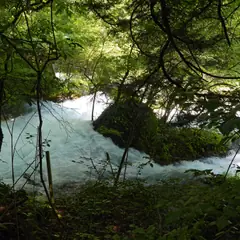
What makes this shrine singular is that its divine body is not a building but a landscape. Its three kami are a family, father, mother and son, and at the same time three mountains. The precinct measures 3,400 hectares, the second largest in Japan after that of Ise, and takes in eight peaks, the Kegon Falls and the winding Irohazaka road. Not even the title of first shrine of the old province of Shimotsuke is settled: it is claimed at once by this shrine and by the Futarayama of Utsunomiya, and the attribution remains unresolved.
The story of Nikkō’s Futarasan also runs through politics. In 1590 the shrine backed the Hōjō during the siege of Odawara and Toyotomi Hideyoshi confiscated its lands; it was the protection of Tokugawa Ieyasu that pulled it out of decline. When Tōshōgū was built for the deceased Ieyasu, the shrine changed site and its buildings were remade, and ever since the oldest shrine in Nikkō has occupied the innermost corner of the complex, discreet beside its golden neighbour.
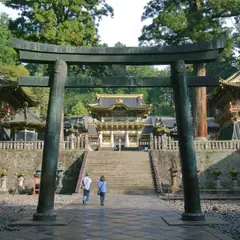
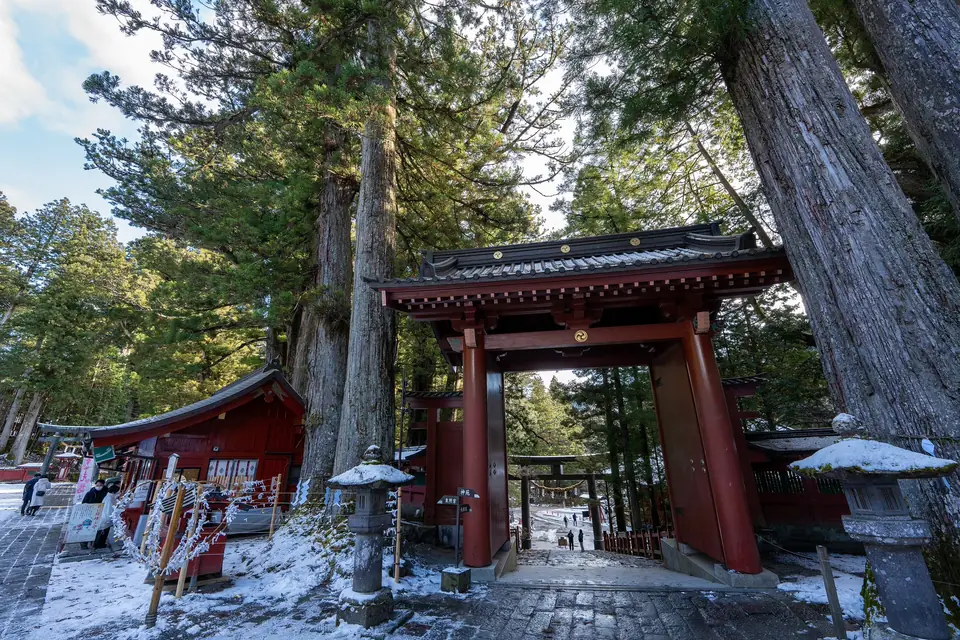
What to see at Futarasan Shrine fits in a short stroll along a gravel path among cedars: a copper torii inscribed in 1799, a cedar with an oak growing on top that has become the tree of couples, a shōgun’s haiden and, at the back, the Shinen garden with its ghost lantern, its thousand-year-old pine and its spring. The audio guide covers it in four stops, with documented narration checked against historical sources that carries the eye from the pavilions to the mountains peeking out behind.
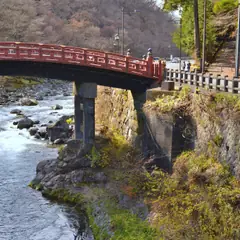
A few steps away rise Tōshōgū Shrine, its golden neighbour, and Rinnōji Temple, whose three Buddhas are those same three mountains; downriver, the Shinkyō Bridge marks the entrance to the sacred precinct.
Cedars that grow as a family
Fūfu-sugi and Oyako-sugi cedars
Summary of this stop
Before the Shinmon gate, two cedars sum up the whole shrine. One, the Fūfu-sugi, is two trunks born of a single root, the “spouses”; opposite, the Oyako-sugi joins three trunks at the base, the “family”. It is the living image of the triad venerated here: Ōnamuchi no Mikoto, the father, is Mount Nantai, 2,486 metres; Tagorihime no Mikoto, his wife, is Mount Nyohō; and Ajisukitakahikone no Mikoto, the son, is Mount Tarō.
From one of those mountains came the town’s name. Futara, the old name of the Nantai, is written with the characters 二荒, and from reading them “nikō” came Nikkō, “sunlight”. Objects found on the summit of the Nantai prove that by the end of the twelfth century, at the start of the Kamakura period, both names already coexisted.
Nikkō’s tradition also keeps a melodrama behind that family of mountains: a court noble, Ariu Chūjō, so fond of falconry that he ended up fleeing the capital with his hawk, his dog and his horse, a river that separated husbands from their wives for ever and a mirror of hell that revealed a past life marked by a terrible arrow shot. How remorse ended up turned into the god of the Nantai is what the narration reveals in front of the cedars.
A shōgun’s calculated sobriety
Haiden
Summary of this stop
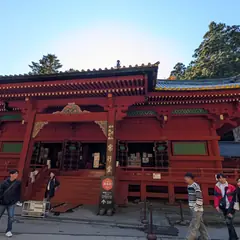
Ahead rises the haiden, the prayer pavilion donated in 1619 by the second Tokugawa shōgun, Hidetada. It is red and black, with sober lines and no carvings or coloured motifs, and inside it hold a guardian samurai and a painted deer, messenger of the kami. That austerity is deliberate: it contrasts on purpose with the polychrome honden hidden behind it and with the opulence of neighbouring Tōshōgū.
The shrine that a monk founded beside the Daiya river got here by a move. According to one version, in 1617, when Tōshōgū was built for Tokugawa Ieyasu, the main shrine was moved to its present site, west of the mausoleum, and its buildings were entirely remade; the Nikkō City Hall, by contrast, places that move in 1645, when the haiden was also rebuilt. Whatever the date, the result is the same: the oldest thing ended up in the innermost corner.
Among the shrine’s swords is the Nenekirimaru, an ōdachi 324.1 centimetres long and some 24 kilos, an Important Cultural Property since 1967, which nobody could ever have wielded. According to Nikkō’s tradition there was no need: the sword leapt out of its scabbard by itself, in the prayer pavilion, to chase a monster of the mountain. What that monster was, and which Nikkō mountain would bear the name of its scream, is heard in front of the haiden.
The lantern the samurai slashed
Bakedōrō
Summary of this stop
Inside the Shinen garden waits the Bakedōrō, the “ghost lantern”: a hexagonal bronze lantern with its upper box for the flame, donated in 1292 by Kanuma Katsutsuna, a powerful samurai of the region. It is an Important Cultural Property and more than three centuries older than the Tokugawa buildings around it, although its presence in this place is recorded only from 1619.
Its body is spattered with more than 70 small sword nicks. Until the end of the Edo period, in 1867, samurai patrolled the precinct at night, and tradition attributes the marks to guards who took the flame for a spectre and attacked it with the katana. It is a traditional tale, not a documented fact, and the name itself has two explanations: sometimes it is said the flame looked like a ghost, other times that its light made objects look double.
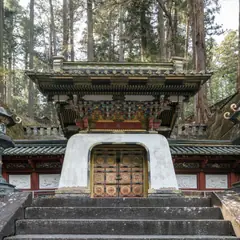
From the garden the honden also peeks out, in yatsumune-zukuri style and built in 1619, surrounded by a lattice wall. It is the oldest building of all the shrines and temples of Nikkō, older than those of Tōshōgū, and yet it is the one that lets itself be seen least: only its side and rear can be properly seen by entering this paid garden. Why the oldest thing in Nikkō goes almost unnoticed is what the narration explains at the lantern.
Praying to eight peaks without climbing them
Futara reisen spring
Summary of this stop
In the same garden, an altar for worship from a distance, with a large rock as the object of veneration, makes it possible to pray to the eight sacred peaks of Nikkō without climbing them. Here the shrine grows to its true scale: the 3,400-hectare precinct takes in summits, the Kegon Falls and the Irohazaka road, and the whole of Mount Nantai is sacred ground. It can be climbed only from 25 April to 11 November, opening each morning at 6 with an ascent offering of 1,000 yen; the rest of the year entry is forbidden from every side. On its summit remains the Okumiya that Shōdō Shōnin founded in 782.
Beside the altar wells up the Futara reisen spring, which brings together two sacred waters. One is the water of Yakushi, which rises in a cave on Mount Kōrei, behind the honden, and is famed for curing eye ailments. The other is the Sake no izumi, the “sake fountain”, which flows beside the Takinoo shrine, a kilometre to the west. The mixture is called the “fountain of youth”, and the faithful drink it and carry it away in bottles, asking for health.
The sake barrels stacked at the shrine entrance have to do with that second spring. Each spring and each autumn, sake brewers from all over Japan come to take a little of its water, and the relation between those barrels and a few drops of spring water is the close of the narration, with the mountains in sight.