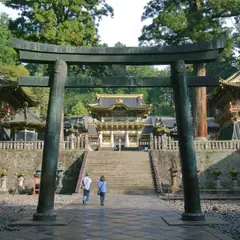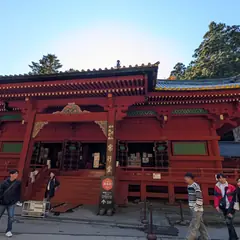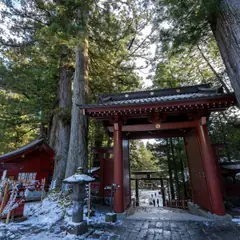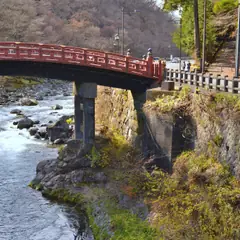
Mausoleum of shōgun Iemitsu
Taiyū-in Mausoleum Audio Guide (Rinnō-ji Taiyū-in)
The third Tokugawa shōgun wished to rest beside his grandfather, but without casting a shadow over him: a black and gold hall among cedars, at the end of a staircase of guarded gates, that turns to face Ieyasu's tomb.
- 45 min of audio
- Tokugawa Buddhist mausoleum
The Taiyū-in is the Buddhist mausoleum of Tokugawa Iemitsu, the third shōgun, who died at Edo Castle in 1651 at the age of 46. By his last wish he was buried at Nikkō, in the Rinnō-ji, and not in Edo like nearly all the shōgun of his line. The main building, of three sections in gongen-zukuri style, was finished in 1653, with his son Ietsuna already in power. Today the precinct holds 22 buildings ranked as National Treasures or Important Cultural Properties and 315 stone and bronze lanterns.
The whole complex obeys an order of modesty. Iemitsu left word that his mausoleum must not surpass that of his grandfather Ieyasu, and the result is a restrained splendour: black and gold where Tōshōgū shines in red, white and gold, towers with less ornament than those of the neighbouring shrine and a honden that does not face south, as custom dictated, but toward his grandfather. Even so, it carries so much gold leaf that it is called the Kinkakuden, “the golden pavilion”.
Highlights
- Niōmon — the first gate, with its two guardians, one mouth open and one closed
- Nitenmon — the largest gate in Nikkō, with a plaque calligraphed by Emperor Go-Mizunoo
- Yashamon — the gate of the peonies, guarded by four coloured yasha
- Haiden — a black and gold hall with 140 golden dragons on the ceiling, every one different
- Kōkamon — the Chinese-style gate behind which Iemitsu rests, closed to the public
The story of the Taiyū-in begins with a death. Tokugawa Iemitsu, third shōgun of the dynasty, died at Edo Castle on 8 June 1651, aged 46. His body passed through the Kan’ei-ji in Edo and continued on to Nikkō, where it was buried in the Rinnō-ji. It was an exception: from Hidetada to Iemochi, the other Tokugawa shōgun rest at the Zōjō-ji or the Kan’ei-ji in the capital. Iemitsu chose to stay close to his grandfather Ieyasu, deified in the neighbouring shrine, in order to go on serving him after death.
That devotion had roots. According to a documented tradition, Iemitsu carried a small amulet pouch, preserved today at the Rinnō-ji, holding papers in which he called himself “second gongen, second shōgun”, wrote that living or dying depended on the Great Gongen and asked to reach seventy in good health. Sickly from childhood, he believed he had been cured by his grandfather’s remedies and, later, by dreams in which the grandfather appeared to him; he had Kanō Tan’yū paint him as he saw him, and some 16 of those dream portraits are known. The same man is credited with a stroke of authority on taking power: gathering the great feudal lords, many older than he, and warning them that anyone unwilling to be treated as a vassal could go home and prepare for war. The idea, it is said, was given to him by the veteran Date Masamune.
The architecture of the Taiyū-in tells the rest. The main building was finished in 1653, only two years after Iemitsu’s death, according to the official information sheets; some popular guidebooks, however, speak of 14 years of construction and of a commission to the monk Tenkai, who died in 1643. After the separation of cults at the start of Meiji, Tōshōgū became a Shinto shrine and this complex stayed on the Buddhist side, as property of the Rinnō-ji, which still holds a service here every month and a major one every 20 April.
The audio guide climbs through the mausoleum in five stops, from the Niōmon to the closed gate of the tomb, with documented narration checked against historical sources that explains why this dazzling place was deliberately kept a step below Ieyasu’s.
That step is best measured beside Tōshōgū Shrine, the grandfather’s tomb, some 300 metres away, and the mausoleum belongs to Rinnōji Temple, the great Buddhist temple of Nikko.
The two Niō of a Buddhist shōgun
Niōmon and omizuya
Summary of this stop
Past a small stone bridge, the Niōmon opens the route with its two guardians: Mishaku, mouth open on the syllable “a”, and Naraen, mouth closed on “un”. They are the first sign that this is a Buddhist temple and not a shrine, a difference fixed when Meiji separated the two cults and left the Taiyū-in in the hands of the Rinnō-ji.
Beside the path appears the omizuya, the granite ablution pavilion donated by the daimyō Nabeshima Katsushige. On its ceiling, a dragon painted by Kanō Yasunobu is reflected in the water of the basin, and for that reason it is called Mizukagami no Ryū, “the dragon of the water mirror”.
The surprise, however, is at ground level. Along the path peek out small dome-shaped stone covers, the ban no soseki, which cap the holes where flagpoles are set during funerals and festivals, a use dating from Ietsuna’s time. Because they recall a turtle’s shell, visitors leave pebbles around them as legs. What that custom has to do with a shōgun’s tomb is what the narration reveals right there.
Lanterns by rank and the emperor’s gate
Stone lanterns and Nitenmon
Summary of this stop
From the lookout beside the path, rows of moss-covered stone lanterns come into view. There are 315 across the precinct, 66 of bronze and 249 of stone, and none stands where it does by chance: they are offerings from the daimyō as proof of loyalty to the shogunate, tiered by rank and wealth. The closer to the mausoleum, the larger and richer, with the metal ones highest; those of the lords of lower rank remained below the lookout, because their position did not allow them to climb further.
Higher up rises the Nitenmon, the largest gate in the whole Nikkōzan precinct. Beneath its curved gable hangs the “Taiyūin” plaque, calligraphed by Emperor Go-Mizunoo, and two of the Four Heavenly Kings stand guard in front. On the rear face wait Fūjin and Raijin, the god of wind and the god of thunder, who arrived from elsewhere at the end of the nineteenth century.
The gate also holds a case of mistaken identity. The official Nikkō information sheets do not agree on the red-skinned heavenly king on the right: some give him as Zōchōten, guardian of the south, and others as Kōmokuten, guardian of the west. And the origin of the weather gods, as the story goes, has to do with the neighbouring shrine. Whom the visitor is really looking at is a question settled by listening before the gate.
The gate of the peonies and its blue demon
Yashamon
Summary of this stop
The path does not climb in a straight line: from the Niōmon to the worship hall it breaks again and again among stone stairways. And along it stand three guardian gates, Niōmon, Nitenmon and Yashamon, each with two or more heavenly warriors, whereas an ordinary temple or shrine makes do with a single gate and two figures. The ascent is designed as a succession of checkpoints.
The Yashamon is the third. Four coloured yasha, one for each cardinal point, keep watch from their niches, and the peonies carved on lintels, plinths and walls, with lions among the flowers, give it its other name: Botanmon, “the gate of the peonies”.
One of the four is blue. He is Umarōga, guardian of the north, with the bow in his left hand and the arrow in his right, and from that arrow, popular belief says, comes the hamaya, the charm against evil that many Japanese buy at New Year. The Taiyū-in offers its own version, the ryūjin hamaya, the arrow of the dragon god. What is engraved on its two faces is told by the narration before the gate.
140 dragons beneath a black and gold ceiling
Ceiling of the 140 dragons
Summary of this stop
Past the Karamon, a small and richly carved gate with white cranes, white dragons and phoenixes, and its fence of carved doves over blue latticework, one reaches the haiden. In front wait three pairs of bronze lanterns, a gift from the three Tokugawa branches of Owari, Kii and Mito, and nearby, the pair sent by the king of Korea in the mid-seventeenth century.
Inside, in the half-light, the ceiling unfolds 140 golden dragons on blue medallions, every one different. The official sheet attributes them to Kanō Tan’yū, official painter of the shogunate from the age of 17, although a popular guidebook divides them between him and his brother Kanō Yasunobu. From the ceiling hangs a golden canopy, a gift from a younger sister of Iemitsu.
Colour is the key. The haiden combines black and gold against the red, white and gold of Tōshōgū, and even the bell tower and the drum tower, of 1653, have less ornament than those of Ieyasu’s shrine. Everything was finished in two years and everything answers the same order from Iemitsu: not to surpass his grandfather. How that restraint reads in a hall that dazzles is what the narration unpicks beneath the dragons.
The dragon gate before a closed tomb
Kōkamon
Summary of this stop
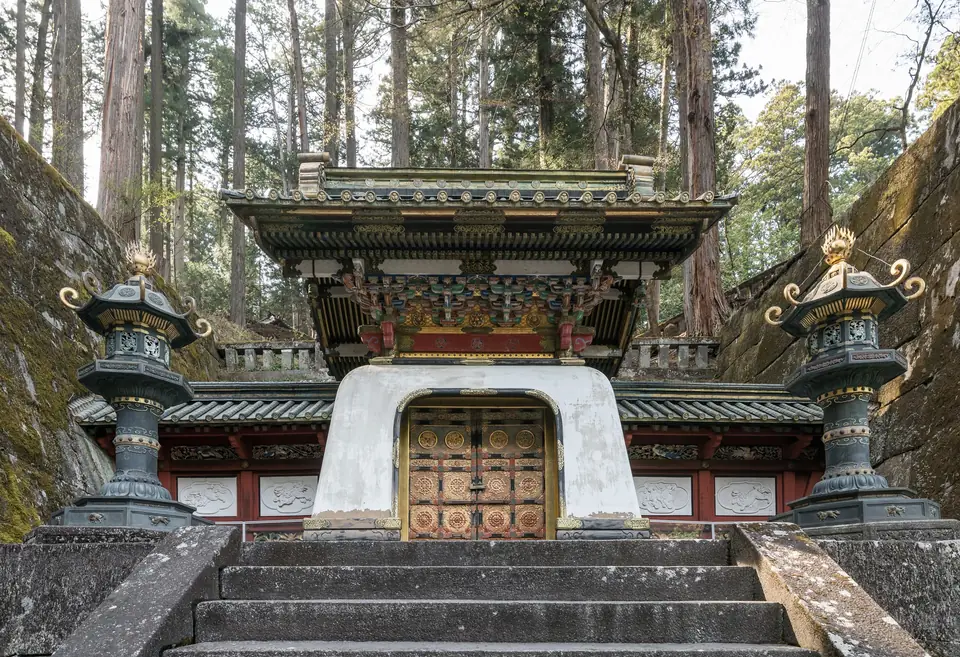
The Kōkamon closes the route: a two-storey gate of Chinese air, in ryūgū style inspired by Ming China, with a white, smooth lower part that stands out amid so much polychrome. Its name was given by the emperor, taken from one of the twelve gates of the imperial palace in Kyoto, and the dragon style was probably chosen because Iemitsu was born in a year of the dragon. Behind lies the shōgun, in a tomb that cannot be visited. Around it grow koyamaki, Japanese umbrella pines planted by his son Ietsuna.
From the gate the honden, the gold-leaf Kinkakuden, is seen head-on, and its final gesture makes sense: it does not face south, the auspicious orientation, but toward Tōshōgū where Ieyasu rests, while the Buddhist image inside does face south. The English versions of the official sheets say northeast; the Japanese one of one of them, north.
At Iemitsu’s death, several of his men, such as Hotta Masamori and Abe Shigetsugu, took their own lives to follow him. His servant Kaji Sadayoshi was not permitted to, and was named guardian of the tomb. What he did during the following 47 years, until his death in 1698 at 87, is the close of the narration.