Sacred gorge of Fudō
Kanmangafuchi Abyss Audio Guide
A river that, they say, recites a mantra, and a row of stone jizō in red caps that nobody manages to count the same way twice. The same water that gave the place its name carried off half the grounds in one night in 1902.
- 40 min of audio
- Volcanic gorge and jizō
The Kanmangafuchi Abyss is a short stretch of the Daiya river, a few hundred metres long, carved in the lava that Mount Nantai spewed out some 7,000 years ago. In 1654 the monk Kōkai, Tenkai's chief disciple, made it a sacred site of Fudō Myōō with the Jiun-ji temple, the Reihikaku pavilion and a 2-metre stone statue, and the place filled with pilgrims and strollers. Matsuo Bashō passed through in 1689, and since 2014 the grounds have been protected as a national place of scenic beauty.
The name is a sacred onomatopoeia. The murmur of the Daiya against the rocks seemed to recite the mantra of Fudō, and the place took its last word, “kanman”. Downstream from the temple, some 70 seated stone jizō facing the river, with moss, bibs and red caps, form the row of the Bake Jizō: as early as 1881 it was said that no two counts ever came out the same, not even by sticking a slip of paper on each figure.
Highlights
- Jiun-ji — the temple that gives its name to a mantra turned into landscape
- Reihikaku pavilion — the fire altar facing a Fudō that no longer exists
- Kanman Sanskrit rock — the thrown brush that legend attributes to Kōbō Daishi
- Bake Jizō — some 70 red-capped jizō that nobody can count the same way
- Daiya lava bed — the gorge that the flood of 1902 left half undone
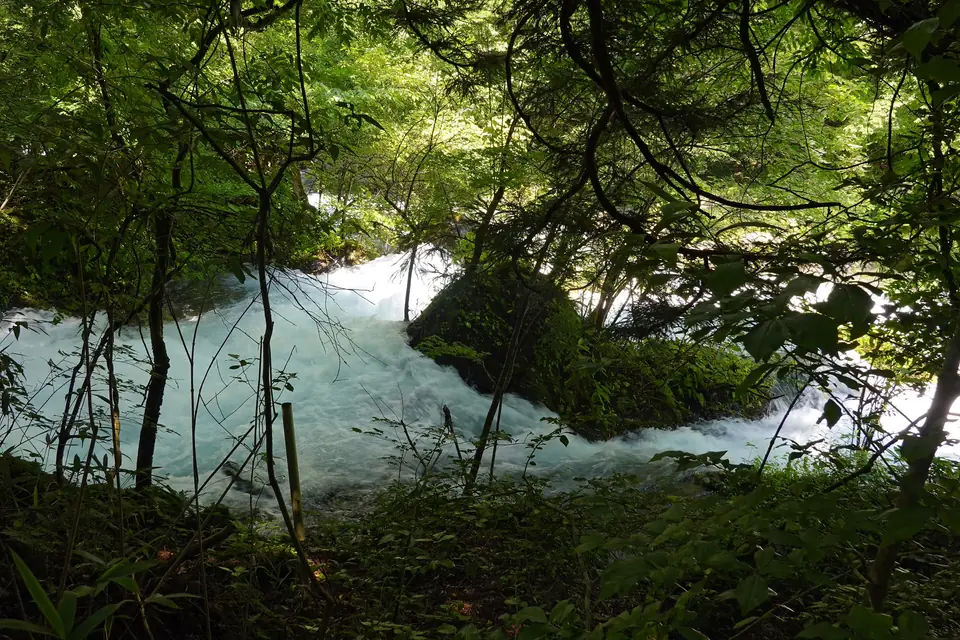
The story of the Kanmangafuchi Abyss begins in a volcano. Some 7,000 years ago, an eruption of Mount Nantai covered the valley in lava, and the Daiya river gradually forced its way through it until it carved a short gorge, a few hundred metres long, its bed strewn with large black blocks of andesite. Against those stones breaks a current whose murmur, according to tradition, sounds like voices reciting the mantra of Fudō Myōō, the king of wisdom who with his sword of flames cuts off worldly desires and protects ascetics.
That voice of the water decided the fate of the place. In 1654, the monk Kōkai, Tenkai’s chief disciple, laid out the bank with the Jiun-ji temple, the Reihikaku pavilion and a 2-metre stone statue of Fudō. The site filled with pilgrims and strollers, and in 1689 Matsuo Bashō visited it during the journey of “Oku no Hosomichi”. Since ancient times it has been held a place where Fudō appears, and it is said that many who have come here have dreamed of him afterwards.
What to see at Kanmangafuchi goes beyond a walk beside the river. The bank holds a fire altar that faces an empty rock, almost invisible Sanskrit syllables with a legend of a flying brush, and a row of stone jizō that already intrigued Victorian travellers. It also holds the scars of 28 September 1902, when the great flood of the Ashio typhoon razed temple, pavilion and statue, and left gaps in the row that have never been filled again.
The audio guide covers the path in four stops, from the gate of Jiun-ji to the end of the row of jizō, with documented narration checked against historical sources that explains why the noise of the river is, at once, the prayer that gave the place its name and the force that carried off half the grounds.
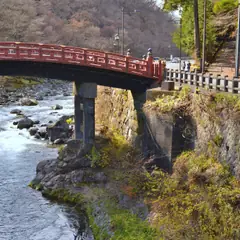
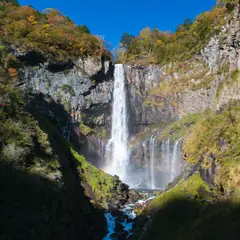
Downriver, the Daiya passes beneath the Shinkyō Bridge, and up the mountain the same lava of the Nantai dammed the lake that now empties over the Kegon Falls.
A name that imitates the murmur of water
Jiunji Temple
Summary of this stop
The visit starts before the gate of the Jiun-ji temple, where a stele carries a tanka by Emperor Taishō: a night walk on the banks of the Daiya, sleeves wet from the spray, beneath a cool moon. The poem anticipates what defines the place, because here the protagonist is the sound of the river. Its murmur seemed to recite the mantra of Fudō Myōō, and the place took the last word of the mantra, “kanman”.
Even the spelling is a game of sounds. The kanji with which the name is written, 憾満 or 含満, are ateji, characters chosen only for how they sound. The reading “Ganmangafuchi”, which comes from 含満, is very common, and under that name, “ガンマンガ淵”, the Jiun-ji grounds were protected on 18 March 2014 as a national place of scenic beauty, among the landscapes of Bashō’s “Oku no Hosomichi”. By the origin of the name, however, the correct form is “Kanmangafuchi”.
That almost everyone pronounces differently a name born to imitate a specific sound is the first irony of the walk. What the mantra of Fudō has to do with the water striking the rocks is best understood by listening to the narration beside the gate.
The fire altar facing an empty rock
Reihikaku pavilion
Summary of this stop
Over the gorge leans the Reihikaku, a small pavilion that shelters a stone altar for the goma, the fire rite, with its small cavity for the flames. Here prayers written on paper or on tablets were burned, facing the statue of Fudō that stood on a great rock on the other bank, and here Kōkai shut himself away in 1654 to pray for the peace of the country. The present pavilion was rebuilt in 1971, and the white-walled main hall of Jiun-ji in 1973: the original buildings had been carried off by the flood of 1902, along with the 2-metre Fudō. The altar still faces an empty rock.
On the rock opposite, inside a large hollow, the Sanskrit syllables “kanman” are engraved, with a groove so shallow it is hard to make out. Who engraved them is a matter of debate. The Rinnō-ji sign takes them as carved in the seventeenth century by a monk contemporary with Kōkai, and the local bibliography speaks of the calligraphy of the monk Sanjun engraved on Kōkai’s orders; the official Nikko tourism website, by contrast, attributes them to Kōbō Daishi.
That last version is the legend of the “Kōbō no nagefude”, the thrown brush: the saint would have written the syllables by hurling his brush against the stone. In 1881 the local guides were already telling it that way to travellers, because it seemed impossible that anyone had crossed the torrent to carve the rock. How a resemblance between two monks’ names could make one swallow up the other is the thread of this stop.
The row of jizō nobody can count
Bake Jizo
Summary of this stop
Downriver, seated facing the water and the edge of the Nikko Botanical Garden, wait some 70 stone jizō in a row, with moss, bibs and red caps, worn faces and heads tilted at different angles; some are reduced to a pair of stones. They are called Bake Jizō, Narabi Jizō or Hyaku Jizō. The row was made by Tenkai’s disciples to pray for the repose of the successive monks of Nikkōzan, and came to have some 100 figures. According to tradition, each of the hundred disciples donated one: one disciple, one jizō.
The exact figure will not be pinned down. Sources speak of about 70, one of 74, and the name “bake” has two explanations: that because they look so alike the counts never come out the same, or that it derives from “bakku”, the “removing of suffering” of the Buddhist expression bakku yoraku. The Rinnō-ji sign dates the shifting count to after the flood of 1902, but in 1881 it was already said that no two counts ever came out the same, not even by sticking a slip of paper on each figure so as not to skip any.
English travellers, who took them for images of Amida and spoke of several hundred, compared the counting with the superstition of the Druidic stone circles of England. Felice Beato photographed the row in the second half of the nineteenth century, and the hand-coloured travel albums sold it under titles such as “100 Stone Images” or “100 Buddhas”. Why that mania for counting has almost a century and a half of history is told by the narration before the first figures.
The flood of 1902 and the bodiless jizō
Daiya lava bed
Summary of this stop
At the end of the row, facing the river, the landscape explains its own history: black blocks of andesite and lava banks against which the current breaks, the same lava the Nantai left here some 7,000 years ago. On 28 September 1902, the great flood caused by the Ashio typhoon razed Jiun-ji, the Reihikaku and the Fudō on the other bank, and damaged or carried off a good part of the jizō. In the Daiya basin there were 156 dead and 63 missing.
The row was headed by two Oya Jizō, the large jizō, and the flood carried one of them away. Its head turned up in the riverbed and is today kept at the Jōkō-ji temple in Nikko as “the venerable head”, registered as a cultural property of the city. The gaps in the row are, in large part, the trace of that night.
There is another jizō of Kanmangafuchi that, according to tradition, is not here either. A flood earlier than that of 1902 would have dragged it some 10 kilometres downriver, to Imaichi, where a stonecutter took it for a rock and drove a wedge into it: red blood welled from the stone. It is the Oiwake Jizō, 2.9 metres tall and weighing some 8 tonnes, which still shows the wedge mark at its crossroads. Where it faces, and why, is what closes the route.