Sacred bridge of Nikko
Shinkyō Bridge Audio Guide
A vermilion arch over the rapids of the Daiya that for centuries only shoguns, imperial envoys and mountain ascetics stepped on. Today it can be crossed with a ticket, but never to the other bank: the walk ends with an about-turn.
- 20 min of audio
- Sacred cantilever bridge
The Shinkyō is the gate to Nikko's sacred precinct, a World Heritage Site since 1999. It already appears in travel accounts of 1486 and 1509 as a cantilever bridge without piers, and in 1636, with the great rebuilding of the Tōshō-gū, it took the form it keeps: some 45,000 carpenter-days and 136,000 labourer-days for a crossing reserved for rites, the shogun and the emperor's envoys. Ordinary people crossed by a temporary bridge downstream, today's Nikkō-bashi.
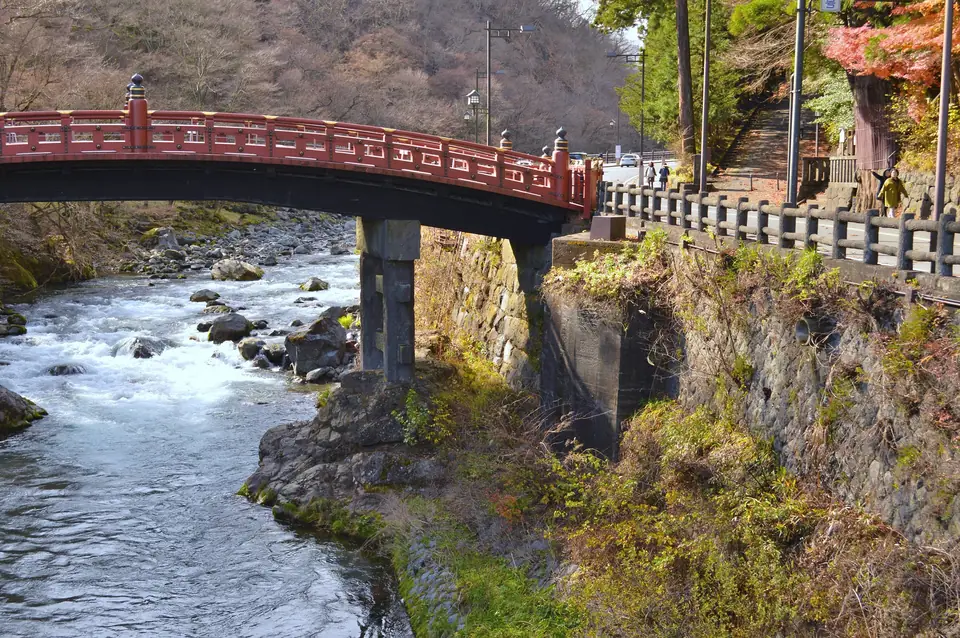
Its secret lies beneath the deck. The main beams, the chinoki, come out embedded in the rock of each bank, rise at an angle and rest their ends on stone piers: it is the only structure of this type among the eight wooden bridges designated Important Cultural Properties of Japan. That ingenuity made it lighter and, at the same time, left it at the mercy of the river, which in September 1902 carried it away entire.
Highlights
- Chinoki — cantilever beams embedded in the banks, a structure unique in Japan
- Giboshi finials — nine of bronze, one a survivor of the flood of 1902
- Vermilion arch — painted in 1792 after a century and a half of bare wood
- Legend of Shōdō — the god who stretched two serpents across the river in 766
- Nikkō-bashi — the commoners' bridge, from where the Shinkyō is best seen
The story of the Shinkyō Bridge begins, according to a documented tradition, in the spring of 766, when the monk Shōdō wished to climb Mount Nantai and the rapids of the Daiya river blocked his way at exactly this spot. The papers come much later: the monk Dōkō, who passed through Nikko in 1486, and the poet Sōchō, in 1509, already describe a hanebashi, a cantilever bridge without piers, spanning the gorge that separates the town from the sacred precinct.
In 1636, with the great rebuilding of the Tōshō-gū, the Tokugawa shogunate remade the bridge with the form and technique it keeps today. The work cost some 6,000 ryō and its ashlar piers applied a method newly introduced on the Sanjō bridge in Kyoto. From then on the Shinkyō was forbidden: only rites, the shogun and imperial envoys stepped on it. For a century and a half it was bare wood; paint came in 1792, with the railings in Bengal-red lacquer, the deck in earth vermilion and the underside in black lacquer.
The story of the Shinkyō is also that of a river that will not be tamed. The typhoon of 1902 swept it away, reconstruction dragged on from 1904 to 1907, between 1950 and 1956 it was dismantled completely to replace almost all its wood, and the great restoration of 1997 to 2005 cost some 800 million yen. That is why the date of 1636 that usually accompanies it describes its design and building system, not the wood seen today. By the official figure, it is 28 metres long and rises 10.6 metres above the water, with a deck that draws an arc of about 26 degrees; other measurements, including the shrine’s own, give slightly less length.
The audio guide covers the bridge in three stops, from the pavement of the Nikkō-bashi to the turning point of the deck, with documented narration checked against historical sources on a crossing that belonged to gods, shoguns and ascetics, and on the river that still roars below as the true master of the place.
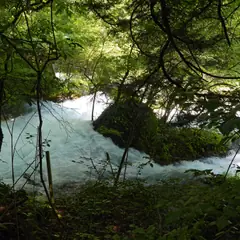
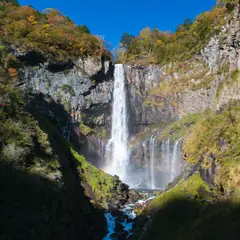
From the bridge starts the road to Futarasan Shrine; upriver, the Daiya runs through the Kanmangafuchi Abyss, and its water comes down from Lake Chūzenji, the same lake that empties over the Kegon Falls.
The forbidden bridge seen from everyone’s bridge
Nikkō-bashi
Summary of this stop
The first glimpse of the Shinkyō comes from the side, from the pavement of the Nikkō-bashi, the bridge that carries the traffic and heir to the temporary crossing used by ordinary people when the sacred one was closed to them. From here is seen what the deck hides: the main beams lacquered black, the chinoki, come out of each bank under small canopies, rise at an angle and rest on ashlar piers shaped like a torii.
Those beams are the heart of the Shinkyō’s architecture and the oldest thing that survives in it. When the bridge was dismantled completely between 1950 and 1956, all the wood was replaced except the chinoki, which were not replaced either in the restoration that ended in 2005. No other of the eight wooden bridges designated Important Cultural Properties of Japan is held up this way.
This same viewpoint was, during the nineteenth century, the place of the foreigners who could not cross. The yamabushi of Nikko, mountain ascetics, crossed on fixed dates; Victorian travellers stood and looked. In 1883 Arthur Crow heard that it was “closed for repairs” and suspected the excuse was permanent. What Eliza Scidmore wrote a few years later about who could step on it completes the scene, and the narration tells it with the bridge in front.
Nine bronze finials and a flood
Giboshi finials of the railing
Summary of this stop
Past the ticket booth, at the bridge entrance, the vermilion railing shows its giboshi finials, bronze bulbs on the main posts. There are nine, although the planned posts are ten. Counting them is reading in metal the night of 28 September 1902, when the Ashio typhoon flooded the Daiya and swept away the Shinkyō, which was under repair, along with the Daiya-bashi bridge and more than a hundred houses. In Tochigi Prefecture 156 people died.
One of the giboshi withstood the flood and is still from the Kan’ei era; the rest were cast by Ōta Gorōhei, of Kanuma, for the reconstruction with the traditional technique that began in 1904. The date of 1904 is the one usually given, but by then the abutments were barely done: the works ended on 28 April 1907, the inauguration was on 6 August of that year and the bill came to 37,951 yen. The gap has its own explanation: a finial was removed in the Shōwa era because of the tram tracks that ran through Nikko and is now displayed in the treasure museum of the Futarasan-jinja. Whether that piece is the survivor of 1902 is something the sources do not clarify.
Upriver, some fifteen metres away, the current covers the Kōzaishi, the “stone of the high seat”. According to local tradition, it appeared and disappeared with each flood and stood out above the water until the flood of 1902; since then it is said to have remained submerged. What relation is attributed to it with the exact spot where the bridge was stretched is the twist of this stop.
An about-turn on the serpent’s back
Vermilion deck of the bridge
Summary of this stop
Since 1973 anyone can step on the deck, an opening tied to the 1,200th anniversary of the enthronement of the god on the summit of the Nantai. An entrance fee of 300 yen is charged, and the walk ends before the other bank: on the vermilion curve, with the clear rapids below, it is time to turn around. The forbidden bridge is today a living rite. Hashihime Myōjin, goddess of bonds of love, is venerated on it; couples married at the Futarasan-jinja make their first crossing here, and since 2020 the “bell of good bonds” has hung on the bridge.
Every December, priests and miko of the shrine sweep the soot from the railings with bamboo brooms and sasa leaves some three metres long, in preparation for New Year. To the north, on the bank, the small Jinjaō-dō shrine is dedicated to Jinja Daiō, the god of the legend that explains why the bridge exists.
That tradition holds that, before the rapids, Shōdō knelt to pray and on the north bank appeared a being over three metres tall with two coiled serpents in his hand, one red and one blue. Hence the bridge’s old name, Yamasuge no jabashi, “the serpent bridge of yamasuge grass”. What those serpents did over the river, and what the monk saw when he turned around, is heard right at the point where the deck forces a return.