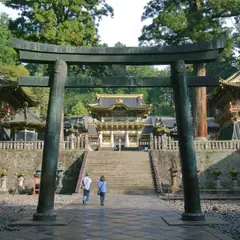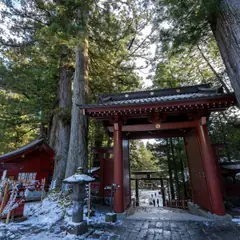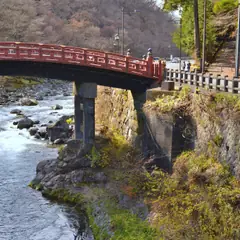
Mother Buddhist temple of Nikko
Rinnōji Temple Audio Guide (Nikkōzan Rinnōji)
Nikko's great vermilion hall was stripped, torn from its site and nearly demolished by decree. It still stands, and inside wait three golden Buddhas over seven metres tall who are, at the same time, the three sacred mountains surrounding the town.
- 45 min of audio
- Buddhist wooden architecture
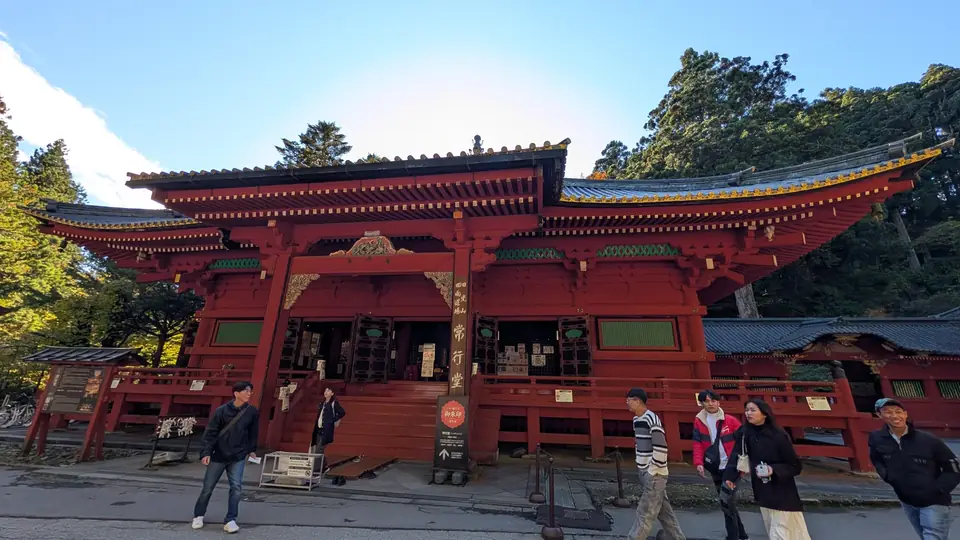
Rinnōji Temple is the mother Buddhist temple of Nikko and the heir to the Shihonryūji, the first temple on the mountain, which the monk Shōdō Shōnin founded in 766 beside the river. Its heart is the Sanbutsudō, the Hall of the Three Buddhas, whose reconstruction was paid for by Tokugawa Iemitsu and finished in the mid-seventeenth century: 33 metres wide, 22 deep and 26 high, the largest wooden building in eastern Japan. Iemitsu wanted the largest and most magnificent main hall in the country; lack of resources prevented it, but it still turned out the biggest east of Kyoto.
This giant is not where it was born. It first stood on the site now occupied by Tōshōgū, was moved in 1617 and, with the 1871 separation of Shinto and Buddhism, the Meiji government ordered it moved and demolished. Kido Takayoshi's intervention halted the demolition and the hall was relocated intact. That is why the buildings of Rinnōji remain scattered across the mountain, and even today two of them have no settled ownership between the temple and Tōshōgū.
Highlights
- Sanbutsudō — the largest wooden building in eastern Japan, lacquered in vermilion
- Three golden Buddhas — Senju Kannon, Amida and Batō Kannon, over seven metres tall
- Kuromon — the Black Gate with imperial chrysanthemums that survived the fire of 1871
- Kongōzakura — the cherry tree over 400 years old to which an abbot recited sutras every morning
- Sōrintō — the bronze column of about 13 metres raised by the monk Tenkai
The story of Rinnōji Temple begins in 766, when the monk Shōdō Shōnin founded the Shihonryūji, the first temple of Nikkōzan, beside the river and far from the spot the great hall occupies today. In 848 the monk Ennin founded the Sanbutsudō, inspired by the one at Enryakuji in Kyoto, and made it the main hall of the whole mountain complex. In the Muromachi period Nikkōzan came to hold domains of 180,000 koku and some 500 monks’ residences, until in 1590 Toyotomi Hideyoshi confiscated its lands for having sided with the Hōjō.
The mountain was reborn with the monk Tenkai and the Tokugawa. In 1655 the retired emperor Go-Mizunoo granted the name Rinnōji to the temple, which until then had been called Mangan-ji, and his son, Prince Shuchō, entered as abbot. From then until the end of the shogunate, 14 ordained imperial princes governed the temple. Some have seen in that prince residing in the east a political insurance for the Tokugawa against the court in the west; it is a suggestive hypothesis, not a documented purpose.
The Meiji era turned everything around. In 1869 the new government withdrew the name Rinnōji, in 1871 came the order to separate gods and buddhas, and the temple did not recover its name until 1883, as the sole Buddhist temple of Nikko. From 2007 the Sanbutsudō spent more than a decade in full restoration works, inside and out; sources do not agree on the exact year they finished, but the hall emerged from them in a brilliant vermilion.
What to see at Rinnōji runs from a surviving gate to a miraculous cherry tree, from a pagoda spire without a pagoda to three Buddhas who are mountains. The audio guide covers it in four stops, with documented narration checked against historical sources, and explains how a gigantic temple survived being stripped, moved and nearly demolished.
Its neighbours complete the story: Tōshōgū Shrine, Ieyasu’s mausoleum; Futarasan Shrine, which venerates the same three mountains as gods; and the Taiyū-in Mausoleum, Iemitsu’s Buddhist tomb.
Imperial chrysanthemums on the Black Gate
Rinnōji Kuromon
Summary of this stop
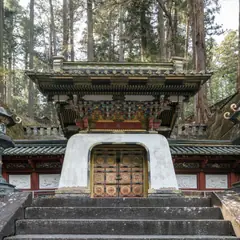
The main access to the precinct is the Kuromon, a gate lacquered black with imperial chrysanthemums carved into the wood. That flower, emblem of the imperial house, betrays its origin: the Kuromon was not born as the entrance to a temple, but as the gate of the residence of the monzeki, the imperial abbot, the palace from which the princes who led Rinnōji since 1655 governed.
In 1871 a fire razed that residence. Only two buildings were saved, the Kuromon and the nearby Gohōtendō, and in 1877 the Sanbutsudō was moved to the empty site. Thus the gate of a burned palace became the main entrance of the whole temple.
The small Gohōtendō, which was the private oratory of the prince abbot, was raised for three gods very popular in Japan: Bishamonten, Daikokuten and Benzaiten. According to the temple’s tradition, they were the closest faces of the three Buddhas of the great neighbouring hall. Today Fudō Myōō and Senju Kannon are venerated in it, and which Buddhas corresponded to each of those gods of fortune is what the narration reveals in front of the gate.
The hall the Meiji government wanted to demolish
Kongōzakura
Summary of this stop
Before the vermilion façade of the Sanbutsudō nothing betrays that this building was an exile. It stood first where Tōshōgū rises today; in 1617, when the mausoleum was created, it was moved near the present office of Futarasan Shrine. And with the 1871 separation of Shinto and Buddhism it was ordered moved and demolished. Kido Takayoshi intervened to halt the demolition and the hall was relocated intact. Sources differ on the year it reached its present site: 1871 is that of the order, 1877 that of the actual move.
That wound explains the map of the mountain. The border between Tōshōgū, Futarasan and Rinnōji has existed only since 1871, which is why the temple’s buildings appear scattered across Nikko, and even today the Kyōzō and the Yakushidō have no settled ownership between Tōshōgū and Rinnōji.
In front of the hall grows the tender counterpoint of this story: the Kongōzakura, a cherry tree over 400 years old that the abbot Hikosaka Jinkō transplanted here in 1881. Fearing it would die, he recited sutras to it every morning. The tree sprouted again with four new trunks, blooms white between late April and early May and is now a Natural Monument. Where its name comes from is told beneath its branches.
Tenkai’s bronze column
Sōrintō
Summary of this stop
Between the Sanbutsudō and the hall of the fire ceremonies stands the Sōrintō, a bronze column of about 13 metres that imitates a pagoda finial and holds sutras inside. It was raised by the monk Tenkai, the man who brought a declining mountain back to life after the confiscation of 1590, inspired by the six that Saichō erected across Japan. Its nine rings represent five buddhas and four bodhisattvas, and its mission was to protect the east of the country.
Next to it is the Daigomadō, the goma hall built in 1998. In it is a closed cabinet that holds the Chinjō Yasha, a form of Bishamonten that protects the country and turns misfortune into fortune. It is one of the hidden buddhas of Rinnōji and, according to the temple’s tradition, is shown only once every nine years, in the year that nine-star astrology calls “the five yellow star in the central palace”.
The last opening was in February 2023, and it did not go as planned. What happened on the day of Setsubun, the festival that drives out demons, and why the temple had to apologise publicly is the anecdote that closes this stop.
Three seven-metre Buddhas, three mountains
Three golden Buddhas of the Sanbutsudō
Summary of this stop
In the inner sanctuary of the Sanbutsudō wait three golden statues: Senju Kannon, the thousand-armed one, on the right; Amida in the centre; and Batō Kannon, horse-headed and wrathful, on the left. With pedestal and halo they measure 703.6, 756.3 and 744.7 centimetres. And, despite their size, they are not designated as cultural property, because it is not known when or how they were made.
Their meaning goes beyond the hall. In the Kamakura period the equivalence of three mountains, three buddhas and three shrines took hold in Nikko: Mount Nantai is Senju Kannon, the Nyohō is Amida and the Tarō is Batō Kannon. The golden figures are, at the same time, the peaks surrounding the town.
This same hall hosts every 2 April the Gōhan-shiki, the “forced rice ceremony”, a documented tradition preserved only at Rinnōji. Monks dressed as yamabushi plant before each participant a bowl of heaped rice and shout at them to eat; that is why it is also called Nikkō-zeme, the torment of Nikko. In the Edo period great daimyo went through it, and the scene was so comic that it ended up turned into a kyōgen piece. What luck is promised by enduring the torment is the closing note of the narration before the three Buddhas.