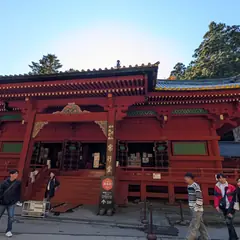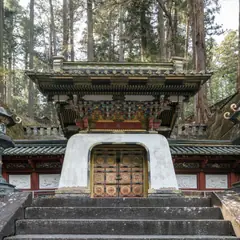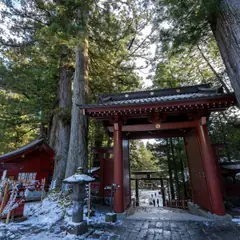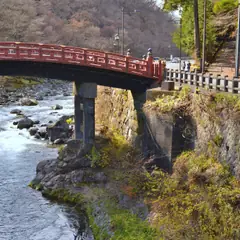
Mausoleum of shogun Ieyasu
Tōshōgū Shrine Audio Guide (Nikkō Tōshōgū)
Ieyasu asked for a small shrine on the mountain; his grandson raised 55 buildings of gold, lacquer and more than five thousand carvings in the middle of a cedar forest. His tomb waits at the top of the stairs, though another tomb claims the same bones.
- 90 min of audio
- Edo-period heritage
Tōshōgū Shrine is where Tokugawa Ieyasu, the first Tokugawa shogun, was made protector god of eastern Japan. He died in 1616 leaving word that he be venerated in a small shrine at Nikkō, and in 1617 his remains arrived here from Kunōzan. Almost everything seen today is something else: the great rebuilding of 1636 ordered by his grandson Iemitsu, 55 buildings raised in a year and five months at a cost of 568,000 ryō of gold, which in 1645 received from the imperial court the rank of gū.
Amid so much gold, the shrine's most famous piece is small and made of wood. The three monkeys who see no evil, speak no evil and hear no evil are just one panel in a series of eight telling a human life, carved on the stable of the sacred horse, the only unpainted building in the complex. A cat barely 15 by 20 centimetres sleeps above a corridor, and under an eave elephants were carved from drawings by a painter who had never seen one.
Highlights
- Great stone torii — 15 blocks brought from Kyūshū and donated in 1618
- Shinkyūsha — the three wise monkeys, one panel among eight on human life
- Honjidō — the ceiling dragon that roars when two wooden clappers sound beneath its head
- Yōmeimon — 508 carvings, 240,000 sheets of gold leaf and a pillar carved upside down against evil
- Okumiya — the 1683 bronze pagoda over Ieyasu's tomb, among the cedars
The story of Tōshōgū Shrine begins with a modest will. Tokugawa Ieyasu died in 1616 at Sunpu and left word that his body be buried at Kunōzan and that, once the first anniversary had passed, a small shrine be raised on Mount Nikkō to venerate him as guardian god of the eight Kantō provinces. In 1617 his remains arrived at Nikkō and, on the 17th day of the fourth month, the anniversary of his death, his son, the shogun Hidetada, presided over the installation of the new god in a shrine then called Tōshōsha.
What came next was anything but modest. In 1636 the third shogun, Iemitsu, Ieyasu’s grandson, ordered everything rebuilt: 55 buildings, the Yōmeimon gate included, raised in just a year and five months under the commissioner Akimoto Yasutomo and the master carpenter Kōra Munehiro, at a cost of 568,000 ryō of gold, 100 kanme of silver and 1,000 koku of rice. The result adds up to 5,173 carvings. In 1645 the imperial court granted it the title of gū, and the Tōshōsha became the Tōshōgū, protector god of the whole country.
The story of Tōshōgū is also that of a showcase of power. The Korean Joseon embassy that visited Edo was taken to pray here, the Dutch trading post at Dejima donated a lantern that still stands in the grounds, and the shrine is a crossing point for legends that never fade, such as the one that makes the monk Tenkai, the adviser who directed the deification of Ieyasu, the traitor Akechi Mitsuhide hidden beneath a habit. No document of the time links the two men, and the most repeated clue has a twist of its own.
The audio guide climbs through the grounds in six stops, from the great stone torii to the shogun’s tomb high in the forest, with documented narration checked against historical sources on the architecture of Tōshōgū and on a grandson determined to turn his grandfather into a god.
A few steps away wait the Taiyū-in Mausoleum, the grandson’s tomb, and Futarasan Shrine, the oldest in Nikkō; and Rinnōji Temple holds the other half of the story, that of the Buddhas whom the Meiji separation pulled apart from the kami.
A Kyūshū torii and a hanging pagoda
Ishidorii
Summary of this stop
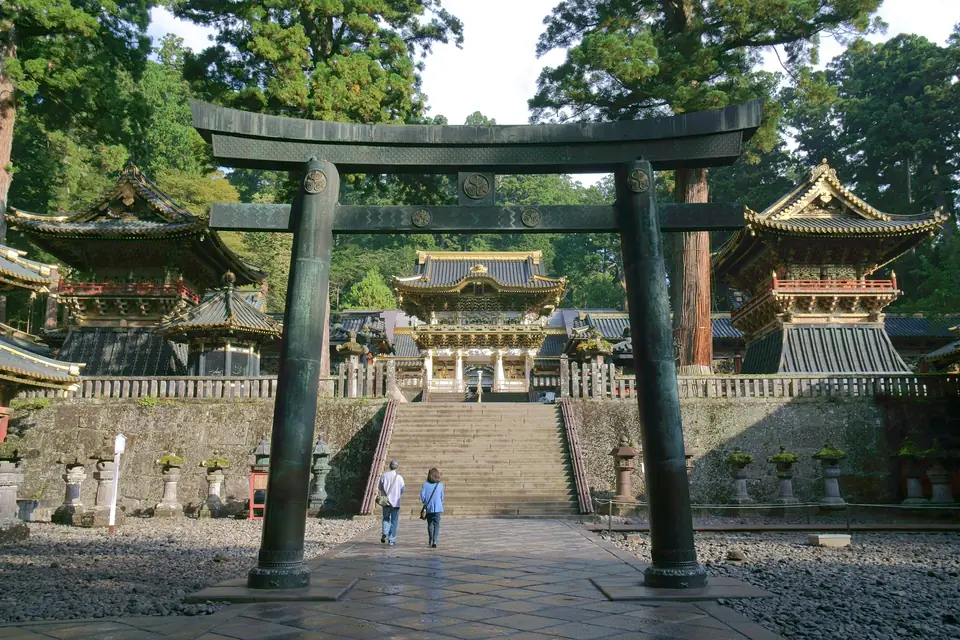
The route starts beneath the great stone torii, 9.2 metres high and 13.2 wide, made of 15 blocks brought from Kyūshū and donated in 1618 by Kuroda Nagamasa, lord of Fukuoka. It was the largest of its time. It is the first sign of the distance between the small shrine Ieyasu asked for and what his grandson ended up building two decades later.
Beside it rises the five-storey pagoda, donated in 1650 by the daimyo Sakai Tadakatsu. It burned in 1815 and was rebuilt in 1818, and inside it hides an engineering device: the central pillar does not rest on the ground but hangs from the fourth floor and stays 10 centimetres above the base, as a counterweight against wind and earthquakes.
What that difference between Ieyasu’s will and Iemitsu’s work tells is the first key to reading the whole shrine, and the narration sets it out right there, before passing through the torii.
The three monkeys are just one panel
Shinkyūsha
Summary of this stop
The stable of the sacred horse, the Shinkyūsha, is the only unpainted wooden building at Tōshōgū. Eight monkey panels run over its lintel, because the monkey was held to be a protector of horses, and together they narrate a human life from beginning to end. The three monkeys who see no evil, speak no evil and hear no evil, perhaps the most reproduced image of Japan, are only the second of those eight panels.
Its latest repainting has not been free of dispute either. In the 2017 restoration the monkeys ended up with bigger eyes than in any earlier photograph, the public criticised it, and some specialists called for that depiction to be reviewed in the next intervention.
Opposite, under the eave of the Kamijinko storehouse, appear elephants carved from a drawing by Kanō Tan’yū, who had never seen one: Japan had no elephants and the people of Edo did not see a living one until 1729. What gives that carving away is easier to see when the narration compares it, on the spot, with the real animal.
The dragon that roars after the fire
Honjidō
Summary of this stop
Behind the shrine’s god there was a Buddha. In 1617 there was a dispute over the rite to deify Ieyasu, Yoshida Shintō against Sannō Shintō, and the Sannō Ichijitsu Shintō defended by the monk Tenkai prevailed: Ieyasu was venerated as Tōshō Daigongen, with the Buddha Yakushi as his original Buddhist form. The Honjidō, or Yakushidō, is the hall of that Buddha, and its ownership is still disputed between Tōshōgū and the neighbouring Rinnōji temple since the Meiji-era separation of Shinto and Buddhism.
On 15 March 1961 the hall burned down completely through carelessness with an electric heater, and with it was lost the ceiling dragon painted by Kanō Yasunobu. The one seen today was painted afterwards by Katayama Nanpū: about 6 by 15 metres across 34 boards of hinoki cypress.
A documented ritual is still alive in the hall. A monk stands right beneath the dragon’s head and strikes two wooden clappers; the clack rebounds and vibrates for several seconds, like a roar, whereas away from that spot the same blow sounds dry. That is why it is called Naki-ryū, the crying dragon, and why the echo returned with the new painter is what the narration tells under the ceiling.
508 carvings and an upside-down pillar
Yōmeimon
Summary of this stop
The Yōmeimon is the gate where the day slips away: it is called Higurashi-no-mon because it concentrates 508 of the shrine’s 5,173 carvings in about 7 metres of width and 11 of height. Chinese sages, immortals, children playing, dragons and kirin cover a two-storey gate in white, gold and polychrome, with the Tōshō Daigongen plaque calligraphed by Emperor Go-Mizunoo. On the railing of the upper floor, a panel shows the boy Sima Guang breaking a jar to save a drowning friend.
Its gold is recent. The restoration began on 8 July 2013 and ended in 2017, with about 240,000 sheets of gold leaf 10.9 centimetres on a side and gilded fittings made with the old technique of mercury amalgam evaporated in fire, not modern electroplating. That same year mould appeared on the shell-white of the gate, which was repaired again between December 2021 and April 2022.
Of its 12 pillars, only one, the second from the west on the rear face, has its spirals carved upside down: it is the sakabashira, the inverted pillar against evil, which leaves the gate imperfect on purpose. A popular belief adds that the Yōmeimon was placed so that the Pole Star would shine right over its centre, and that from it the shrine faces north. What links that motionless star with Edo Castle and Mount Fuji is what the narration unpicks in front of the gate.
The ambassadors’ gate and the cat’s
Sleeping cat of the east corridor
Summary of this stop
Before the main shrine rises the Karamon, a gate painted white with gofun and flanked by openwork walls that close off the inner precinct. Here Tōshōgū reads as a diplomatic showcase: around 1636 the Korean embassy that visited Edo was taken to pray at Nikkō at the request of the Sō clan of Tsushima, and from 1646 the imperial court sent an emissary every year with offerings for the annual festival. Among the lanterns of the courtyard, beside the bell tower and the drum tower, stands the rotating bronze lantern donated in 1643 by the Dutch trading post at Dejima.
Next to such pomp, the most beloved piece in the precinct measures barely 15 by 20 centimetres. It is the sleeping cat, the Nemuri-neko, carved among peonies on the east corridor, before the Sakashitamon gate that leads to the tomb; on the opposite face of the same piece are sparrows among bamboo.
Tradition attributes it to Hidari Jingorō, but the piece is by an unknown author and since 1926 several scholars have doubted that attribution: the dates do not fit, and it is not even clear that Hidari Jingorō was a specific person and not a generic name for a master carver. Why a sleeping cat guards this particular gate is the thread of the stop.
Two tombs for a single shogun
Okumiya
Summary of this stop
Past the Sakashitamon, a stone stairway of 207 steps climbs among cedars to the Okumiya, where the 1683 bronze pagoda covers Ieyasu’s remains. Beside it stands the kanō-sugi, the wish-granting cedar, a sacred tree of unknown age that, according to the story, was already there before the shrine, and in front of which visitors queue on some days.
It is the end of the journey that began at Kunōzan, where Ieyasu was buried in 1616 before his coffin set out for Nikkō the following year. But Kunōzan continues to maintain that his remains were buried there and does not speak of any transfer, so the question of in which of the two tombs the first shogun’s bones truly rest remains open.
Meanwhile, the arrival is re-enacted. Every 18 May, and again on 17 October, the Hyakumono-zoroi Sennin Musha Gyōretsu procession gathers more than 1,200 participants of 53 types, with armoured warriors escorting the sacred palanquins to the Otabisho. What that procession means before a tomb that may be empty is the conclusion of the narration.