A 97-metre drop
Kegon Falls Audio Guide (Kegon no Taki)
An entire lake, dammed by the lava of Mount Nantai, empties through a single 97-metre drop. It looks like raw nature, but a sluice gate sets its flow and its lip is stitched from within.
- 40 min of audio
- Volcanic waterfall
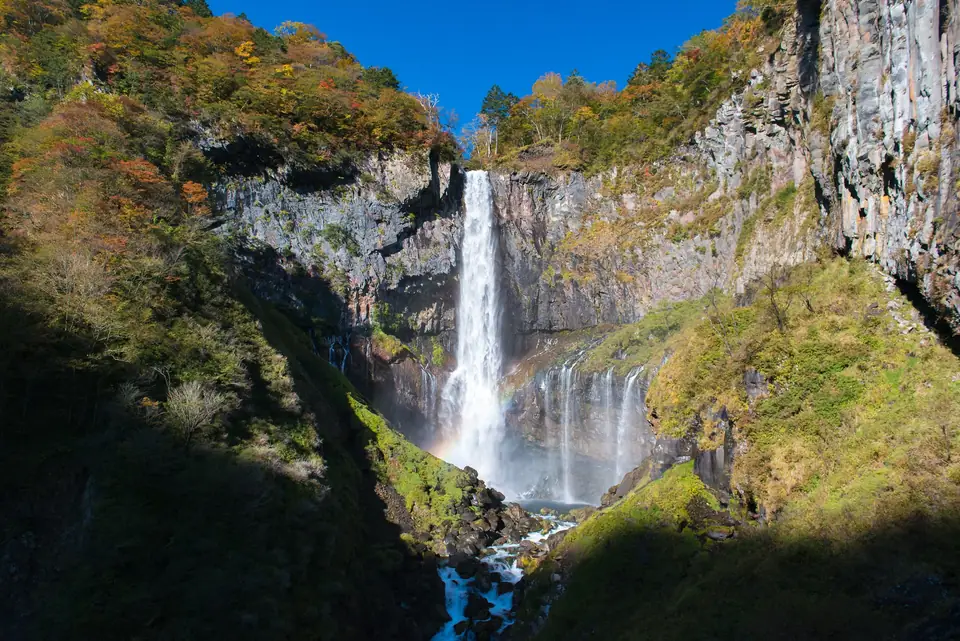
Kegon Falls is the only outlet of Lake Chūzenji, a volcanic dam lake born when the lava of Mount Nantai blocked the Daiya river. Its water leaves through the Ōjiri, one of the shortest rivers in Nikkō, which plunges in a single 97-metre drop and, from the pool onward, is called the Daiya. Its name refers to the Kegon Sutra, and in 1927 it was included among the eight new views of Japan of the Shōwa era; in 1931 it was declared a national Place of Scenic Beauty together with the lake shore.
What looks wild is measured to the cubic metre. The Chūzenji dam, at the mouth of the lake, decides how much water falls: between 1 and 2.5 m³/s by day, about 0.5 at night, and barely 0.1 in the droughts of 2024 and 2026, when the main jet dropped below the Twelve Falls that spring from the wall. In 1986 the lip collapsed and retreated some 8 metres; the works that consolidated it were done from shafts dug inside the rock, so that not a single wall would show.
Highlights
- Upper viewpoint — the fall of Lake Chūzenji seen from the top of the canyon
- Kegon elevator — 100 metres inside the rock in one minute, since 1930
- Twelve Falls — the curtain of jets halfway up the wall that never dries
- Lava wall — andesite columns with five and six sides
- Lip of the fall — the edge that retreated 8 metres in 1986 and holds the memory of 1903
The story of Kegon Falls begins with a volcano. Some 20,000 years ago, according to the multilingual sheet of the Government of Japan (other sources speak of about 15,000), the lava of Mount Nantai closed off the valley of the Daiya river and left Lake Chūzenji dammed. That lake has a single outlet, and it is this one: the Ōjiri river runs a very short stretch and hurls itself in a single 97-metre drop, some 7 metres wide at normal flow, into a pool about 4.5 metres deep.
According to tradition, it was the ascetic monk Shōdō Shōnin, who opened Mount Nikkō to worship and in 784 founded the Chūzen-ji temple on the lakeshore, who found the falls during his explorations, some 1,200 years ago. The name has two explanations. The better established derives it from the Kegon Sutra: it is one of the five waterfalls of the canyon named for the five periods of the Buddha’s teaching, together with Agon, Hōtō, Hannya and Nehan. The official Nikkō sign, by contrast, explains it by the azaleas that bloom on the cliff.
What to see at Kegon Falls goes beyond the postcard of the white jet among trees. There is the wall, fractured into polygonal columns of lava. There is the curtain of the Twelve Falls, which springs from halfway up. There is the elevator that has descended since 1930 inside the rock to a viewpoint almost at the level of the pool, where sunny mornings bring rainbows through the spray. And there is the lip of the fall, which holds one of the saddest stories of modern Japan.
The audio guide covers the falls in four stops, from the free viewpoint above to the lower viewpoint facing the drop, with documented narration checked against historical sources. In the end, the waterfall turns out to be at once a volcano, a sluice gate, a wall stitched from within and the memory of a sixteen-year-old boy that nobody has managed to erase.
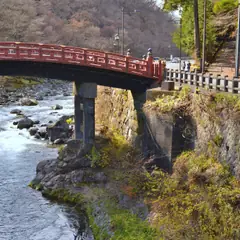
The same lava of the Nantai forms, in Nikko itself, the Kanmangafuchi Abyss; the falls lie within the immense sacred precinct of Futarasan Shrine, and their water ends up passing beneath the Shinkyō Bridge.
A lava lake that empties here
Free viewpoint over the fall
Summary of this stop
The first encounter comes from above, at the free viewpoint beside the public car park: a platform among the trees from which the water is seen falling and the depth of the canyon can be guessed. From here the whole geography is understood. Lake Chūzenji lies behind, the Ōjiri river barely has time to exist and, from the drop onward, the water changes name and becomes the Daiya.
The Buddhist name is no accident. The Kegon period is, in that five-stage scheme, the one of the most condensed teaching, that of the Kegon Sutra, and the largest waterfall carries it as its banner. The other four share the canyon with it, downstream.
Then there is the fame. Kegon is always presented as one of the three great waterfalls of Japan, together with Nachi, in Wakayama, and Fukuroda, in Ibaraki. That triad, however, is a popular consensus: it has no jury or official list, and leaves out other famous falls such as Akiu, Shōmyō or Shiramizu. In Nikkō, moreover, Kegon appears in two other local triads. How all those lists fit together, and why only one waterfall appears in all of them, is what the narration tells while looking at the drop.
A hundred metres of rock in a minute
Elevator and tunnel to the lower viewpoint
Summary of this stop
Beside the upper viewpoint stands a pavilion with a Japanese-style roof: the elevator building. At the ticket office the ticket is still punched by hand, and inside the emblem of the first elevator, that of 1930, is preserved. The present one is the third. It descends 100 metres inside the rock in a minute and emerges into an underground corridor, damp and cold, that leads to the stairs of the lower viewpoint.
Before it existed, the view from below had to be earned. Until 1900 the falls could only be seen from the top of the valley. According to a documented tradition, Hoshino Gorobei, already over sixty, asked permission from Futarasan Shrine to open a new path and spent seven years clearing it by himself along the cliff to the pool, where he built a teahouse for visitors. The painter Kosugi Hōan left in writing the day an avalanche of earth, rock, ice and snow fell on them in the middle of the work, and the reaction of “old Gorobei”, which the narration recovers in the tunnel.
The wall, formed of material from the Nantai, is very fragile. On 6 July 1935 a block of rock came loose and fell on the Gorōdaira chaya, a teahouse beside the pool, and four people died. Today neither Gorobei’s path nor his teahouse remains: only the elevator.
The waterfall regulated by a sluice gate
Twelve Falls of the wall
Summary of this stop
The lower viewpoint has three levels and sits almost at the height of the pool, facing the drop. From here is seen what goes unnoticed above: halfway up the wall, on both sides of the main jet, springs a curtain of fine jets, the Jūni-taki or Twelve Falls. It is water from Lake Chūzenji filtered through the rock, and it does not dry up at any time of year; in winter it freezes. All around, the wall shows its volcanic origin in columns of five or six sides, layers of andesite alternating with conglomerate.
The main drop, by contrast, obeys a sluice gate. The Chūzenji dam, at the lake outlet, sets the flow: normally between 1 and 2.5 m³/s by day and about 0.5 at night, with peaks such as the 55 m³/s of the typhoon of October 2018. In the droughts of 2024 and 2026 it was reduced to 0.1 m³/s on weekdays and cut off at night, until the jet fell below the water of the Twelve Falls. On 19 September 2026 it returned to 1.0 m³/s.
Nor is the wall what it seems. In 1986 part of the lip collapsed, retreating some 8 metres, and between 1990 and 2007 it was consolidated in three phases with rock anchors. On the face of the falls, however, there is not a wall or a mesh to be seen. How a cliff was stitched without it showing is the detail the narration reveals facing the drop.
A poem of 1903 on the lip
Lip of the fall
Summary of this stop
From the lower level, the gaze rises to the lip, the overhanging edge over which the river plunges. Beside it stood a large oak, mizunara according to the biography of its protagonist and the press that studied the photographs, kashi according to the Japanese sheet on the falls. On 22 May 1903, Fujimura Misao, a 16-year-old student of the Ichikō, the First Higher School in Tokyo, wrote in ink on its stripped trunk a short text, the “Gantō no kan”, which reduced the truth of the universe to one word: “fukakai”, incomprehensible. Then he took his own life at the falls. His English teacher had been Natsume Sōseki, who alluded to the case in two of his novels.
His motives remain disputed: the poem imposed the image of a philosophical death, but one biography points to loss of motivation and fear of repeating a year, and another hypothesis, which his friends denied, speaks of a romantic disappointment. His uncle, the historian Naka Michiyo, reached Nikkō the next day and found his writing tools beside the tree; the body took weeks to appear.
The death had a tragic echo: in the following four years, 185 people attempted to take their own lives at the same place, most stopped by the police, and 40 died. The authorities had the inscription scraped off in less than a month and later felled the tree, but a local photographer had already pictured it, and the postcards kept returning to the counters despite the bans. The narration closes the route on this edge, with the story of the tree that was meant to be erased.