Shrine of the sea gods
Sumiyoshi Taisha Shrine Audio Guide
Four pavilions of 1810 lined up like a fleet toward a sea that is now almost seven kilometres away. Ambassadors sailing for China prayed here, and Osaka's shipowners and merchants still sign in stone here.
- 45 min of audio
- National Treasure
Sumiyoshi Taisha Shrine is the head of some 2,300 Sumiyoshi shrines. Tradition places its founding in the year 211 and attributes it to the legendary Empress Jingū, who is said to have enshrined the three sea gods here, although the real dating is disputed and the first reliably documented mention is an offering recorded in the Nihon Shoki in 686. In 733 a poem in the Man'yōshū already invoked its god as protector of the ships of the embassies to Tang China.
The shrine was built a few metres from Osaka Bay, but silt and landfill have pushed the coast almost 7 kilometres to the west, about 8 according to other sources. The pavilions still face west, toward the old bay, and not south or east like most shrines: a wooden fleet praying to a sea that can no longer be seen.
Highlights
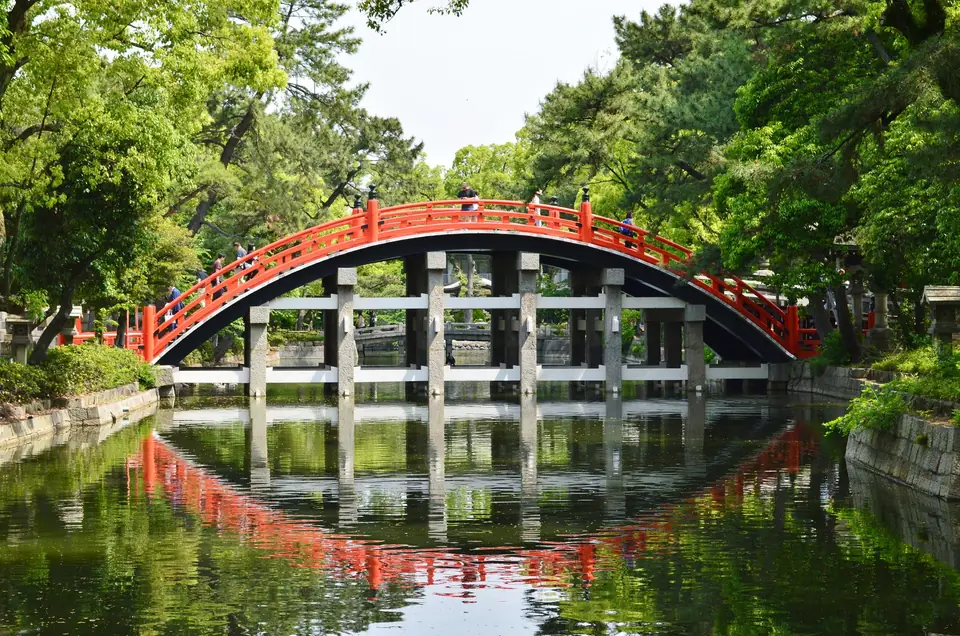
- Sorihashi — the steeply arched red bridge, without steps until 1955
- Four pavilions of 1810 — sumiyoshi-zukuri style, National Treasure, in fleet formation
- More than 600 stone lanterns — signed by shipowners, fishermen and merchants
- The toymakers' lanterns — two giants of more than 10 m beside the bridge
- Ishibutai — the stone stage of Hideyori's reconstruction
Sumiyoshi Taisha Shrine is a harbour without water. Its gods are those of the sea, its worshippers were for centuries shipowners, fishermen and merchants, and its pavilions face a shore that is now city. In the first three days of January some two million people come here for hatsumōde, the first visit of the year, and on 1 August, at the Sumiyoshi Matsuri, the mikoshi crosses the steep Sorihashi and travels to the Shukuin shrine in Sakai, wading the Yamato river; in 2005 it was carried on shoulders again after more than four decades in vehicles.
The history of Sumiyoshi Taisha is full of tales and absences. According to the folk tale, Issun-bōshi, the “one-inch boy”, was born of the prayers of an elderly couple at this shrine and set sail from Sumiyoshi Bay in a rice bowl. For centuries the compound also had its own Buddhist temple, the Shiragi-dera, with two pagodas, torn down in 1873 with the forced separation of Shinto and Buddhism. North of the pavilions the O-Bunko is preserved, a book repository founded in 1723 by booksellers of Osaka, Kyoto and Edo, where each publisher offered the first printing of their works: it exceeds 50,000 volumes and is considered the oldest library in Osaka.
Matsuo Bashō also passed through here. In the ninth month of 1694, at the ritual fair of the Takara-no-ichi, the poet bought himself a wooden measure, felt unwell and skipped an evening of moon-viewing; the next day he apologised with a haiku. He died in Osaka a month later, aged 51.
The shrine lies south of the centre, and the audio guide covers it in five stops, from the path of lanterns to the sacred rice field, with documented narration checked against historical sources.
To the north, Shitenno-ji Temple, born in the 6th century, is the other great piece of the oldest sacred Osaka, and next to it, about four and a half kilometres from here, the district of Shinsekai shows the popular, modern face of the city.
Six hundred names of seafarers without a sea
Rows of stone lanterns
Summary of this stop
The access path from the tram is flanked by more than 600 stone lanterns, made to order and engraved with the names and trades of their donors: shipowners, fishermen, indigo dyers, second-hand clothes sellers. The oldest dates from 1644, the custom became fashionable in the early 18th century and close to half of the donors made their living from the sea. Between 1716 and 1736, 96 lanterns tied to fishing and maritime transport were donated, and from 1727 the Sumitomo family added theirs.
No shore is in sight. The flat city skyline was once bay, and prayers were said here for the ships of the embassies departing for Tang China. What trades hide in the inscriptions of those lanterns is what the narration reads out along the path.
A dizzying bridge built by ship carpenters
Sorihashi Bridge
Summary of this stop
The Sorihashi, also called Taikobashi, crosses the entrance pond with an arch so pronounced that its reflection draws the silhouette of a drum. There are records of a bridge on this spot since the 13th century; the first arched bridge is attributed to ship carpenters and shipyards have led its maintenance ever since. Until 1955 it had no steps: it could only be walked by stepping in the gaps between planks, open over the water. An Osaka shipyard restored it in 2009, and the railing fittings preserve Edo-period pieces. Its stone pillars date from the Keichō era, and tradition attributes their donation to Yodo-dono or her son Hideyori; the sources do not agree on its measurements either.
On both sides rise the shrine’s largest lanterns, of more than 10 metres, donated not by shipowners but by the guild of toy and doll makers, first in 1762; among the names on their bases is Bandai Namco. The Nobel laureate Kawabata Yasunari set his 1948 story “Sorihashi” on this bridge. Why going down proved more terrifying than going up for its narrator is the emotion with which the narration accompanies the climb.
Four pavilions sailing toward a lost bay
Square-pillared torii
Summary of this stop
In front of the Kōjumon gate stands a torii with square-section pillars, with a plaque in the hand of Prince Arisugawa Takahito, and behind it the four main pavilions. The first, second and third line up one behind the other and the fourth sits beside the third, an arrangement that evokes a fleet sailing west.
They were built in 1810 in sumiyoshi-zukuri style, one of the oldest types of Shinto architecture: a gabled roof of hinoki cypress bark with no curvature, entry through the gable end, vermilion pillars and walls whitened with ground shell. They have been a National Treasure since 1953. The crossed roof beams, the chigi, are cut vertically on the first three and horizontally on the fourth, the one dedicated to Empress Jingū, which several authors consider a later addition. Beside the torii, a fenced stone keeps a legend of the Shimazu, told as a disputed tradition, about a birth in the middle of a storm guided by fox fires; who was born there, according to that story, is the tale the narration reveals before the stone.
What Hideyori raised between two fires
Ishibutai, the stone stage
Summary of this stop
South of the first pavilion, on a stone bridge in a pond, rises the Ishibutai, a stage about 6 metres square, one of the three great stages of Japan, where bugaku is danced. Together with the South Gate, of thick Momoyama-style timbers, and the two long music pavilions, it is what remains of the reconstruction ordered by Toyotomi Hideyori in 1606, after in 1576, during the Ishiyama war, Hongan-ji forces set the pavilions on fire.
The peace did not last. In the winter campaign of 1614 Tokugawa Ieyasu set up his headquarters in the high priest’s house, and in 1615 Ōno Dōken, of the castle side, set fire to the shrine. Like Ise, Sumiyoshi rebuilt its pavilions every 20 years, a cycle already recorded in the year 812; the wars broke it and it disappeared after 1810, although the shrine counts 49 ritual relocations, the last in 2011. Where one of the pagodas of the temple torn down in 1873 ended up is the surprise the narration keeps for this point.
Sacred rice field and dragon-by-dragon fortune
Sacred Otaue rice field
Summary of this stop
The tour ends at the edge of the sacred rice field, southwest of the pavilions. Every 14 June the Otaue Shinji turns it into a stage: oxen with wooden ploughs plough the field and the planters transplant the rice amid field dances, a parade of warriors and the Sumiyoshi dance. It has been an Important Intangible Folk Cultural Property of Japan since 1979.
The shrine is also alive for merchants. On the first dragon day of each month, according to the twelve-day cycle of the Chinese calendar, worshippers pray in order at four minor shrines in the Hattatsu Mairi, a pun between “first dragon” and “to prosper”. Which clay cat each visitor takes home, and how many years it takes to collect the largest, is the count with which the narration closes the walk.