Temple of Prince Shōtoku
Shitenno-ji Temple Audio Guide
A temple born of a wartime vow in the 6th century that has not moved an inch from its axis, although its pagoda, burned and toppled again and again, is now on its eighth life. And a stone torii that marks the eastern gate of paradise.
- 50 min of audio
- 6th-century layout
The history of Shitenno-ji Temple begins in 587, in the war between the Soga clan, favourable to Buddhism, and the Mononobe clan. The young Prince Shōtoku carved small images of the Four Heavenly Kings, the Shitennō, and promised to raise a temple to them if the Soga won; they did, and according to the Nihon Shoki the work began in 593 at Arahaka, in Naniwa. The date and the authorship are disputed, but archaeology confirms that the temple existed before the middle of the 7th century.
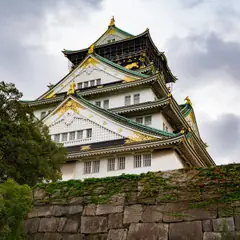
Its architecture preserves one of the oldest temple layouts in Japan: central gate, pagoda, Kondō and Kōdō aligned from south to north. In 1934, 3.6 metres beneath the base of the toppled pagoda, the great foundation stone of the Asuka period came to light, proof that the pagoda has never moved from its place. Today's, from 1959, is the eighth and the first five-storey one made of reinforced concrete.
Highlights
- Stone torii — from 1294, the oldest thing still standing at the temple
- Five-storey pagoda — the eighth, from 1959 and 39.2 m, which can be climbed inside
- Ishibutai — the stone stage of 1808 over the turtle pond
- Rokujidō — the timber hall of 1623 that the pond water saved in 1945
- Kameidō — a turtle-shaped stone basin from the 7th century
Shitenno-ji Temple has burned and fallen again and again without moving from its axis, and those who raised it anew were as often the merchants and guilds of Osaka as the monks. The temple and the Osaka tourist office present it as the first Buddhist temple sponsored by the State, although part of the historiography gives that title to Kudara Ōdera, in Asuka. What nobody disputes is its age: the tiles of its first construction came from the same mould as those of the first Hōryū-ji, a mould that already appears damaged at Shitenno-ji, and tiles of its own found beneath the Naniwa palace of the mid-7th century prove that the temple predates that court.
Its history is made of fires. Tradition blames the one of 1576 on the troops of Oda Nobunaga, but the diary of the monk Gien attributes it to the Ikkō followers, and source criticism leans toward the latter. In 1801 lightning burned the pagoda, in 1934 a typhoon toppled it and in 1945 bombs razed the central compound. In between survive legends such as that of the defeated man’s spirit turned into woodpeckers, and traditions such as the one that says the warrior Kusunoki Masashige came here to consult the “Miraiki”, a secret book of prophecies attributed to Shōtoku. Each 14 January the “Doyadoya” is held, Osaka’s only naked festival, with young men in loincloths contending for the blessed amulets.
Beside the Treasure Hall, the Cat Gate shows a carved cat that, according to popular belief, the work of the legendary Hidari Jingorō, meows three times on the morning of New Year. On the 21st and 22nd of each month the compound fills with stalls, with an antiques market of between 300 and 500, one of the largest in Kansai.
The audio guide covers the temple in five stops, from the stone torii to the turtle pond, with documented narration checked against historical sources.
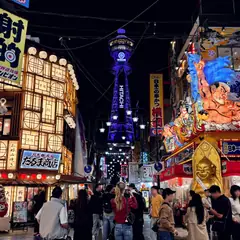
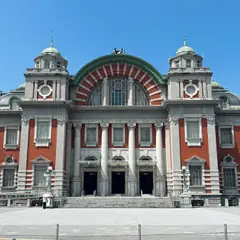
To the west, beyond Tennōji Park, the district of Shinsekai occupies part of the old site of an exposition, and to the south Sumiyoshi Taisha Shrine is the other great sacred place of the oldest Osaka. Further north, on the island of Nakanoshima, the Osaka City Central Public Hall shows another face of the patronage of the city’s merchants.
A torii of 1294 before paradise
Stone torii
Summary of this stop
Beside the street, at the west entrance, stands a stone torii that the monk Ninshō raised in 1294 to replace a wooden one. It is the oldest thing still standing at the temple: the oldest surviving buildings date from the early 17th century. Its bronze plaque proclaims that the Buddha preaches here and that here is the centre of the eastern gate of paradise. At its foot, a stone column with a square hollow, the “ponpon-ishi”, invites visitors to strike it and put an ear close.
Aligned with the torii, the West Gate or Gokuraku-mon, rebuilt in 1962 with a donation from Matsushita Kōnosuke, has been a place of pilgrimage since the Heian period for watching the sun sink into the sea. At the equinoxes the Jissōkan is held, the meditation on the sunset, with the sun falling inside the torii. In front of this same gate, the noh play “Yoroboshi” places a blind boy who came to watch the sunset; what he believed he saw in that instant is the scene with which the narration opens the tour.
A wartime vow laid out in a straight line
Chūmon and central cloister
Summary of this stop
A red and white cloister encloses the central compound, and at the central gate, the Chūmon, two colossal Niō guardians donated by the Japan Sumo Association stand watch. From here the row of buildings that reproduces the founding layout can be seen at a glance, the pagoda, the Kondō and the Kōdō from south to north, born of Shōtoku’s vow after the war of 587.
It was raised by carpenters who came from Baekje. Kongō Gumi, the company that, according to its family tradition, was founded in 578 by Kongō Shigemitsu, one of those carpenters, was for centuries the temple’s official carpenter, until in January 2006, hard pressed by builders putting up temples in concrete, it became a subsidiary of the Takamatsu group. Inside the compound, a small shrine honours Mononobe no Moriya, the defeated enemy. What his spirit did to the temple’s beams, according to a Kamakura-period legend, is the echo of that war which the narration recovers here.
The pagoda on its eighth life
Five-storey pagoda
Summary of this stop
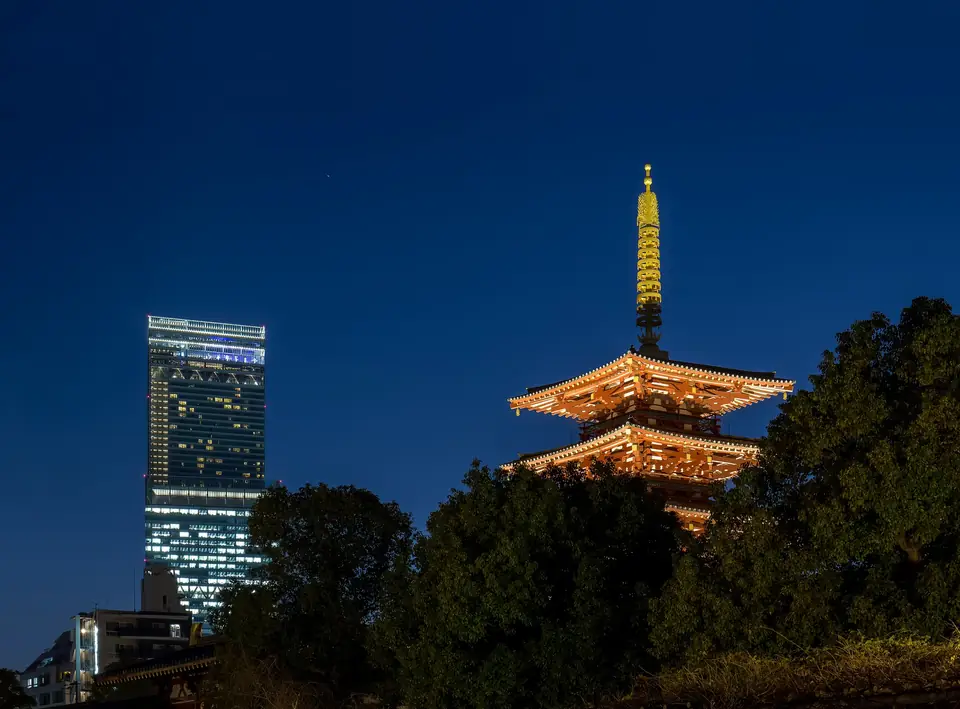
The five-storey pagoda rising at the centre measures 39.2 metres, of which 12.3 belong to the nine-ring finial, and it can be climbed inside up to the fifth floor, decorated with murals by Yamashita Maki. Obayashi finished it in April 1959 as the first five-storey pagoda in reinforced concrete with a steel structure, and the rest of the central compound was completed in 1963 to a design by Fujishima Gaijirō.
It is the eighth. The sixth was born of a fire: on 5 December 1801 lightning burned the pagoda and the eastern half of the compound, and Awajiya Tarōbei, a used-paper wholesaler from the Shirokane-chō district, donated his entire fortune and went out begging himself; the work was completed in 1813, the same year he died, aged 54. On 21 September 1934 the Muroto typhoon toppled it onto the Kondō and 15 people died; the pagoda served as a viewing deck and, to open its top floor, some of the eave lever beams had been removed. The seventh, of wood, was inaugurated in 1940 after a tussle with the law. How long that pagoda lasted, and why, is what the narration tells at the foot of the eighth.
The pond that stopped the 1945 fire
Rokujidō and Ishibutai
Summary of this stop
In the first great bombing of Osaka, on 13 and 14 March 1945, the central compound, the pagoda and the Great East Gate, then a National Treasure, burned. The fire reached the Rokujidō and was put out with water from the Kame-no-ike pond, the turtle pond: that is why the great timber hall of 1623, an Important Cultural Property, and the buildings to the north are still standing.
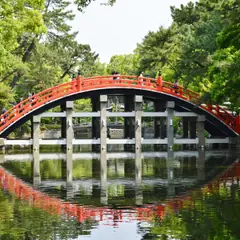
Across the pond runs the Ishibutai, a stage on a stone bridge that was built in wood in 1623 and redone in stone in 1808 with donations from the Osaka timber wholesalers’ guild, whose inscription can still be read on its side. What is danced upon it each 22 April, the anniversary of Shōtoku’s death, is the picture with which the narration portrays this surviving corner.
Memorial tablets in 7th-century water
Kameidō
Summary of this stop
Inside the small Kameidō there is a turtle-shaped basin from the 7th century, carved in Tatsuyama stone and twin to the one at the Sakafuneishi site in Asuka, linked to State water rites. Fujiwara no Michinaga washed his hands in it in 1023, and today worshippers let wooden tablets with the names of the dead run in its water.
The temple has also served the living. It is associated with four institutions, the temple, a pharmacy, a hospital and an almshouse, attributed by tradition to Shōtoku and attested at least since the Kamakura period; in 1933 the hospital that has been called Shitennōji Hospital since 1948 was founded to the southwest. Nearby, the Kamei Fudō shrine keeps another water legend, that of the image the prince saw reflected in a well, which the narration tells in a low voice as it closes the tour.