Red brick of 1918
Osaka City Central Public Hall Audio Guide (Ōsaka-shi Chūō Kōkaidō)
A red-brick neo-Renaissance palace on the island of Nakanoshima, given to the city by a stockbroker who preferred to die rather than ask for his money back, and saved from demolition seventy years later by thirteen thousand townspeople.
- 30 min of audio
- Important Cultural Property
The history of the Osaka City Central Public Hall, the Nakanoshima Kōkaidō, begins in 1909, when the stockbroker Iwamoto Einosuke travelled to the United States with Shibusawa Eiichi's business mission and came back determined to build a public hall like those paid for by American millionaires. In 1911 he donated 1 million yen to the city, several billion in today's money. Work began in June 1913 on the site of the old warehouse-residence of the Hamada domain and the hall opened on 17 November 1918.
Its donor never saw it. In 1916, ruined by a bearish bet during the stock-market boom of the First World War, Iwamoto refused to ask the city to return part of the million, considering it a disgrace for an Osaka merchant, and took his own life at the age of 39, two years before the opening.
Highlights
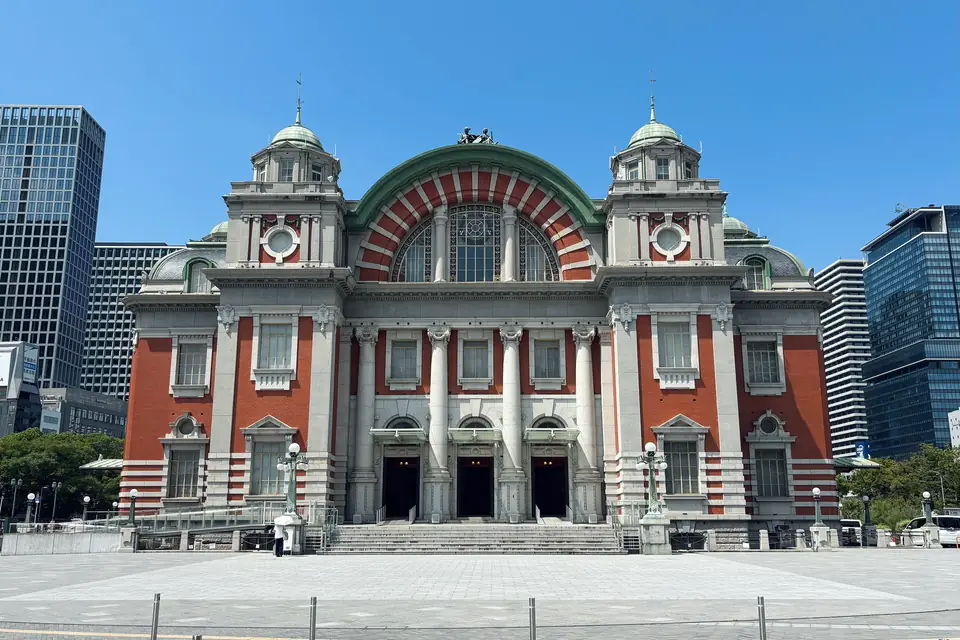
- Red brick and white stone facade — crowned by a great neo-Renaissance arch
- Minerva and Mercury — the statues of art and commerce, restored in 2002
- Main Hall — the stage of Einstein in 1922 and Helen Keller in 1955
- Iwamoto Memorial Room — the donor's bronze statue, in the basement
- 1918 seat — with a hat hook under the seat
The Osaka City Central Public Hall is a gift returned. A merchant paid for it with his fortune and, seven decades later, a collection among the townspeople saved it. In between, its Main Hall, for some 1,000 people on two levels, received Albert Einstein in 1922, Helen Keller in 1955, Yuri Gagarin in 1962 and Mikhail Gorbachev in 1997. In 1943 the wartime requisition of metals stripped it of its lifts, handrails and statues; in 1945 it suspended its activity to house the victims of the bombings, and between 1946 and 1949 it hosted daily rallies and jazz and popular-song concerts, the music the war had silenced.
The architecture of the Osaka City Central Public Hall has its own misunderstanding. It is often attributed to Tatsuno Kingo, the architect of Tokyo Station, but the winning design of the 1912 competition was that of the 30-year-old Okada Shin’ichirō; Tatsuno organised the competition and, with Kataoka Yasushi, signed the working design. The construction lasted five years and took 184,000 days of craftsmen’s labour. In the Special Room on the third floor, the Italian-trained painter Matsuoka Hisashi painted on the ceiling Izanagi and Izanami receiving the spear with which they create the world, and over the west arch the emperor Nintoku observing the lack of smoke from the hearths.
Each December, within the OSAKA Hikari no Renaissance festival of lights, the east facade becomes the screen of a free mapping show that can be seen from Nakanoshima Park; it began in 2016 with a piece by students reviewing the building’s 100 years.
The audio guide covers the building in four stops, from the great arch of the facade to the basement, with documented narration checked against historical sources.
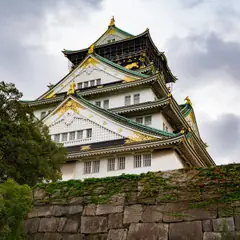
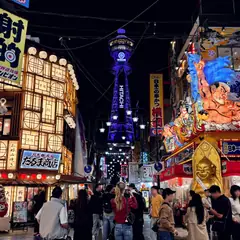
Upriver, to the east, rise the walls of Osaka Castle, and to the south, less than three kilometres away, the neon of Dotonbori closes the axis of merchant Osaka.
Minerva and Mercury above the great arch
Great arch facade
Summary of this stop
In front of the main facade, the white stone bands over the red brick and the domed copper roofs frame the great entrance arch, the most recognisable feature of Okada’s design. Its selection was unusual: using a method devised by Tatsuno, of the 17 architects invited the 13 who accepted judged one another, and the young Okada won unanimously. In the arch gleams a stained-glass window of 200 pieces of lenticular glass with a phoenix and four miotsukushi, the channel markers that are the city’s emblem.
Above the arch Minerva and Mercury keep watch, art and commerce, who returned with the restoration of 1999-2002 after decades of absence, along with the metal pieces removed during the war. The fate of Iwamoto’s million was not settled: parks and schools were discussed, and the final list came down to an avenue of cherry trees, an education fund or a public hall. Which sentence, according to tradition, tipped the balance toward this building is what the narration tells before the arch.
The stage of Einstein and Helen Keller
Main Hall foyer
Summary of this stop
The first-floor foyer opens on days when the hall is not in use, and the Main Hall is accessible only for events. On its stage, presided over by a mask of the bugaku court dance Ranryō-ō, Einstein spoke during his Japanese tour of 1922 and Helen Keller in 1955, and through the same hall passed in 1919 the Russian opera with Aida.
The hall has been everything. Inaugurated on 17 November 1918, after works that ended in October of that year, it was stripped of its metals in 1943, a refuge for victims in 1945 and, in the immediate postwar, a meeting place for parties and unions and a stage for jazz. How the return of that banned music resounded between these walls is the scene the narration evokes in the foyer.
The merchant who never asked for his million
Iwamoto Memorial Room
Summary of this stop
In the first basement, a free exhibition on the building’s history includes the Iwamoto Memorial Room, with his bronze statue and personal items. The million he donated combined the 500,000 yen inherited from his father, who died while he was travelling in the United States, and his own fortune. According to a disputed story, his fame came from the 1907 crash in Kitahama, when he is said to have played against his own gains to save the bearish brokers; another account maintains the opposite, that he bought with everything he had to sustain the market.
In 1916 ruin came through a bearish bet. Iwamoto shot himself at home in October and died on the 27th, after five days of agony during which the Kitahama brokers who owed him their salvation in 1907 kept bonfires lit all night at the Osaka Tenmangu shrine praying for him. Some sources give 1915 for his death and 1912 for the donation. The details of that last day, with an outing to pick mushrooms and a poem about a maple leaf, are told in several ways, and the narration gathers them before his statue.
Thirteen thousand names against demolition
Red Brick Fund relief
Summary of this stop
In the same basement, a relief records the names of the donors who saved the building. In June 1971 the municipal development plan for eastern Nakanoshima put it in danger, and in September of that year the Kinki branch of the Architectural Institute of Japan handed the city a conservation petition joined by architects, historians, planners and jurists. In 1988 the city decided on its permanent preservation, and the Red Brick Fund, promoted by the newspaper Asahi Shimbun, gathered more than 700 million yen from some 13,000 citizens and companies.
The restoration from March 1999 to September 2002 returned the building to its original appearance and mounted it on seismic isolators in a new basement; in December 2002 it became the first public hall in western Japan to be declared an Important Cultural Property. Fragments of the original building are reused framed as windows, and very close by a 1918 seat is preserved. The detail it hides under the seat is the nod with which the narration closes the visit.