Three castles in one
Osaka Castle Audio Guide (Ōsaka-jō)
Beneath the Tokugawa granite walls lies Hideyoshi's buried castle, and above it rises a 1931 concrete keep paid for by the townspeople themselves. Three castles stacked on a single hill.
- 90 min of audio
- Tokugawa walls
The history of Osaka Castle begins in 1583, when Toyotomi Hideyoshi started building it on the site of the Ishiyama Hongan-ji, the fortified temple that Oda Nobunaga had defeated in 1580 after ten years of war. The work dragged on for some fifteen years. After the fall of 1615, the Tokugawa shogunate rebuilt it between 1620 and 1629 in three phases, mobilising 47, 58 and 57 daimyo: a castle four times smaller, but with moats up to about 90 metres wide and a wall of some 32 metres on the east face of the honmaru, the tallest in Japan.
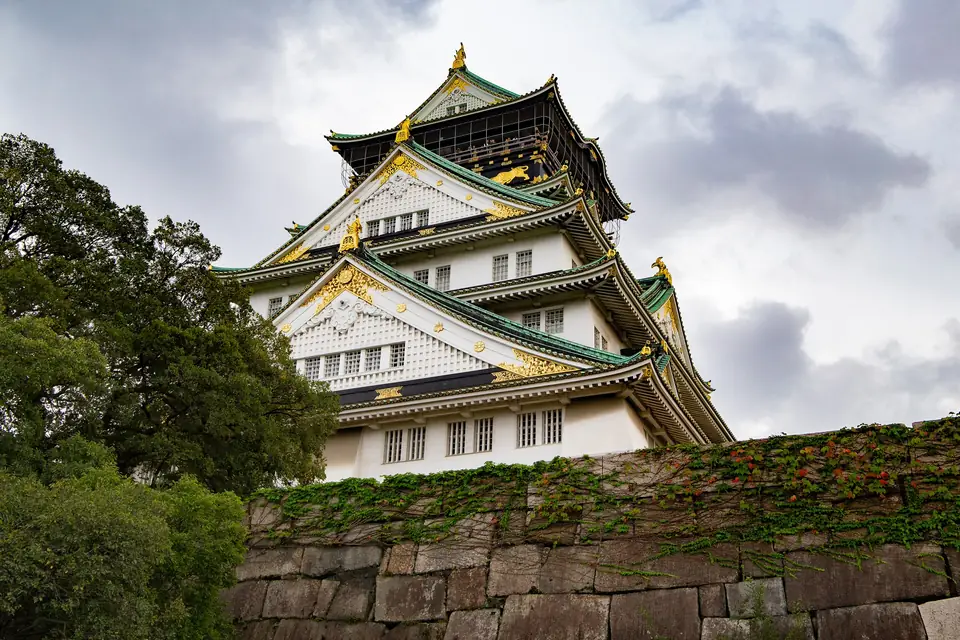
The keep that everyone photographs belongs neither to Hideyoshi nor to the Tokugawa. The Tokugawa keep burned after a lightning strike in 1665 and the castle spent 266 years without one, until in 1931 the city gathered 1.5 million yen in some 78,250 donations. The Army set a condition for handing over the site: 800,000 yen went to a new headquarters for the 4th Division and 470,000 to the keep.
Highlights
- Takoishi — the castle's largest stone, about 108 tonnes brought from Bizen in 1624
- Honmaru wall — about 32 m from the moat floor, the tallest in Japan
- Toyotomi Ishigaki-kan — Hideyoshi's wall, open to visit underground since 2025
- The 1931 keep — 58 m of concrete and steel, five storeys outside and eight inside
- Keep base — the stones shifted by a one-tonne bomb in 1945
Osaka Castle has an identity problem. Popular memory calls it Hideyoshi’s castle, but its visible walls, moats and buildings come from the Tokugawa reconstruction of 1620 to 1629, and the keep crowning the complex dates from 1931: it imitates the Toyotomi keep painted on a folding screen, but it stands on the Tokugawa base, on a site slightly shifted from the original. Underneath it all, deliberately buried beneath some six metres of earth, Hideyoshi’s castle is still there. In between fit a lightning strike that in 1660 set off some 82.4 tonnes of gunpowder and brought down 1,481 houses in the city, a last shogun who fled by night in 1868 and an Army arsenal that came to employ more than 60,000 people and that the bombing of 14 August 1945 destroyed by 90 %.
The history of Osaka Castle is full of episodes that border on legend. It is told that the powder-magazine explosion hurled a leaf of the Aoyamon gate as far as the Kuragari pass, some 14 kilometres away. Its replacement, the Ensho-gura of 1685, was built entirely of granite, with walls about 2.4 metres thick, and it is one of the compound’s 13 Important Cultural Properties. In 1740 a 25-year-old guard stole 4,000 ryō of gold from the castle itself and ended up crucified; legend turned the theft into the search for the gold Hideyoshi supposedly threw into the Kinmeisui well, a well that was in fact built in 1626, decades after his death. And in 1866 the Tokugawa shogun Iemochi died here, aged 20 and of beriberi, one of only three shoguns who ever entered the castle.
What became of the heir is not known for certain either. Nobody saw Hideyori die and his body never appeared, and the rumour soon spread that he had fled south, as far as Kagoshima, where a tomb attributed to him is pointed out. In 1980, an excavation in the San-no-maru turned up the skull of a man in his twenties with a wound consistent with ritual decapitation; from his age and build it was thought it might be Hideyori, and in 1983 it was buried at the Seiryō-ji temple in Kyoto, although the identification is still disputed.
The audio guide covers the large compound in five stops, from the outer moat to the silent northern enclosure, with documented narration checked against historical sources that tells the three superimposed castles apart.
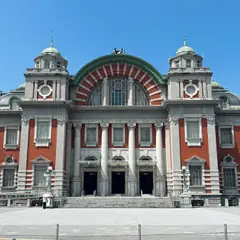
To the west, downriver, the island of Nakanoshima holds the red brick of the Osaka City Central Public Hall, and some three kilometres to the southwest the neon of Dotonbori, the old theatre district of the merchant city, begins.
Ōtemon, the gate Hideyoshi never crossed
Ōtemon gate
Summary of this stop
The tour starts at the Ōtemon bridge, the main gate of 1628, an Important Cultural Property, on the far side of the outer moat. Beside it stands the Sengan-yagura, a corner turret of 1620 that shares with the Inui-yagura the title of oldest building in the compound. From here the scale of Osaka Castle’s architecture can be measured: moats up to some 90 metres wide and walls raised by dozens of daimyo.
The paradox is that this imposing fortress is the one built by Hideyoshi’s conquerors. And its preservation has another irony: when lightning burned the Ōte Tamon-yagura in 1783, the shogunate’s penury left the repair pending for decades, until the great restoration begun in 1845 with funds demanded from the merchants of Osaka, the goyōkin.
On the roof of the Ōtemon there is also a detail repeated around the compound: peach-shaped tiles, a fruit held in Japan to be an amulet against evil. Where the others hide is the game the narration proposes from this point on.
A 108-tonne octopus at the Sakuramon
Sakuramon gate
Summary of this stop
Beyond the Sakuramon gate, rebuilt in the late 19th century, opens a fortified courtyard of 1624 dominated by the Takoishi, the castle’s largest stone: some 108 tonnes according to the official sign and about 60 square metres of face. Other sources raise the estimate to 130 tonnes, and no figure comes from an actual weighing. It was set in place by the daimyo Ikeda Tadao after quarrying it in Bizen, present-day Okayama, more than 100 kilometres away, and in its lower left corner it shows the octopus-shaped stain that gives it its name.
Against that eternal stone, the castle’s timber proved fragile. The Tokugawa keep, finished in 1626, burned on 2 January 1665 when lightning struck the north shachi on its roof: it lasted 39 years and was not rebuilt. On 2 February 1868, the day of the handover to the new government, a fire that began in the kitchen of the honmaru palace destroyed the palace, its 11 three-storey turrets and all the honmaru gates, barely three days after the last shogun, Tokugawa Yoshinobu, fled by night following the defeat at Toba-Fushimi.
How a mountain of more than a hundred tonnes is dragged over a hundred kilometres is the question the narration answers before the Takoishi.
Hideyoshi’s wall, six metres underground
Toyotomi Ishigaki-kan
Summary of this stop
The third stop goes down into the underground hall of the Toyotomi Ishigaki-kan, the museum opened in 2025. When rebuilding the castle from 1620, the Tokugawa shogunate buried Hideyoshi’s work under a fill of some 6 metres on the middle level of the honmaru. A 1984 excavation brought to light a wall of unworked stone from the private enclosure of Hideyoshi and Yodo-dono, with traces of the fire of 1615, and it is that wall which can be visited underground today. It should not be confused with another find, from the 1959 survey, which located a Toyotomi wall at a depth of 7.3 metres.
These stones also keep a scene of power. In the tenth month of 1586 Tokugawa Ieyasu, Hideyoshi’s last great rival, arrived in Osaka to submit. According to the tradition recorded in the Tokugawa Jikki chronicle, on the eve of the audience Hideyoshi turned up incognito at his lodgings to ask him to bow deeply to him the next day, before the daimyo.
What Ieyasu asked of Hideyoshi after that bow, and how his lineage ended up burying this wall, is the twist that reframes the whole tour.
The townspeople’s keep and its 1945 scar
Main keep
Summary of this stop
On the northeast corner of the base the biography of the 1931 keep can be read. It was driven by Mayor Seki Hajime and designed by the architect Furukawa Shigeharu from the Toyotomi keep on the Ōsaka Natsu no Jin-zu Byōbu screen, but set on the Tokugawa base: 58 metres high, steel and concrete structure, five storeys outside and eight inside, white walls, green roofs, gilded ornaments and tiger reliefs on the fifth level. Inside there is a museum and, on the eighth floor, a viewing deck.
It was paid for by some 78,250 donations, and the same money built the headquarters of the 4th Division, the European-looking building that now houses MIRAIZA OSAKA-JO, opposite the keep. Beside it survives the Kinmeisui well pavilion, from 1626, which escaped the fire of 1665.
On 14 August 1945, the eve of the surrender, a one-tonne bomb exploded beside this face of the keep. The stones of the base are still visibly displaced, but the concrete held. What it means that a merchant city raised its own keep is the idea with which the narration closes this stop.
Yamazato-maru, where the Toyotomi came to an end
Yamazato-maru
Summary of this stop
The tour ends at the Yamazato-maru, a quiet corner north of the keep where a memorial stone commemorates Hideyori and Yodo-dono, at the place associated with the suicide of mother and son in 1615. Their end began with a trap: the peace that closed the winter campaign of 1614 forced the demolition of the third and second rings and left the castle with only the inner moat and the honmaru. When Hideyori tried to rebuild the moats, the agreement was considered broken, and the castle fell in the summer of 1615.
Here echoes the story of Senhime, Ieyasu’s granddaughter, married to Hideyori since the age of seven. On the day of the fall she was sent out to plead in her grandfather’s camp for the lives of mother and son; Ieyasu left the decision to his son, the shogun Hidetada, Senhime’s father, who refused. Nearby, in the plaza of marked stones, the blocks engraved with the crests of the daimyo of the Tokugawa reconstruction sign off the ending. The reproach Senhime received from her own father is the bitterest detail the narration keeps for this corner.