Osaka's kitchen
Kuromon Market Audio Guide (Kuromon Ichiba)
A covered market named after a black temple gate that burned down in 1912. It began by selling fish to Osaka's cooks, was reborn from a fire and from bombs, and today fights to remain a market and not just a shop window.
- 45 min of audio
- Fish market
The history of Kuromon Market begins in the Bunsei period (1818-1831), when fresh-fish merchants set up in front of the black-lacquered gate of the Enmyō-ji temple; by around 1822-1823 they were selling fish brought from Sakai and Kishū, present-day Wakayama. In 1902 the prefecture recognised it as an authorised market, and some sources take that year as its founding. Its classic customers are the itamae, the cooks of Japanese restaurants, hence the abundance of fugu and shellfish.
No black gate marks the market today. The Enmyō-ji gate burned in the great Minami fire of 16 January 1912, the temple moved to another district and the market took, just then, the name of what it had lost: Kuromon Ichiba, the “Black Gate Market”.
Highlights
- Live fugu tanks — the fish the market has brought in year-round from Shimonoseki since 2016
- Steel arcade — the roof that replaced the canvas awnings in the 1960s
- Fukahiro fishmonger — the market's oldest, founded in 1905
- Seafood counters — crab, oysters and sea urchin to eat on the spot, standing up
- Kuromon Park — the stele of an old 18th-century coin mint
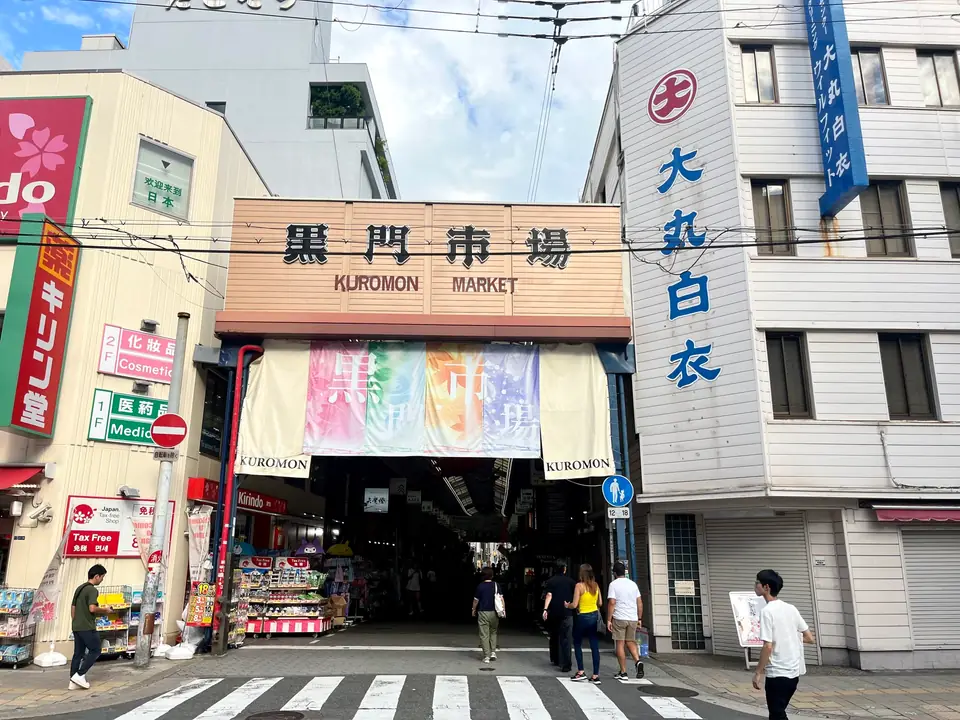
Kuromon Market stretches beneath an arcade of about 580 metres, though other sources speak of some 600, in the Nipponbashi district, and gathers between 150 and 180 shops depending on the year and who is counting. On weekdays some 18,000 people pass through it, and at year’s end, when Osaka shops for the New Year, as many as 150,000. Behind those figures lies a market that has been reborn as many times as it has been razed: the fire of 1912 took away the temple that gave it meaning, the bombing of the night of 13 to 14 March 1945 reduced it to a scorched lot and the pandemic left it almost empty between 2019 and 2021.
Its name also hides a curiosity. According to a documented tradition, Osaka once had another “Kuromon Ichiba”: in front of the black-painted Tamatsukuri gate, southeast of the Toyotomi castle, a white pickling melon, the shirouri, was sold, and people ended up calling it simply “kuromon”. Beneath the present arcade the market is divided into seven neighbourhood associations chained along some 400 metres, two of them with the black gate in their name, and the 2024 map showed only 120 of the roughly 170 shops.
To the east, in the small Kuromon Park, a stele marks the site of an old mint: between 1740 and 1745 merchants licensed by the shogunate struck Kan’ei Tsūhō copper coins there, and it is said that what closed the workshop was a fraud by its administrator, although that story is still disputed.
The audio guide covers the market from north to south in five stops, from the Sennichimae-dōri avenue, with documented narration checked against historical sources.
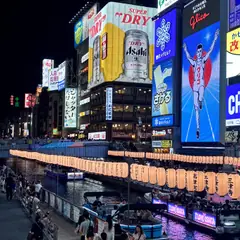
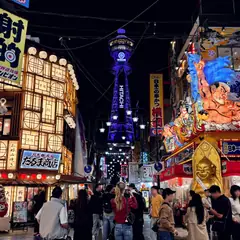
To the west, a short distance away, the canal of Dotonbori turns that same food culture into a neon spectacle, and to the south Shinsekai can be reached on foot, another working-class district of the Osaka of old. Further south, about six kilometres away, Sumiyoshi Taisha Shrine was for centuries the shrine of the city’s shipowners and fishermen.
A black gate that burned in 1912
North entrance
Summary of this stop
The market’s north entrance opens onto the great Sennichimae-dōri avenue, and that is where the paradox begins: the avenue was laid out on the strip razed by the same fire that finished off the black gate. The Minami fire of 1912 started in the Yūrakukan brothel in Nanba Shinchi, burned for some 10 hours and destroyed 5,200 houses along a strip 1.4 kilometres from east to west. Over the burned ground, the Kujō-Kōzu tramway was laid in 1914-1915, now part of Sennichimae-dōri.
On 16 January 1912 the flames reached the Enmyō-ji and destroyed all its buildings, gate included. The temple moved to the village of Yata, today the Higashisumiyoshi district, and the market took the name of the lost gate. What a striped melon has to do with the sign at the entrance is the irony with which the narration opens the tour.
Fish from Sakai for Osaka’s cooks
Live fugu tanks
Summary of this stop
In front of the fish wholesalers, tanks and blue buckets line up with live fugu that are served raw at the stall itself. They are the legacy of a market born as a trade pantry: fish from the coast south of Osaka sold before a temple gate of the Jōdo Shinshū school and bought by the itamae.
That fugu, however, no longer follows the rules. Following Japanese custom, Kuromon did not buy it in summer; faced with tourist demand, in spring 2016 it began bringing it in all year round thanks to an agreement with Shimonoseki, the great fugu port, and it sold explosively. What that change says about who rules the market today is what the narration raises in front of the tanks.
A corridor that emptied twice
Steel arcade
Summary of this stop
At the crossing of branches, the continuous roof reads like a scar. After the bombing of 1945 the prefecture put up housing shacks on the lot, the market soon recovered as the “kitchen of Naniwa” and in 1948 the merchants’ union that still runs it was founded. Between 1960 and 1965, at the height of the night stalls, the canvas awnings gave way to a steel-framed arcade; in 1962 the union counted 167 shops with some 750 employees.
The second time the corridor emptied was recent. On Friday 10 July 2020, when the city was supposed to be welcoming visitors to the Olympic Games, the covered street had almost no strollers; between 2019 and 2021 footfall fell to about a thirtieth and dozens of shops closed. What happened when the tourists returned, with an old restaurant besieged by property developers, is the epilogue the narration tells beneath the arcade.
The stallholders who swore never to serve standing
Seafood counters
Summary of this stop
The street-level seafood counters pile up crab legs, oysters and sea urchin, and at many stalls the food is eaten right there, standing. It is a very recent custom. Around 2011-2012, with empty premises and falling custom, the market turned toward the foreign visitor: it used to receive 12,000-13,000 people a day, almost all Japanese, and in March 2018 the average was 30,000 a day, 90 % foreign.
When they began serving food to eat at the counter, some stallholders swore that at their stall nobody would eat standing, until they saw the queue in front of the neighbour. Since 2023 tourist prices have earned it the nickname “botakuri”, rip-off, on social media, for figures such as 30,000 yen for four crab legs; the association replies that since August 2024 its members have applied reasonable prices and attributes the inflated ones mostly to non-member shops. How long those who swore took to give in is the detail with which the narration portrays this turn.
A bamboo basket among the tourists
Kuromon Information Center
Summary of this stop
The tour ends at the Kuromon Information Center, the empty premises that the union bought in 2015 and turned into a multilingual information centre with a free seated eating area; repairing its toilets alone cost 20 million yen. Very close by, the Fukahiro fishmonger, founded in 1905, the oldest in the market, still supplies fish from the central market and from Akashi to hotels and restaurants.
The neighbourhood Kuromon also holds out among the crowd. Takemoto Oritayū, narrator of the bunraku puppet theatre, whose National Theatre is five or six minutes’ walk away, does his shopping here with an ichiba-kago, the big bamboo basket of working cooks. What he buys and for whom, from fruit for jams to flowers for the graves of his masters, is the picture with which the narration closes the market.