Retro district of 1912
Shinsekai Audio Guide
An entertainment district of 1912 laid out half like Paris and half like Coney Island, with a tower scrapped for the war that the neighbours raised again and a god of luck who arrived from Kansas City.
- 60 min of audio
- Tsutenkaku Tower
Shinsekai, the “New World”, occupies part of the grounds of the Fifth National Industrial Exposition, held in 1903 in Tennōji-Imamiya: 153 days, 4,350,693 visitors, the last and largest of those expositions and the first to open at night under electric light. In 1909 the western half of the site passed to the Osaka Tochi Tatemono company, financed by the city's business community, and the district opened on 3 July 1912, a date it still celebrates as its founding day.
The 1912 plan imitated Paris in the northern half and Coney Island's Luna Park in the southern one. The first Tsutenkaku, an Arc de Triomphe crowned by the upper half of an Eiffel Tower, was damaged by fire in 1943 and dismantled to hand its steel over to the war. The second was promoted by the neighbours themselves and opened in 1956, a little further north.
Highlights
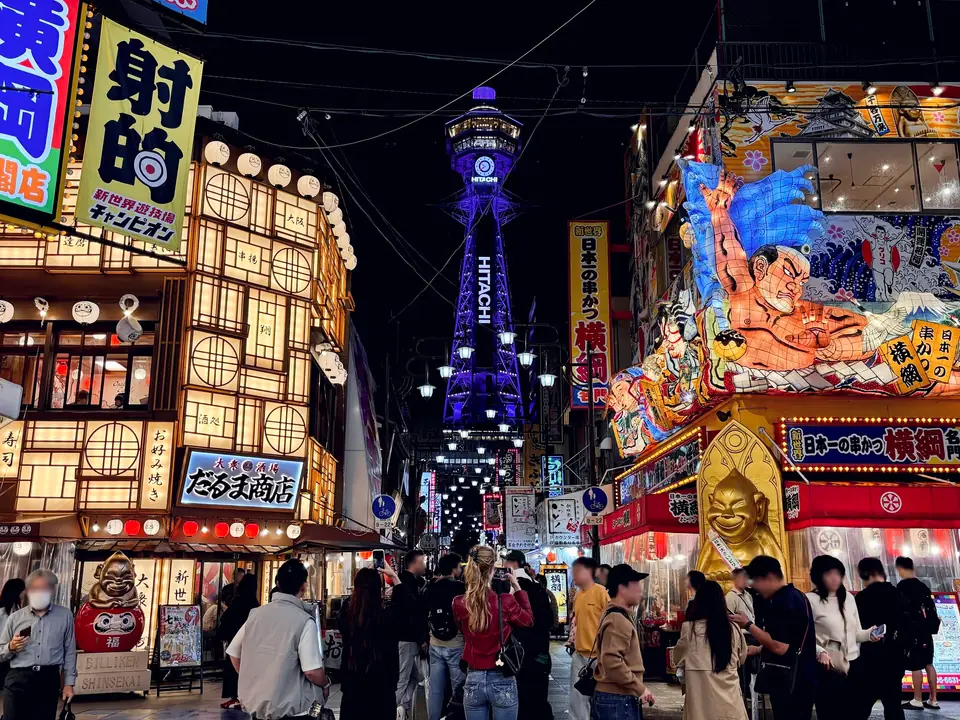
- Tsutenkaku Tower — 108 m with lightning rod, raised by the neighbours in 1956
- Peacock ceiling — a replica of the advertisement that decorated the first tower until 1943
- Golden-observatory Billiken — a camphor-wood carving at 87.5 m with worn-down feet
- Fan-shaped streets — the Parisian plan of 1912 converging on the tower
- Jan-Jan Yokochō — 180 m of kushikatsu bars and shogi halls since 1921
Shinsekai was born as a dream of modernity paid for by merchants and ended up as a second-hand New World in the best sense. In 1912 it had Parisian streets, a tower with the air of an Eiffel Tower, an amusement park with thermal baths, a swimming pool, a carousel and Japan’s first passenger cable car, made by the Italian firm Ceretti & Tanfani. Luna Park closed in 1923, although one version of the official tourism text gives 1925, and its land became a tram depot; the war took the tower and Osaka’s first great bombing, on 13 March 1945, razed the district.
The history of Shinsekai then has a long decline. After the anti-prostitution law of 1958 and the Kamagasaki riot of 1961, it became a feared district, frequented mostly by day labourers, and in the 1975 fiscal year the tower hit its all-time low: 193,045 visitors. Its recovery as a retro destination began with the trilogy Sakamoto Junji filmed there between 1989 and 1996. Along the way come episodes such as 1938, when the Tsutenkaku passed into the hands of Yoshimoto Kōgyō, Osaka’s great comedy house, or the aquarium of some two hundred tanks that operated in the tower’s basement from 1968 and that the oil crisis left without kerosene to heat the water: only the carp and the crucian carp survived, and it closed in October 1973.
The tower has its rituals too. Every year’s end since 1956 it holds the “zodiac relay ceremony”, with real animals, and from 28 April 1979 to 31 July 2022 the neon at its summit announced the next day’s weather in four colours: white for sun, orange for clouds, blue for rain and pink for snow.
The audio guide covers the district from north to south in four stops, from the fan-shaped streets to the Jan-Jan Yokochō arcade, with documented narration checked against historical sources.
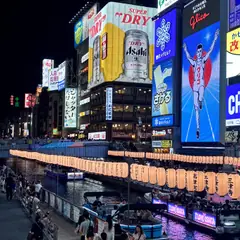
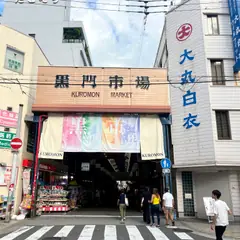
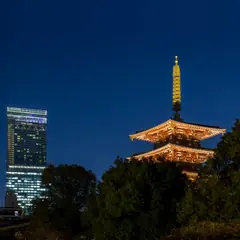
Its neon competes with that of Dotonbori, a few kilometres to the north, and in the same direction lies Kuromon Market, Osaka’s popular pantry. To the east, beyond Tennōji Park, rises Shitenno-ji Temple, tied by tradition to Prince Shōtoku.
The Parisian avenues of the New World
Tsutenkaku Hondōri
Summary of this stop
The tour starts at the north entrance of Tsutenkaku Hondōri, from where the streets converge on the tower. It is no coincidence: from a circular plaza three radial streets ran north in the Parisian manner, Ebisu-dōri, now Tsutenkaku Hondōri, Tamamizu-dōri, now Kasuga-dōri, and Gappō-dōri.
Before it was called Shinsekai, the district was given provisional names such as “New Paris” and “Second Sennichi”. In 1909 the eastern half of the exposition site, some 50,000 tsubo, became Tennōji Park, and the western one, some 28,000 tsubo, the property venture that shaped these streets. What exactly that name of New World promised is the idea with which the narration opens the walk.
Two towers, a fire and a neighbourhood joke
Tsutenkaku Tower
Summary of this stop
Beneath the tower’s four legs, an octagonal ceiling painted with peacocks lights up at dusk: it is a replica, installed in 2015, of the Club cosmetics advertisement that decorated the first tower from 1911 to 1943. That Tsutenkaku of 1912, designed by Shitara Sadao, cost some 97,000 yen and its name, “tall building that communicates with the sky”, was given by the Confucian scholar Fujisawa Nangaku. Its height is a small enigma: it was announced at 300 shaku, about 91 metres, but measured 250, about 75, and some official sources speak of 64. On 16 January 1943 the Ōhashi-za cinema at its feet burned and the fire damaged it; from 20 February its structure was cut up for the war.
The second tower, by the engineer Naitō Tachū, of Tokyo Tower fame, opened on 28 October 1956, a little further north because the original site already had houses. It measures 108 metres with the lightning rod, although the structure comes to 100, and it has been a registered cultural property since 2007. According to a documented tradition, the idea of rebuilding it began around 1953 as a neighbourhood joke, was paid for in part with loans from moneylenders and the company lost its name for two or three days. What they forgot to include in the project, and what the plans revealed in 2022, is the closing touch the narration keeps beneath the legs.
The god of luck who came from Kansas
Billikens at the shop doors
Summary of this stop
At the door of shops and kushikatsu bars, smiling statues with worn-down feet repeat: Billiken. It was created by the illustrator Florence Pretz, an art teacher in Kansas City, who obtained the design patent on 6 October 1908; through a badly made contract she earned only 30 dollars a month, and at the end of 1909 the press wrote that the doll had brought happiness to everyone except its author. In 1912 a Billiken presided over a Luna Park pavilion; the park closed and the statue disappeared. On that land, turned into a depot, Festival Gate and Spa World opened in 1997.
The tower recovered it in 1979, and by March 2012 that wooden carving had the soles of its feet worn down about 4 centimetres after 32 years of caresses; in May 2012 it was replaced by a third, of camphor wood and 60 centimetres, in the golden observatory on the fifth floor. On this same street hung the enormous pufferfish of the Zuboraya fugu house, founded in 1920, the district’s other obligatory photo. What happened to it one night in 2020 is the story the narration tells in front of the Billikens.
Shamisen, shogi and single-dip sauce
Jan-Jan Yokochō
Summary of this stop
The tour ends at Jan-Jan Yokochō, an arcade about 180 metres long and 2.5 wide born in 1921. Its nickname imitates the “jan-jan” of the shamisen with which customers were called in, although the date of the christening is disputed, and its official name, Nan’yō-dōri Shōtengai, is hardly used. Behind its windows games of shogi and go can be seen in halls that have produced several professional players; at the foot of the tower, a gravestone of 1969 commemorates the player Sakata Sankichi.
Here kushikatsu rules. It is dipped in Worcester sauce served in steel containers shared along the whole counter, hence the ban on dipping the same skewer twice, and the thick batter answered a working-class clientele looking to fill up cheaply; the Daruma restaurant opened in Shinsekai in 1929. How this corridor went from feared district to retro destination is the turn with which the narration closes the tour.