Lutheran church
Hallgrímskirkja Audio Guide
A concrete tower that pretends to be basalt, raised over 41 years on the Skólavörðuholt hill: Iceland's largest church hides a story of pirates, ransom and forbidden love in its bells.
- 45 min of audio
- 20th-century architecture
Hallgrímskirkja grew out of a 1929 competition that called for a church for 1,200 people and a tall tower, useful for the radio about to reach Iceland. The State Architect Guðjón Samúelsson began designing it in 1937, inspired by the island's columnar rocks, mountains and glaciers. It was his last work: he died in 1950, 36 years before seeing it consecrated.
Construction began in 1945 at the end opposite the tower and was not finished until 26 October 1986. For decades services were held in the crypt, and the organ that now fills the nave was paid for largely by selling its pipes one by one to anyone who wanted to buy them.
Highlights
- Stepped concrete tower imitating Iceland's basalt columns, about 74.5 metres high
- Leif Erikson statue from 1932, a gift from the United States, older than the church itself
- Three bells named after the poet Hallgrímur, his wife Guðríður and his daughter Steinunn
- Klais organ of 5,275 pipes and 15 metres, funded by selling pipes to private donors
- Baptismal font of real Icelandic basalt and Czech lead crystal
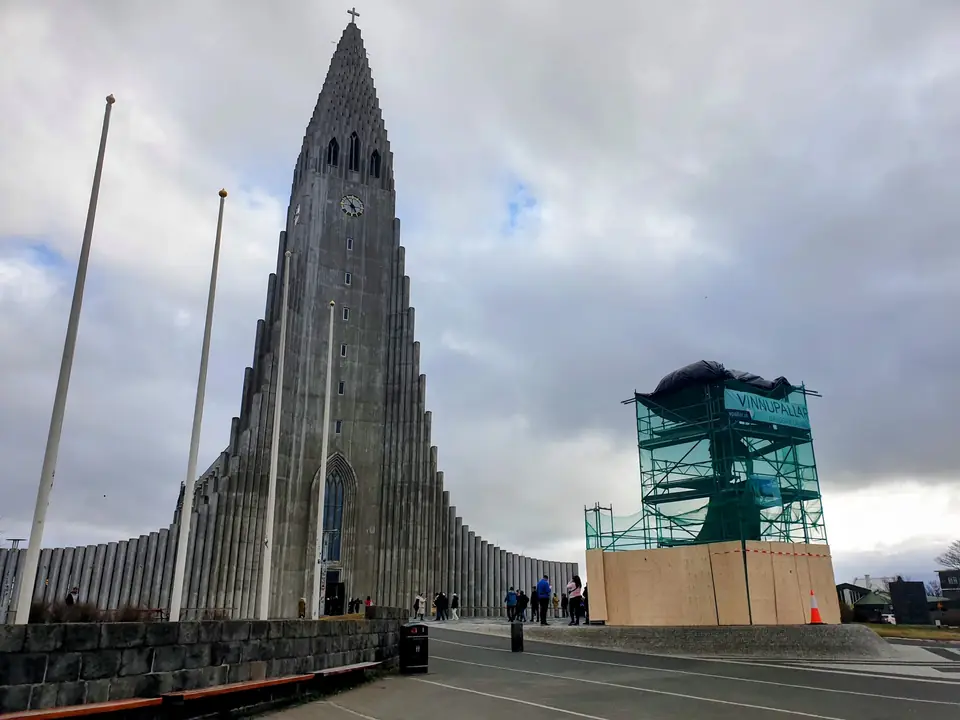
From almost any street in Reykjavik the same grey silhouette peers out: a tower that steps down to the sides like a cascade of columns. It is Hallgrímskirkja, Iceland’s largest church and, at about 74.5 metres, the second-tallest free-standing structure in the country, behind only the Gufuskálar longwave mast. Figures vary by source: the parish speaks of 73 metres for the tower, and everything suggests that different points are being measured. Its history, though, is longer than its shadow. It began with a competition in 1929, continued with Guðjón Samúelsson’s plans from 1937 and stretched across 41 years of construction, from 1945 to 1986, the same year Reykjavik celebrated its bicentenary.
Anyone looking for what to see at Hallgrímskirkja usually settles for the lookout and the façade. But the story of Hallgrímskirkja is also told in what is not obvious at a glance: an old vanished stone tower, a furious poem against the architect, two thirds of the cost paid by the parish itself and by private donors, and a 17th-century family whose names still ring out every hour. The audio guide tours the church in five stops, from the statue on the forecourt to the great organ, with narration documented and checked against historical sources.
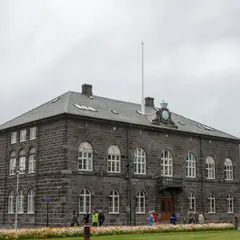
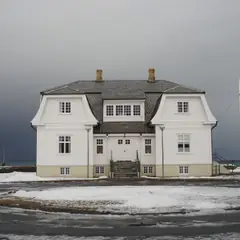
The Leif Erikson statue on the forecourt was the United States’ gift for the Althing’s millennium, an assembly that now meets in the Parliament House, and from the top of the tower the dome of Perlan, the city’s other great lookout, can be seen to the south. The 1986 consecration coincided with the year the Höfði house hosted the Reagan-Gorbachev summit.
A Viking older than the church
Leif Erikson statue
Summary of this stop
Before the church, the hill already had its tower. In 1793 the Skólavarðan, a rectangular stone tower that gave the hill its name, was raised on top of Skólavörðuholt and stood until 1931. Nothing remains of it today: in its place stands Leif Erikson, in bronze, gazing out to sea. The statue, the work of Alexander Stirling Calder, was the US government’s gift for the 1930 millennium of the Alþingi and was unveiled on 17 July 1932, when the church did not yet exist. The old tower was pulled down to make room for it.
The pedestal, of red Texas granite and 4.6 metres tall, imitates the prow of a Viking ship and bears an inscription that was quite a statement: “Son of Iceland”. In Iceland the gift was read as American recognition that Leif was Icelandic, against the Norwegian claim to the explorer; even the spelling of the name on the stone caused comment.
That prow also holds a more homely memory. In the late 1940s and the 1950s the hill was a village of barracks for newcomers to the city, and according to one of those children, the neighbourhood gang had a secret club with a very specific entry test. What it was, and what it says about the height of that statue, is left for the narration at the foot of the pedestal.
Fake basalt and a 1929 antenna
Stepped concrete tower
Summary of this stop
At the foot of the tower, the stepped pillars stop looking like an abstraction. The architecture of Hallgrímskirkja translates into concrete the basalt columns found all over Iceland, along with the outline of its mountains and glaciers, as Guðjón Samúelsson conceived it. The curved wings embracing the tower house services and the parish hall opened in 1974.
The height was not only an aesthetic matter. The 1929 competition demanded a tall tower usable for the broadcasting about to arrive, and the tower still carries radio and telephone company equipment today. Some claim the spire grew to outshine the Catholic cathedral of Landakot, also by Samúelsson, although that version rests on weak sources and the parish explains it by that technical requirement.
The building was born amid criticism: it was accused of being old-fashioned and a mix of styles, and an irritated poet dedicated verses to it that ended by asking the State Architect to stop once and for all. Nor did the concrete prove eternal. The tower, built between 1961 and 1973, already showed damage in 1983, and in the major repair of 2008 a good part of its outer skin had to be redone and the side pillars raised again.
Bells named after a family
Tower lookout
Summary of this stop
A lift climbs to the tower’s lookout, with Reykjavik at one’s feet, the mountains in the distance and the ocean all around. Up there also live the bells: three large ones, named Hallgrímur, Guðríður and Steinunn, plus a carillon of 29 bells, the first of its kind in Iceland. The heaviest, Hallgrímur, at 2,851 kilos, is the one that strikes the hours.
The names are those of the poet Hallgrímur Pétursson, his wife and his daughter. Behind Guðríður’s lies one of the island’s most novelistic stories, gathered by documented tradition: abducted in 1627 by Barbary pirates in the Westman Islands, sold as a slave in Algiers and ransomed almost ten years later by the King of Denmark. In Copenhagen, a student about to finish his studies was charged with restoring the captives’ faith and language.
That student was Hallgrímur, and what happened between them cost him his career. For centuries, too, folk tales distorted the figure of Guðríður into something else, a portrait scholars now dispute. How the episode ends, and why the bell gives her back some dignity, is heard right there, with the sound of the hours in the background.
Hymns of a grieving father
Glass pulpit
Summary of this stop
Inside, beside the pulpit and the baptismal font, the poet who gives the church its name becomes almost tangible. The glass pulpit, by Leifur Breiðfjörð, reproduces images from the autograph of the Passíusálmar, the 50 Hymns of the Passion by Hallgrímur Pétursson (1614–1674), in the greens and purples of Lent. First published at Hólar in 1666 and printed 87 times, these hymns are recited aloud in the church every Lent, with a full reading on Good Friday.
A few steps away, the baptismal font consecrated in 2001 resolves a paradox of the façade: it is made of Icelandic columnar rock and Czech lead crystal, so the basalt that the exterior imitates in concrete appears here in real stone.
The hymns have a hard biography behind them. Steinunn, the daughter who gives her name to another of the bells, was born at Hvalsnes, where Hallgrímur was pastor, and died as a child; according to tradition, her father wrote her a deeply personal poem and carved with his own hands the gravestone that is still kept there. The poet’s own end, in 1674, completes a story that the narration unfolds in front of the glass.
An organ paid for pipe by pipe
Klais organ
Summary of this stop
Beneath the organ, with the whole white nave ahead, the scale of the undertaking becomes clear. The Klais organ, built in Bonn and inaugurated in December 1992, stands 15 metres high, weighs about 25 tonnes and has 5,275 pipes and 72 stops: it is the largest in Iceland. It was financed mainly by donations, inviting people to buy pipes, and the church shop still sells certificates of ownership of a specific pipe.
At the far end, the cylindrical apse marks where it all began. Work started in 1945 at that end, and in 1948 the crypt under the choir was consecrated as a parish hall; Mass was celebrated there until 1974. The State and the city backed the project, but two thirds of the cost came from the church’s own funds and from private donors, among them the Hallgrímskirkja Women’s Association, founded in 1942.
The consecration came on 26 October 1986, after 41 years of work. Seen from here, the grey tower that looked cold from outside takes on another meaning, and the tour’s last stop gathers the pieces of that patient, collective work.