Lookout and museum
Perlan Audio Guide
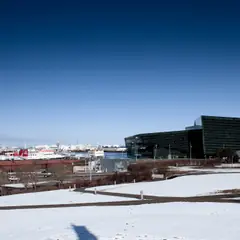
A glass dome atop Öskjuhlíð that looks like an observatory and is in fact the lid of the hot-water tanks that still heat Reykjavik.
- 60 min of audio
- Geothermal architecture
Perlan opened on 21 June 1991 above six geothermal water tanks, with a dome designed by the architect Ingimundur Sveinsson. It was built by the municipal heating company, Hitaveita Reykjavíkur, and today combines a lookout, a natural history museum, an ice cave and a planetarium without ever ceasing to be part of the network that brings heat to the city.
The steel frame holding up the glass is hollow: hot water runs through it on cold winter days and cold water on the hottest summer ones. The whole building works as its own radiator, and four of its six tanks still store hot water for Reykjavik.
Highlights
- Glass dome by Ingimundur Sveinsson — opened on 21 June 1991 above six tanks
- Hollow steel frame — the water that heats or cools the building flows inside
- Artificial ice cave — about 100 metres of ice, snow and ash at 10 degrees below zero
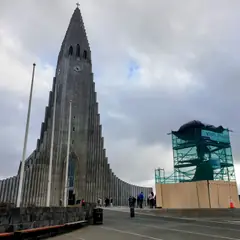
- 360° observation deck — the city, the bay, the mountains and the Hallgrímskirkja tower
- Rotating restaurant — a full turn of the city every hour beneath the glass
From almost anywhere in Reykjavik a gleaming half-sphere can be seen above the wooded hill of Öskjuhlíð. Anyone looking for what to see at Perlan tends to imagine a lookout with a restaurant, and it is one, but its history begins much earlier and underground: around 1939 the city’s first hot-water tank was built on that summit, and in the next two decades five more followed. Sources do not entirely agree on the date: Perlan’s official website gives 1939, while others place the first tank in 1940 and the construction of the whole complex between 1940 and 1966.
The original tanks were demolished and rebuilt in 1986–1987, and over them the architect Ingimundur Sveinsson designed the glass dome that began construction in 1988 and opened on 21 June 1991. The story of Perlan is that of a piece of municipal plumbing turned into a symbol, with its share of controversy, a painter’s dream that came six decades early and a recent multimillion sale. The 60-minute tour follows that thread from the forecourt to the circular platform, with narration documented and checked against historical sources that is best heard on the spot, with the whole city at one’s feet.
From this same hill of Öskjuhlíð came, by train, the rock used to build the breakwaters of the Old Harbour, and from the platform the view reaches the tower of Hallgrímskirkja, Reykjavik’s other great lookout.
Six tanks under a glass bubble
Perlan
Summary of this stop
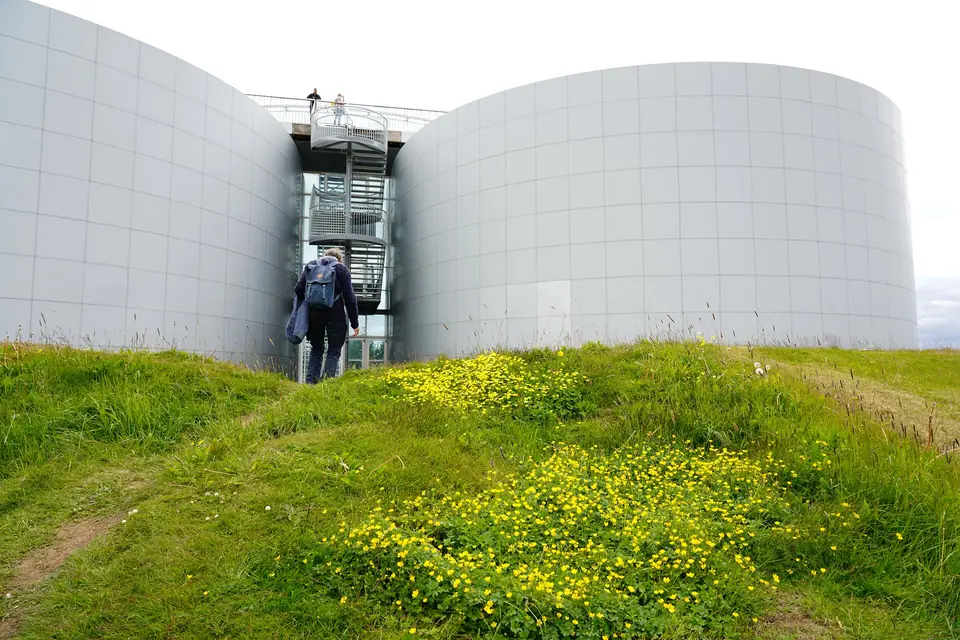
On the forecourt, the six large cylinders arranged in a ring make the essential point clear: the dome is not a floating whim but the lid of a hot-water system. According to the official website, each tank can hold about 4 million litres of geothermal water (other sources, without clear backing, speak of 5 million). Four still store water for the city; the other two changed their lives, one to house an ice cave and the other a planetarium.
Long before this dome, in 1930, the painter Jóhannes Kjarval imagined on Öskjuhlíð a temple-building with its sides covered in mirror tiles so that the northern lights would come down to people’s feet, with a roof of coloured glass and a spotlight on the summit to light up the tanks. What was built in 1991 echoes, in its way, something of that vision of glass and light.
The city, for its part, has its own reading of the building. A popular joke says the dome on its hill resembles a giant nipple, a female counterpart to the Hallgrímskirkja tower, to which phallic symbolism is attributed: two landmarks of Reykjavik’s skyline facing each other. The detail that links Kjarval’s dreamed temple with what is seen on the hill today is best appreciated by hearing the narration in front of the tanks.
A steel skeleton that works as a radiator
Steel frame and grand staircase
Summary of this stop
On entering the foyer, the eye rises to the steel lattice that joins the tanks and holds up the glass. Those beams are hollow and form the building’s radiator system: in winter hot water flows through them and on the hottest summer days, cold water. Rarely is the architecture of Perlan, with its futuristic air, so literally a heating installation.
The project was driven by the municipal company Hitaveita Reykjavíkur, largely through the determination of Davíð Oddsson during his time as mayor. The opening was not a calm one: the cost, equivalent to about 64 million dollars at the time, set off fierce criticism, and soon afterwards, as it is remembered, fourteen visitors were trapped in one of its lifts and nearly suffocated because the emergency bell did not work. The episode added fuel to the controversy.
Beside the grand staircase an artificial geyser worked for years, throwing water from the ground floor to the fourth. Today the jet is idle, and its silence is part of the story of a building that wanted to show off the future from day one.
A glacier inside a hot tank
Ice cave
Summary of this stop
One of the cylinders meant to store geothermal water now holds glacial cold. On 2 July 2017 the exhibition Glaciers and Ice (Jöklar og íshellir) opened there, starting with an artificial ice cave of about 100 metres, built by Johan Larsson from ice, snow and ash and kept at 10 degrees below zero. The physical paradox is hard to miss: a frozen tunnel inside a hot-water tank.
The change of use has its own history. One of the tanks housed for years the Sögusýningin, an exhibition on the history of Iceland. On 22 November 2012 the city council approved negotiating with Orkuveita Reykjavíkur to buy the building and lease it to the State as the home of a natural history exhibition, and the city closed it in 2013.
In 2018 the planetarium was added, and with the museum Iceland’s natural history collections, kept in boxes for decades, went back on public display. A heating company’s building thus ended up a showcase for the country’s glaciers, volcanoes and wildlife.
Hallgrímskirkja, the yardstick of the tanks
360° observation deck
Summary of this stop
The 360° observation deck on the fourth floor circles the dome and opens the view to the city, the bay and the mountains. Towards the old town the Hallgrímskirkja tower stands out above Skólavörðuholt, and not by chance: the first tank was placed at 61 metres above sea level because that height gave enough pressure to lift water to the tenth floor of a building standing at 38 metres, the elevation of that hill. The water came from Reykir, in Mosfellssveit, along a 15 km pipeline that was the longest in the world when it was built; the heat kept snow from piling up on top and neighbours used it as a path between districts.
Beneath the glass, the restaurant makes a full turn every hour, and at the top of the dome a light rotates as a signal to the planes of Reykjavik airport, at the foot of the hill. That proximity gave rise to one of the most curious episodes in the city’s recent history: the Öskjuhlíð forest, planted since the 1950s, grew until it encroached on the approach to the east-west runway.
In 2023 Isavia demanded the felling of 2,900 of its 8,300 trees; the city resisted and on 8 February 2025 the runway was closed, a dispute the mayor cited the next day when announcing the break-up of the municipal coalition. The felling was won for 19.7 million krónur by Tandrabretti, a pallet maker from Eskifjörður, against the 142 and 468 million asked by two landscaping firms. How those trunks ended up, and what is seen today from the platform, closes the tour with the whole city in view.