Historic harbour
Old Harbour Audio Guide (Gamla höfnin)
A hand-made harbour built with rock brought by train, where whale-watching boats moor beside whalers, a patrol vessel from the Cod Wars and warehouses that are now museums.
- 45 min of audio
- Harbour and maritime history
Reykjavik's Old Harbour was built between 1913 and 1917: first the Ingólfsgarður breakwater, from the city side, and then Norðurgarður, from the island of Örfirisey. Between the two arms they enclosed some 46 hectares of water. It was pushed by the merchants of the centre, who feared seeing the harbour built elsewhere, after the isthmus to Örfirisey broke in 1902 and a storm in 1910 tore many boats from their moorings.
The name is misleading: for half a century it was simply the harbour. Only when the first phase of Sundahöfn opened in 1968 and the cargo moved there did it begin to be called “old”. Since then its warehouses have become an art museum, a flea market and a maritime museum, and on its quays the booths selling the thrill of seeing whales sit alongside the whalers that hunt them.
Highlights
- Steinbryggja — the stone pier of 1884, buried around 1940 and unearthed in 2018
- Mosaic by Gerður Helgadóttir — 44 by 4.5 metres on the life of the harbour, on the old customs house
- Minør locomotive — survivor of the train that brought the breakwater rock from Öskjuhlíð
- Hvalur 6 and Hvalur 7 — the whalers sunk in the harbour in the early hours of 9 November 1986
- Patrol vessel Óðinn — 63 metres, veteran of all three Cod Wars and a museum ship since 2008
Almost everything a stroller treads on in Reykjavik’s Old Harbour, Gamla höfnin in Icelandic, is land that used to be sea. Between 1913 and 1917 the city closed the bay with two arms of rock, Ingólfsgarður and Norðurgarður, and the stone arrived on a small steam train from the Öskjuhlíð quarry. Behind the work lay haste and rivalry: at the start of the 20th century the poet and entrepreneur Einar Benediktsson had founded, with English financiers, the company Höfn to build his own harbour, and that competition most likely sped up the project that the city council approved in 1911 and awarded to the Danish engineer N. C. Monberg.
Today the place has a pleasant promenade air, with tour booths, museums and the mountain of Esja closing the horizon across the bay. But these quays have seen an invasion land, two whalers sink and ships sail off to fight for cod. What to see at Gamla höfnin and what its history is are best understood on foot, quay by quay, from the old stone landing to Grandi’s Maritime Museum: it is the route the audio guide follows, documented and checked against historical sources.
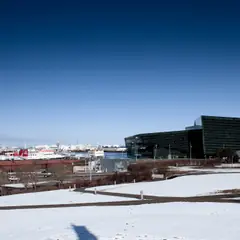
The breakwater rock came by train from Öskjuhlíð, the hill now crowned by Perlan; on the harbour’s east shore the glass of Harpa gleams, and a few streets inland the Settlement Exhibition keeps the remains of the first Reykjavik.
A stone pier under the asphalt
Steinbryggja
Summary of this stop
The route starts by going down, not up. Wooden dock steps descend to the Steinbryggjan, the stone pier the city council paid for in 1884, expensive for its day, to replace the merchants’ small wooden landing stages. For decades it was the first ground anyone arriving in Iceland stepped on. Around 1940 it vanished under the harbour’s landfill and only showed itself now and then when a trench was opened.
In the summer of 2018, during works on Tryggvagata and Hafnartorg, it appeared beneath Pósthússtræti so intact that it surprised the landscapers themselves. The approved project planned to cover it again; the design was changed, the street was renamed Steinbryggja and the recovered pier was inaugurated on 12 June 2020, with a poets’ bench and the poem “Vetur” by Vilborg Dagbjartsdóttir carved in the rock.
This point marks the old shore, the one from before the breakwaters, and explains the urgency with which the city wanted a real harbour after the storms of the early century, when the merchants of the centre feared it would be taken to Nauthólsvík or the island of Viðey. How that tug-of-war was won, and what it says about the city, is left for the narration, heard on the spot.
The customs house that awaited a motorway
Tollhúsið
Summary of this stop
On the façade of the old customs house, the Tollhúsið, spreads a 44 by 4.5 metre mosaic by the artist Gerður Helgadóttir devoted to the life of the harbour. It was made with the German Oidtmann brothers’ workshop and installed in 1972–1973, after the wall stood for years unplastered awaiting the Finance Minister’s permission. The rest of the wall is clad in green gabbro slabs.
The building, opened in early 1971, holds a plan that was never fulfilled: it was designed under the obligation to let a four-lane motorway along Geirsgata pass over it, at a height of 6.5 metres. In 1986 the quay was extended 20 metres, the street was laid at ground level and that elevated motorway stayed on paper. Around 1994 its former port warehouse came to house the Kolaportið flea market.
A few steps away, Hafnarhús shows the other face of the working harbour. The warehouse and port offices designed between 1933 and 1939 by the architect Sigurður Guðmundsson and harbour master Þórarinn Kristjánsson, one of the largest buildings in Iceland in its day, keeps its horizontal lines and its truck bays, and since April 2000 it has been home to the Reykjavik Art Museum, with the Erró collection.
Minør, the train that raised the breakwaters
Miðbakki
Summary of this stop
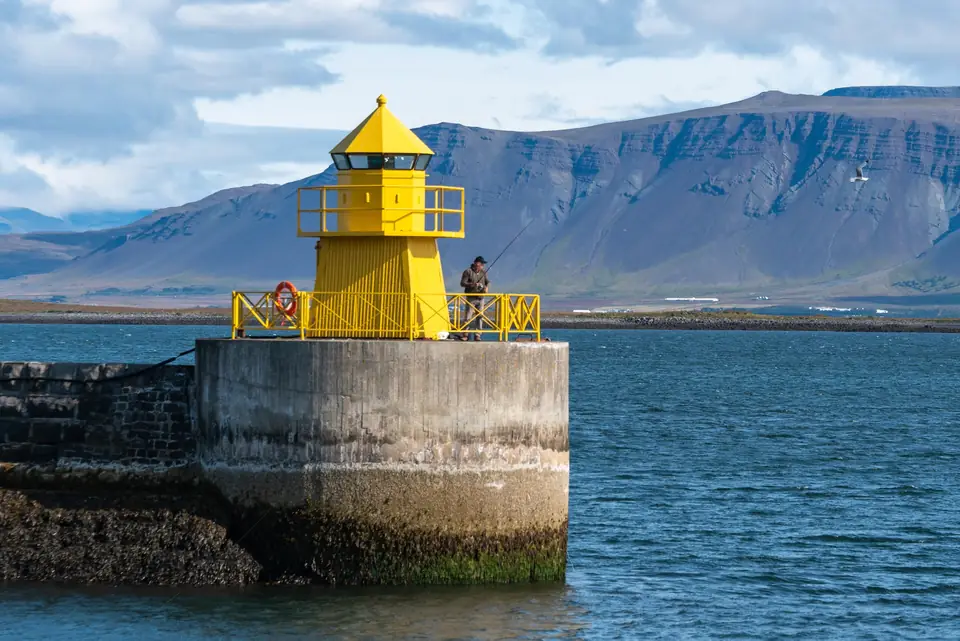
From the edge of Miðbakki the two rock arms that close the harbour can be seen and, between them, the opening through which fishing boats, whalers and tour boats enter. To build them a narrow-gauge railway was laid that ran intermittently between 1913 and 1928, pulled by two German steam locomotives from the Jung company, Minør and Pioner. Both survive: Pioner in the Árbær museum and Minør in the open air on the quay.
That train had a price. In 1916 it ran over Guðlaug Eiríksdóttir, a five-year-old girl, beside the docks; she died the next day in hospital: it was Iceland’s first railway death.
These same quays were also the gateway of an invasion. According to the account that has come down to the present, in the early hours of 10 May 1940 a British seaplane woke half the city, the German consul went down to the harbour with binoculars and, around five, the destroyer Fearless docked at the old pier loaded with marines before a knot of onlookers. What an Icelander did with the rifle of one of those soldiers sums up the tone of the day, and the audio guide tells it at the exact spot where it happened.
Whale watching beside the whalers
Ægisgarður
Summary of this stop
At Ægisgarður the booths of the whale- and puffin-watching operators line up, with their boats moored in front. When they are in port, the dark hulls of the Hvalur hf. whalers peer out behind the buildings, with their name and number. Few places put side by side so closely the two trades that the northern sea sets against each other.
In the early hours of 9 November 1986, around five, the Sea Shepherd activists Rod Coronado and David Howitt opened the cooling valves of Hvalur 6 and Hvalur 7, moored unguarded, and sank them in half an hour. The two 430-tonne vessels were refloated that same month and never hunted again. The episode still receives opposing labels: for the Icelandic government and part of the press it was terrorism or vandalism; for its perpetrators, an action against a hunt they considered illegal after the International Whaling Commission’s moratorium. Iceland never pressed charges and the offence expired under the statute of limitations.
Hvalur 8 was saved that night because it had a watchman aboard, and its story is even stranger: built in Norway in 1948, in 1973 it was requisitioned by the Coast Guard, repainted and armed with a cannon for the second Cod War. How it ended up going back to work decades later is one of the twists this stop keeps.
Óðinn, the ship that rammed for cod
Reykjavík Maritime Museum
Summary of this stop
The route ends in front of the patrol vessel Óðinn, built in Aalborg in 1959, of 910 tonnes and 63 metres, which took part in all three Cod Wars. On its stern deck the trawl-wire cutter is still there, and on 30 April 1976 it rammed the British trawler Arctic Corsair after three attempts to cut its wires. Since 2008 it has been a museum ship beside the Maritime Museum, housed in a former fish-freezing plant of 1947, and in 2017 it swapped its bell with that of the Arctic Corsair, also turned into a museum.
Every first Sunday in June the harbour becomes the seafarers’ again with the Sjómannadagurinn, Seamen’s Day, which Reykjavik has celebrated since 1938. Wreaths are laid for sailors who died and the quay fills with families, rescue demonstrations, the línubrú, the lifeline across which one crosses hanging, and strange fish on ice; that day entry to the museum and to Óðinn is free.
Further on, at the tip of Grandi, stands Þúfa, an 8-metre grass mound by the artist Ólöf Nordal with a fish-drying shed on top: an artificial hill on land won from the sea, a lookout over the harbour mouth and Esja. The perfect finale for a harbour that only began to be called old in 1968, and whose latest twist is heard with eyes on the water.