Political history
Parliament House Audio Guide (Alþingishúsið)
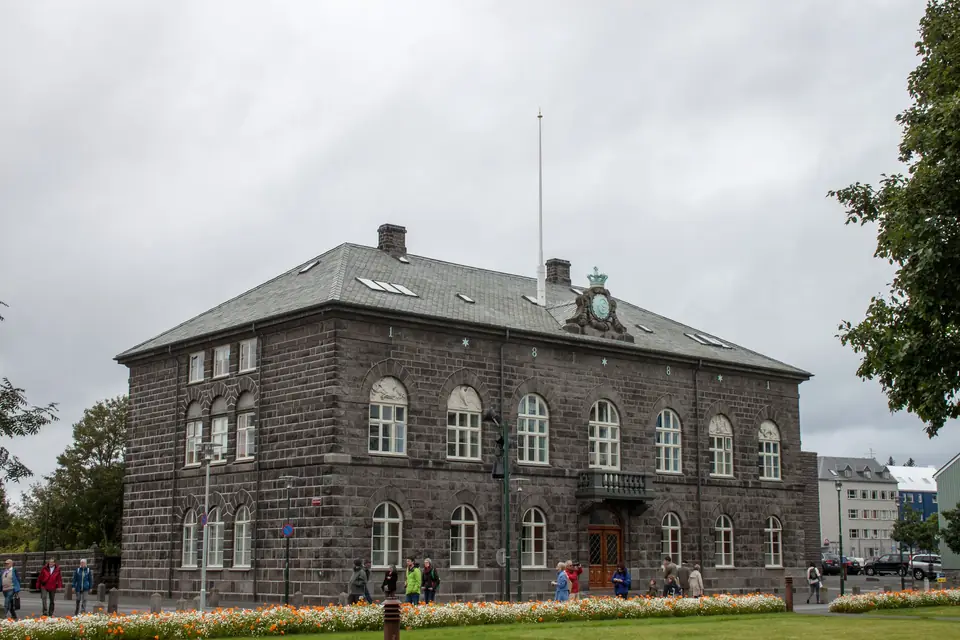
A volcanic-stone house of 1881, still crowned by the emblem of a Danish king, where an assembly born in the open air around the year 930 meets. Its façade has received wreaths, stones, eggs and skyr: here Iceland celebrates and argues over its power in full view.
- 30 min of audio
- Volcanic stone of 1881
The story of Alþingishúsið begins in 1867, when the Althing decided to mark the millennium of Iceland's settlement with a Parliament house raised in Icelandic stone. It was designed by the Dane Ferdinand Meldahl, director of the Copenhagen Academy of Fine Arts, and built between 1880 and 1881 with dolerite cut on the Skólavörðuholt hill, the same one where Hallgrímskirkja now stands. It opened on 1 July 1881 and has housed since then the assembly that had been reborn in Reykjavik in 1845.
The contrast is plain in the architecture of Alþingishúsið: at the top of the façade the crown of Christian IX of Denmark remains, although Iceland has been a republic since 1944, and beneath it four Icelandic guardian spirits watch from the windows. Opposite, the square Austurvöllur has been the stage of the country's great protests, from the broken glass of 1949 to the pots and pans of 2009 and the afternoon of 2016 that brought down a prime minister.
Highlights
- Crown and emblem of Christian IX — a Danish king over the Parliament of a republic
- Reliefs of the four landvættir — giant, bird, bull and dragon, guardians of Iceland
- Dolerite walls of 1881 — rough stone from the Hallgrímskirkja hill
- Façade of the protests — stones in 1949, pots and pans in 2009, skyr in 2016
- Statue of Jón Sigurðsson — by Einar Jónsson, facing Parliament since 1931
Facing the square Austurvöllur stands a grey two-storey house that does not look like what it holds. It is Alþingishúsið, the seat of Iceland’s Parliament, the Althing, an assembly founded around the year 930 in the open air at Þingvellir, dissolved by royal decree in 1800 and restored in Reykjavik on 1 July 1845. During its first decades it met in the old Latin School, now Menntaskólinn í Reykjavík, until in 1881 it moved to this building. It is often presented as the oldest functioning parliament in the world, although the title is disputed: it was interrupted between 1800 and 1845 and was only advisory until 1874, and Guinness recognises it as the oldest legislative body on record while attributing the longest continuous history to the Tynwald of the Isle of Man.
The history of Alþingishúsið is also that of its site. In 1867 the Althing decided to mark the settlement millennium with a house of its own in Icelandic stone; the hill of Arnarhóll and Bakarabrekka were considered, and it was even planned to build it on Bakarastígur, today’s Bankastræti, before opting for the old cabbage garden of Professor Halldór Kr. Friðriksson, beside Kirkjustígur, who sold the land for 2,500 krónur, a price considered exorbitant. The architect was the Dane Ferdinand Meldahl, who in those same years was directing the reconstruction of Frederiksborg Castle and the completion of the Frederik’s Church in Copenhagen.
Inside, the building came to house the National Library, the Antiquities Collection and the National Gallery; the University of Iceland occupied its first floor from 1911 to 1940 and the country’s president had his office here until 1973. Today what remains is mainly the plenary chamber and a few rooms, but the true story is outside, in the stone and in the square. What to see at Alþingishúsið is best understood by touring its exterior stop by stop with the audio guide, documented and checked against historical sources.
About 150 metres away, beneath a hotel on Aðalstræti, the Settlement Exhibition shows the Viking hall where the city’s history begins, and high on Skólavörðuholt the Leif Erikson statue at Hallgrímskirkja recalls the United States’ gift for the Althing’s millennium in 1930.
Jón Sigurðsson facing Parliament head-on
Austurvöllur
Summary of this stop
In the centre of Austurvöllur, a bronze by Einar Jónsson faces the façade head-on. It is Jón Sigurðsson, leader of the independence movement, sculpted for the centenary of his birth in 1911. The statue was unveiled that year in front of the Government House and in 1931 moved here, where it replaced Bertel Thorvaldsen’s self-portrait, a gift from Copenhagen in 1874. Of the Danish sculptor only the name of the street Thorvaldsensstræti remains, on one side of the square. On the pedestal appears the relief “The Pioneer”, and Einar himself said that, on that base, the figure seemed to fall backwards.
This pedestal and the Parliament door are joined every 17 June, Iceland’s national day, in a documented tradition. The official ceremony begins at eleven after a service in the cathedral: in 2026, Prime Minister Kristrún Frostadóttir and President Halla Tómasdóttir walked out of the building together with two newly graduated secondary-school students carrying the wreath, laid before the statue on behalf of the Icelandic people.
Then comes the most awaited moment: the Fjallkonan, the “Lady of the Mountain”, speaks, her identity kept secret each year until that instant. Who embodied that figure in 2026 and where the procession heads at the end is part of what is told right there, with the statue in front.
The windows the country stoned
Main façade windows
Summary of this stop
From the lawn in front of the main façade, Austurvöllur reveals itself as the great stage of Icelandic protest. The tradition begins in 1905, when thousands gathered over the so-called “símamál”, the dispute over telegraph communications; in 1915 the square filled to celebrate women’s suffrage. On 30 March 1949, while the Althing voted on Iceland’s entry into NATO, protesters threw stones and eggs at a building defended by hundreds of citizens: not a window on the main façade was left whole, some stones fell inside the plenary chamber and the police used tear gas for the first time in the country.
Sixty years later the uproar returned. From 20 to 22 January 2009, in the Búsáhaldabyltingin or “pots-and-pans revolution”, thousands surrounded Parliament banging pots, broke windows and threw skyr and snowballs at the stone. On 22 January tear gas returned, for the first time since 1949, and Geir Haarde’s government resigned on the 26th.
In April 2016, after the publication of the Panama Papers, an improvised call on Facebook filled the square while the MPs were still in session; estimates speak of 9,000 to 23,000 people, one of the largest political demonstrations in Icelandic history. How it went from tubs of skyr against the façade to the fall of a prime minister in under 48 hours is the episode this stop unfolds.
A Danish crown and four Icelandic guardians
Crown of Christian IX
Summary of this stop
At the foot of the north façade, the architecture of Alþingishúsið reads as a document of double loyalty. At the very top of the roof the crown and emblem of King Christian IX of Denmark remain, and under the eaves the date 1881 in metal figures separated by stars. Everything is still in place although Iceland has been a republic since 1944.
Lower down, above four windows, the landvættir appear in relief, Iceland’s guardian spirits: a giant, a bird, a bull and a dragon. The paradox is one of the calendar: these figures were already watching over the façade in 1881, but did not enter the country’s official coat of arms until 12 February 1919.
The walls tell their own story. They are ashlars of dolerite, volcanic stone taken from the Skólavörðuholt hill and left barely dressed on the outside. With this work and with the Skólavörðustígur prison of 1872, Reykjavik’s craftsmen learned to cut the stone of their hills for building, following Meldahl’s design. What that rough texture reveals about the country that raised it is best appreciated with the narration and the façade a step away.
A few steps from cathedral to Parliament
Dómkirkjan
Summary of this stop
Next to Parliament stands the Dómkirkjan, the Lutheran cathedral. Since the Althing’s restoration in 1845, every parliamentary session begins with a service there, and the dean then leads the MPs in procession to the stone house. It is barely a few steps, charged with solemnity.
After the banking collapse of 2008, that walk became something else. At the opening in October 2010, some 2,000 protesters threw eggs and tomatoes at Prime Minister Jóhanna Sigurðardóttir and other politicians; a year later, with pots and pans, firecrackers and yoghurt in the air, an MP ended up on the ground after an egg hit his head, and President Ólafur Ragnar Grímsson spoke in his speech of a dangerous gulf between the people and the politicians.
At the back await two quieter corners: the Kringlan, the rotunda added in 1908–1909 for Hannes Hafstein and to receive heads of state, and the Alþingi garden, of 1893–1894, surrounded by stone walls and protected since November 2024. Official sources attribute it to the initiative of the MP Tryggvi Gunnarsson, although the municipal website mentions another promoter. The reason a monument by Ríkarður Jónsson stands among its flowerbeds is the last secret of the tour.