Cold War setting
Höfði Audio Guide
A timber house that arrived by sea from Norway in 1909 and ended up holding, for two days in October 1986, the nuclear fate of the planet. Among consuls, poets and ghosts, Höfði keeps the Reagan-Gorbachev summit a few steps from the bay.
- 25 min of audio
- Cold War history
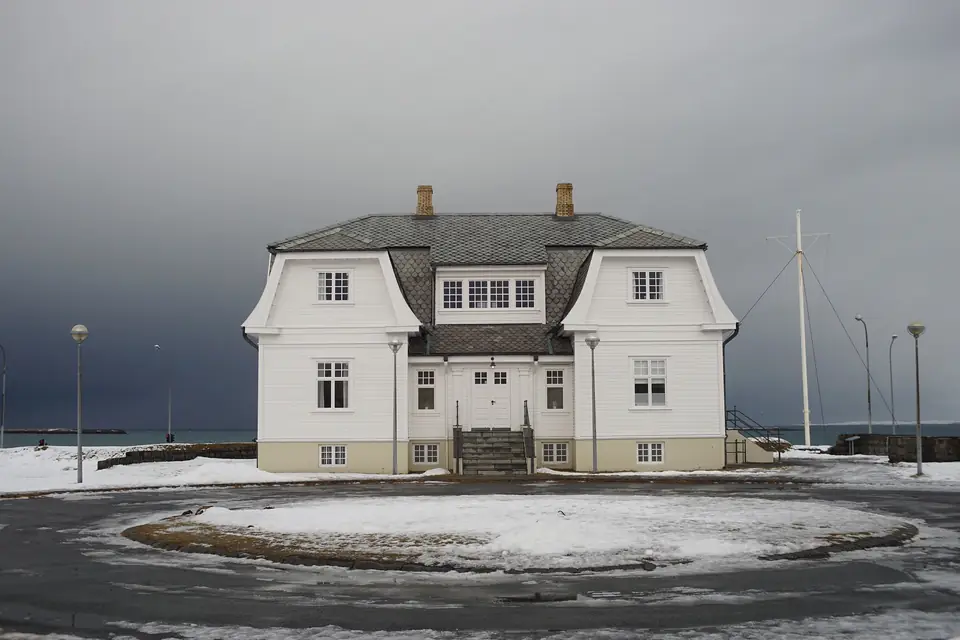
Höfði was prefabricated in Norway and raised in 1909 facing Reykjavik's bay for the French consul Jean-Paul Brillouin, even before the city granted permission. It was the largest private estate in the capital, a mix of Art Nouveau, neo-baroque and Norwegian national romanticism, and later the residence of a poet, the British consulate and the mayor's reception hall.
On 11 and 12 October 1986, Ronald Reagan and Mikhail Gorbachev came to discuss here eliminating all nuclear weapons within ten years. The summit broke down over a single word, but what was achieved in this white house led to the INF Treaty of 1987.
Highlights
- Reagan-Gorbachev summit — 11 and 12 October 1986, one step from total nuclear disarmament
- Catalogue house — prefabricated in Norway and raised in 1909 for the French consul
- Statue of Einar Benediktsson — six metres by Ásmundur Sveinsson, beside a harp
- Fragment of the Berlin Wall — about 4 tonnes from Potsdamer Platz, painted by Jakob Wagner
- Iceland's first radiotelegram — sent from this site to Poldhu in 1905
Alone on an open lawn facing the bay of Faxaflói, with the mountains of the far shore behind, Höfði seems too small for what it has lived through. It is a white timber house with sloping roofs that arrived in pieces from Norway and was assembled in 1909 for the French consul. In a little over a century it passed through the hands of a visionary poet, a hydroelectric company, a doctor, the British foreign service and, since 1958, the City of Reykjavik, which uses it as an official reception hall.
The history of Höfði begins even before the house: on this very site, in 1905, the first radio communication between Iceland and the outside world was established. And it reaches its peak in October 1986, when Ronald Reagan and Mikhail Gorbachev sat down here and came close to agreeing the end of all nuclear weapons. Around that web of diplomacy are tangled ghosts, an almost clandestine restoration and a fragment of the Berlin Wall. The tour circles the house from outside, from the façade to the seaward side, and the documented narration unfolds what to see at Höfði and why this little catalogue house ended up in the history books.
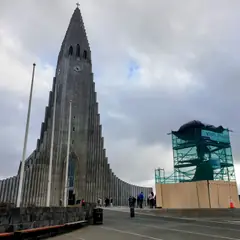
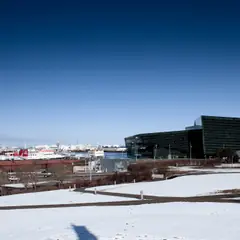
Along the bay promenade, a little over a kilometre to the west, lies Harpa, and the same autumn as the summit Hallgrímskirkja was consecrated, after 41 years of work.
A catalogue mansion from Norway
Höfði
Summary of this stop
The first encounter is with the façade: boards painted white, sloping roofs and a decoration where Art Nouveau, classical neo-baroque and Norwegian national romanticism coexist. The architecture of Höfði is that of a catalogue house, prefabricated in Norway and shipped to Iceland for the French consul Jean-Paul Brillouin. It was raised in 1909, before the planning department granted permission, and in its day it was the largest private estate in Reykjavik.
Inside, on the door of the reception room, Brillouin’s name and the year 1909 are still written in gold letters. As to who designed it, popular accounts give different versions: some tourist websites attribute it to the Icelandic architect Guðjón Samúelsson, while most sources describe it as a house designed in Norway and exported.
Its timber fragility was exposed on 25 September 2009, the very day it turned a hundred: a fire damaged it, although all the irreplaceable objects were saved. What that coincidence says about the house is left for the narration on the lawn itself.
The door that faced the sea
Höfði's bay-side façade
Summary of this stop
On the side facing the bay stood the main entrance in the early years. Brillouin, married to a Norwegian woman, lived here until 1913, and soon afterwards the door was moved. From this side the house looks out on the same open view over the water that its original façade had before it.
In 1938 the British foreign service bought Höfði from the doctor Matthías Einarsson and made it a consulate and then an embassy; sources disagree on how long that stage lasted, which the Icelandic Wikipedia extends to 1951. During the Second World War Winston Churchill and Marlene Dietrich passed through the house. The city bought it in 1958, restored it and since 1967 has used it for the mayor’s receptions.
Between one era and another slips in the house’s most disputed story: that of its “white lady”. It is said that the last British ambassador who lived here, John Greenway, complained of knocks in the night and asked London for permission to sell it. The Foreign Office’s official reply about the supposed ghost is the part that sounds best right there, facing the sea.
A six-metre poet and his ghost
Einar Benediktsson statue
Summary of this stop
Beside the house rises, outsized, the statue of Einar Benediktsson sculpted by Ásmundur Sveinsson: six metres, the poet standing next to a harp, because the sculptor wanted to show that Einar did not know how to think small. It stood in Klambratún from 1964 and moved here on 31 October 2015, the anniversary of the poet’s birth. Next to it, a bench lets visitors listen to his poems through a QR code.
Nearby, a plaque recalls that on 26 June 1905 this site was Iceland’s first window of radio: a Marconi antenna promoted by Einar himself communicated with Poldhu, in Cornwall, and worked until October 1906. Poet and businessman, Einar lived at Höfði with his family, between 1914 and 1917 according to the city (other sources lengthen his stay), and the house then passed to Títan, the company he had co-founded to study the hydroelectric use of the river Þjórsá.
A shadow accompanies the poet’s figure. According to a documented tradition, Einar, as a district magistrate, presided over the case against a maidservant from the north who died in the middle of the process, and he himself said that the young woman appeared to him at night in this house. Who she was and what happened at that trial, still disputed, is what the stop finishes telling.
The word that broke the summit
Reagan-Gorbachev summit plaque
Summary of this stop
A plaque recalls the meeting of October 1986. The summit was announced on 30 September and Reykjavik, which was celebrating its 200 years as a city, had some ten days to prepare: about 2,000 officials and journalists arrived, roughly as many as there were hotel beds in the whole urban area. The government requisitioned four hotels and asked Icelanders to eat at home.
Behind those windows, on 11 and 12 October, Reagan and Gorbachev came to discuss eliminating all nuclear weapons within ten years. The summit broke down because Gorbachev demanded that Strategic Defense Initiative research be limited to the laboratory, and Reagan asked him whether he was going to turn down a historic opportunity over a single word.
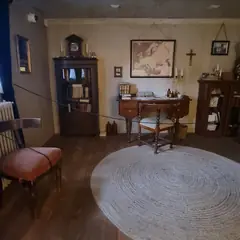
Inside, the meeting room remains almost exactly as that October, with the guest book signed by both in a display case and the flags of the United States and the Soviet Union crossed. It opens only on open-door days, so the story of Höfði in those decisive hours is reconstructed from outside, step by step, in the audio guide.
A piece of the Wall facing the bay
Berlin Wall fragment
Summary of this stop
The tour ends before a fragment of about four tonnes of the Berlin Wall, from the Potsdamer Platz section, painted by the street artist Jakob Wagner. It was given by the art centre Neu West Berlin and installed here in 2015, on the 25th anniversary of German reunification.
The Höfði summit ended without agreement, but what was achieved there led to the INF Treaty on intermediate-range nuclear forces, signed in Washington on 8 December 1987. And on 26 August 1991, in this very house, the foreign ministers of Estonia, Latvia and Lithuania signed with the Icelander Jón Baldvin Hannibalsson the re-establishment of relations: Iceland was the first state to recognise their independence.
The image of the house travelled so far that, it is said, a Japanese businessman had an exact replica built in his country. How that distant twin, the painted wall and the little white house are linked is the closing the narration reserves for this last point.