Viking archaeology
Settlement Exhibition Audio Guide (Landnámssýningin)
Beneath a hotel on Aðalstræti still stands Reykjavik's first known home: a 10th-century hall and, beside it, a turf wall raised before the ash of 871 covered Iceland.
- 60 min of audio
- 10th-century ruin
The Settlement Exhibition occupies the basement of the Hótel Reykjavík Centrum, on the corner of Aðalstræti and Túngata. There, the excavation begun in January 2001 brought to light a longhouse inhabited roughly between 930 and 1000, with turf-block walls on a stone base, one of the largest hearths found in Iceland and a roof resting on only two posts, something unusual in the dwellings of its time.
The oldest thing on the site is not the house: it is a fragment of turf wall north of the hall, built before the year 871 and covered by volcanic ash whose date is read in Greenland's ice. That wall confirms that the first settlers lived exactly where the tradition of Ingólfur Arnarson placed them, and raises an awkward question about the date the sagas set.
Highlights
- 10th-century Viking hall — longhouse inhabited c. 930–1000, preserved in its full plan
- Great central hearth — one of the largest ever found in Iceland
- Turf wall predating 871 — one of the oldest archaeological remains in the country
- Light strip of the tephra — marks the floor onto which the ash of 871±2 fell
- 2022 underground passage — links the ruin to Aðalstræti 10, a timber house of 1762
For decades, the corner of Aðalstræti and Túngata was a place with no apparent history: a lot of parked cars in the middle of Reykjavik. In the summer of 2000 the City Council agreed with Minjavernd to build a hotel there, and in January 2001 the Icelandic Institute of Archaeology began excavating the plots at Aðalstræti 14–18. What appeared changed the way the city’s origin is told: the hall of a farm inhabited roughly between 930 and 1000 and, beside it, a fragment of turf wall predating the year 871, one of the oldest archaeological remains in Iceland.
Today those ruins are preserved in the basement of the Hótel Reykjavík Centrum, inside the Settlement Exhibition, the Landnámssýningin. Anyone wondering what to see at Landnámssýningin finds much more than a display case: a longhouse in its full plan, one of the largest hearths found in the country, an oval wall with a 360-degree panorama of the settlement landscape and, since 2022, an underground passage leading to the oldest timber house in the Kvos. The history of Landnámssýningin crosses with the tradition of Ingólfur Arnarson, with a volcanic ash dated in Greenland’s ice and with a still-open debate about when the first settlers really arrived. Touring it with the audio guide, stop by stop and with documented narration, turns low earthen walls into the story of how Reykjavik began.
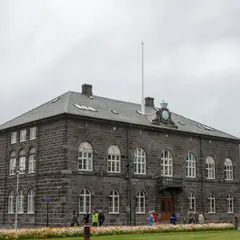
About 150 metres away, the Parliament House houses the assembly that inherits the Althing, and a few streets towards the sea begins the Old Harbour.
A car park that covered the first house
Landnámssýningin
Summary of this stop
The route starts on the street, in front of the hotel that covers the ruin. On that same corner stood Uppsalir, a building demolished in the 1960s because the urban plan foresaw a motorway through the Grjótaþorp district. The motorway never came, and the neighbouring plots ended up as car parks until 2000. Nobody suspected that beneath the asphalt slept the oldest known house in the city.
Across Aðalstræti, the Fógetagarður garden holds another layer of memory. There stood, according to documented tradition, the small church of Víkurkirkja with its cemetery, used for at least six centuries. In 1785 it was decided to build a cathedral around the old church, but digging turned up graves of victims of smallpox from decades before; in 1787 the plan was abandoned and the cathedral moved towards Austurvöllur, where it was consecrated in 1796. It is estimated that some thirty generations of Reykjavik residents lie beneath that garden.
The narration of this first stop links both sides of the street and explains why the discussion about hotels built on land with memory is not only a thing of the past.
The light line of the 871 ash
Light strip of the tephra
Summary of this stop
At the foot of the staircase, a dark blue oval wall surrounds the hall. Along it unfolds a panoramic photograph that returns the landscape of Reykjavik as it may have looked in the settlement era, and a light strip runs along the wall at the exact height of the floor onto which the tephra of 871 fell. That line of light is, in truth, a calendar.
The ash comes from an eruption in the Torfajökull area, some 400 kilometres to the east, which covered all of Iceland. Its date, with a margin of two years, is fixed because the same layer was trapped in Greenland’s ice; another independent study proposed 877±4, a nuance archaeologists keep in mind. What lies below that layer predates it; what lies above, postdates it.
Under the panorama, built-in display cases gather what those first inhabitants used: bones of the great auk, the now-extinct bird, fish-oil lamps, an iron axe and a spindle whorl with a runic inscription from the workshops excavated beside the Alþingi. The audio guide teaches how to read this wall before looking at the ruin.
A giant hearth on trodden earth
Great hearth of the Viking hall
Summary of this stop
From the railing the hall, or skáli, inhabited roughly between 930 and 1000, can be taken in. Its walls are of turf blocks called strengur on a stone base, and today they rise barely a few hand-spans from the ground. The roof, also of turf, rested on only two posts and partly on the walls themselves, an unusual solution in the dwellings of the time.
In the centre stretches the hearth, one of the largest ever found in Iceland, marked with beams of light that come on at the press of a button. Only a small area at the west end had a wooden floor or platform, the owners’ space; the rest was trodden earth. The Reconstruction Window superimposes the house raised over the ruin and helps to imagine the volume it had.
Under the west wall lies the backbone of a horse or a cow, together with other bones. Why it is there is one of the questions the narration leaves posed before the ruin itself.
The wall older than the legend
Turf wall predating 871
Summary of this stop
At the far end, in the north of the hall, some low fragments of wall are easily overlooked. They are the oldest thing on the site: a turf wall built before the year 871, older than the longhouse itself and covered in its day by the settlement ash.
Written tradition places Ingólfur Arnarson and Hallveig here, and the 2001 find confirmed that the first inhabitants lived where the story said: at the southern end of the Kvos, the gravel ridge between the lake Tjörnin and the sea. According to that tradition, Ingólfur threw the pillars of his high seat into the sea and settled where his slaves found them after three years of searching; one of them, Karli, complained of having left good land to live on a remote peninsula. But the tradition fixes the arrival in 874, and the wall lay beneath an ash of around 871: everything points to a somewhat earlier presence. Some versions identify the ruin itself with Ingólfur’s farm, something archaeology cannot confirm, because it preserves no names.
That age-old fragility has needed care: the ruin was first consolidated in 2006 and in September 2021 the exhibition closed for four days to reconsolidate it, because fragments had come loose, some torn off by visitors. The audio guide keeps the tour’s central revelation for this point.
From Viking farm to the bishop’s house
Aðalstræti 10
Summary of this stop
On 7 May 2022 an extension opened that runs underground from Aðalstræti 16 to Aðalstræti 10. Along the way appears a walrus skull found in Tjörnin, the lake in the centre of Reykjavik, a reminder of the fauna the first settlers met.
The passage ends at a timber house of 1762, built for the Innréttingar, the textile company with which urban Reykjavik began, and the oldest in the Kvos. Its façade can be seen from the street, a few steps from the entrance. In a single visit one thus passes from the 10th-century farm to the birth of the modern city.
Those walls also hold a documented episode: from 1807 until his death in 1823 Geir Vídalín lived there, the first bishop of all Iceland, known as “the good bishop”. How his generosity ended up with a committee rationing his ink and tobacco is the story that closes the audio guide with a smile.