Contemporary architecture
Harpa Audio Guide
A glass wall that imitates basalt columns and changes colour as one walks. Behind it, the building site that the 2008 crash left half done and that Iceland chose to finish rather than demolish.
- 40 min of audio
- Contemporary architecture
Harpa is the concert hall and conference centre of Reykjavik's harbour and the first purpose-built concert hall in the city, after more than a century of petitions. It was born as the centrepiece of a bankers' project, was left a skeleton by the 2008 financial collapse and, after opening in 2011, came to be read as a symbol of the country's recovery.
Its façade, signed by Olafur Eliasson, starts from a twelve-sided Icelandic geometry inspired by basalt. It had to be assembled twice. And inside, in the red Eldborg hall, a large box hanging on the back wall is still waiting for an organ the budget never managed to pay for.
Highlights
- South façade by Olafur Eliasson — over 1,000 glass and steel quasi-bricks inspired by basalt
- Work halted in 2008 — some called for demolishing it or turning it into a prison
- Opening in 2011 — about 32,000 people in two days of open doors
- Eldborg hall — up to 1,734 seats and reverberation adjustable between 1.7 and 3.8 seconds
- 2013 Mies van der Rohe Award — the European Union prize for contemporary architecture
The story of Harpa begins long before its first stone. In 1881 the Icelandic press was already calling for a concert hall for the country; in 1983 an association was founded to get one, and for decades the Iceland Symphony Orchestra played in a former cinema, Háskólabíó. Construction began on 12 January 2007 in Austurhöfn, beside the harbour, as the jewel of a new district of hotels, luxury flats and bank offices. In October 2008 Icelandic banking collapsed and the site was left a skeleton.
What happened next explains why this building weighs so heavily in the country’s memory. Work resumed in the middle of the crisis, for years it was the only construction project under way in all of Iceland and, on opening in May 2011, it welcomed a crowd equal to a tenth of the population. Two years later it won Europe’s most prestigious architecture prize. The story of Harpa, its architecture and what its main hall holds are covered in four stops, from the outdoor forecourt to the red heart of Eldborg, with documented narration that saves its best twists for when it is heard in front of the glass.
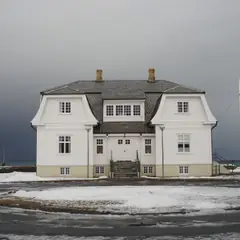
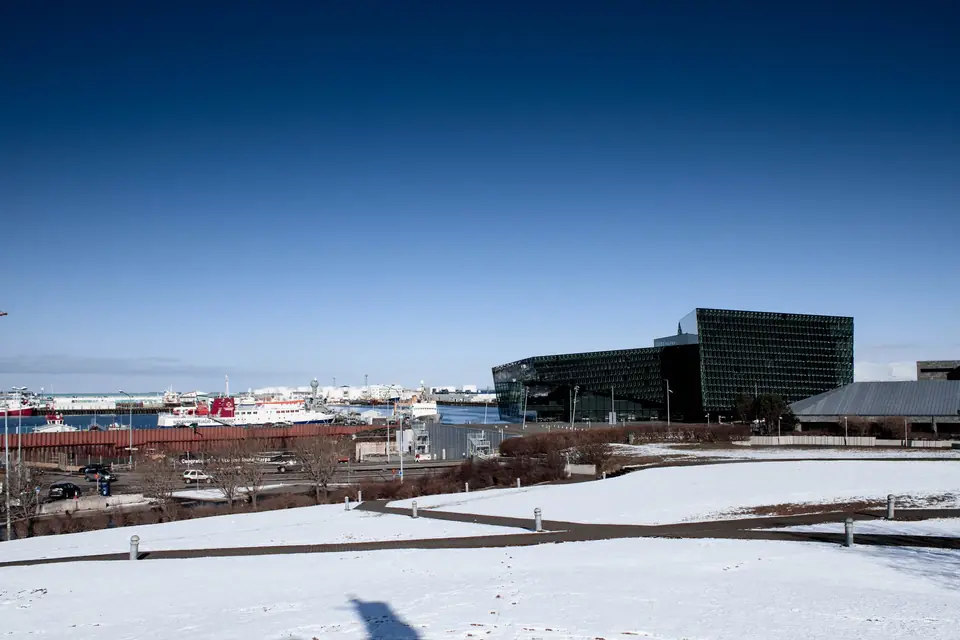
Harpa stands on the shore of the Old Harbour, and the bay promenade leads east, a little over a kilometre, to the Höfði house.
Basalt columns made of glass
South quasi-brick façade
Summary of this stop
The southern forecourt offers the building’s most famous view: a column-free wall made of more than a thousand glass and steel modules that recall the basalt columns of Iceland’s coast. Its shape has a name of its own, the “quasi-brick”, a polyhedron of twelve rhombic and hexagonal faces that the Icelandic geometer Einar Thorsteinn developed in the 1980s after fifteen years of research. Only this façade uses the modules in relief; the west, north and east ones are a flat cut of that same geometry, and the contrast is plain at the corners. The dichroic panels change tone with the light and the viewer’s position, so the wall seems to move with every step.
Behind the shimmer lies a lesser-known episode. Only one builder from China agreed to make the metal structure, and one of its subcontractors did not respect the specifications of the cast-iron corner nodes: the south façade, already assembled in Reykjavik, had to be dismantled and redone with corrected parts.
Among players of EVE Online, who gather here every spring, a theory also circulates: that Harpa’s spaceship look is no accident and that the Icelandic company CCP Games had something to do with it. It is a popular belief with no basis, but it is repeated every year in front of this very façade. How this wall of artificial basalt is really read is left for the narration on the spot.
The ruin that might have been a prison
Reykjastræti
Summary of this stop
From the mouth of the pedestrian street Reykjastræti it becomes clear that Harpa was never meant to stand alone. It was part of a project christened World Trade Center Reykjavík, with a 400-room hotel, luxury apartments and the new headquarters of the bank Landsbanki. Private funding came from the businessman Björgólfur Guðmundsson through the bank’s stake in Portus, the construction company. The hotel and bank headquarters that now flank the street were not finished until the 2020s.
When everything stopped in 2008, some Icelanders called for demolishing the skeleton, leaving it half-built as a monument to greed or turning it into a prison for those responsible for the collapse. Halldór Guðmundsson, Harpa’s first director, summed up the dilemma: a half-finished ruin in the middle of the city or a symbol of resurrection. According to the official website, work resumed in March 2009 by decision of the Minister of Education Katrín Jakobsdóttir and Mayor Hanna Birna Kristjánsdóttir, although other sources date that rescue somewhat differently.
In those months of uncertainty the building even had a fictional life. In Gæska (“Goodness”), a novel by Eiríkur Örn Norðdahl published in 2009, the unfinished concert hall was temporarily turned into a mosque by an added minaret.
A tenth of the country in two days
Mirrored foyer ceiling
Summary of this stop
Under the foyer’s mirrored ceiling, which multiplies the light and the visitors’ silhouettes, the opening was lived as a national celebration. The name had been announced on 11 December 2009, Icelandic Music Day, chosen from 4,156 proposals from 1,200 citizens: besides “harp”, harpa is a month at the start of spring in the old Nordic calendar. It was presented by the president of Portus with the help of a ten-year-old girl who was, precisely, called Harpa. On 4 May 2011 Beethoven’s Ninth sounded with Vladimir Ashkenazy and, after the official inauguration on 13 May, some 32,000 people came in over two days of open doors.
That same autumn, Björk opened the Iceland Airwaves festival here with the home premiere of Biophilia: in one of the small halls, with the audience around a square stage, a cage with two Tesla coils was lowered from the rigging, throwing lightning in time with the music, while Reykjavik schoolchildren composed on tablets in daily workshops.
The party had its flip side. Harpa cost about 18.6 billion Icelandic krónur according to one source, although other estimates put the figure higher, and in 2012 it was losing more than a million krónur an hour. In the summer of 2013 its closure was even debated. The outcome of that debate is told at the stop.
The red box of the missing organ
Eldborg hall
Summary of this stop
Eldborg, the main hall, takes its name from a volcanic crater on the Snæfellsnes peninsula: “mountain of fire”. It is a box of black concrete lined with birch veneer varnished red, with a 19-metre ceiling and up to 1,734 seats depending on the configuration, although the capacity is quoted in several ways. Its acoustics breathe: reverberation chambers allow it to be adjusted between 1.7 and 3.8 seconds. It is the hall the country had waited for since that 1881 petition.
On the back wall hangs a large red box. It was intended for a pipe organ that was cut from the project for lack of budget during construction, and in 2011 its panels were made ready to conceal it should money ever appear. It is a visible absence, the clearest trace of the crisis inside the building.
In 2013 Harpa won the European Union Prize for Contemporary Architecture, the Mies van der Rohe Award, given to Henning Larsen Architects, Batteríið and Olafur Eliasson. The jury chair, Wiel Arets, wrote that the building had captured the myth of a nation that bet on culture in the middle of the Great Recession. What that empty box says about that bet is revealed on hearing it in there.