1938 adobe royal diwan
Al Murabba Palace Audio Guide (Qasr Al Murabba)
A palace of mud, straw and tamarisk from which Abdulaziz ruled Saudi Arabia between 1938 and 1953. Beneath its painted beams the new kingdom's currency, radio and army were decided, and its staircases had to yield to the country's first lift.
- 45 min of audio
- Najdi adobe architecture
In 1936, with Riyadh spilling beyond its walls, King Abdulaziz ordered a complex of palaces built some 2 km from the old city, on farmland between Wadi al-Batha and Wadi Abu Rafi', which was given the name Murabba. The layout was conceived by the king himself and carried out by the master builder Hamad bin Qabba': a large courtyard enclosed by one- and two-storey halls, adobe walls on stone foundations, plaster with Najdi geometric incisions and ceilings of tamarisk and palm matting.
Of that walled compound of 16 towers, which one traveller even mistook from afar for Riyadh itself, only the Diwan, the king's office, still stands, together with two towers and a stretch of wall. In that mud house with small windows the Ministry of Defence, Saudi Radio, the Monetary Agency and the Riyadh-Dammam railway were decided, and in 2017 the state dinner in honour of Donald Trump was held.
Highlights
- Diwan facade: the 1939 foundation plaque and the remains of the 16-tower wall
- Central courtyard: two floors of halls, plastered columns and battlements restored in 1999
- Great majlis: three stone columns beneath beams painted yellow, red and black
- Saudi Arabia's first lift: installed in the late 1940s for a king with arthritis
- Rooftop: the king's summer majlis, with its room for cooling water
Thirty-six years after taking Riyadh, in 1938, King Abdulaziz left the old walled city and settled in a new palace built out in the countryside, about 2 km from its gates. From that adobe building he ruled Saudi Arabia until his death in 1953. The history of Al Murabba Palace is, for that reason, that of a state organised from a house of mud and palm: here the kingdom’s currency, Saudi Radio, the Ministry of Defence and the first formal schools were decided, and its Political Section was the seed of today’s Ministry of Foreign Affairs.
The dates shift depending on the source. The order to build is placed in 1936, the year 1355 of the Hijri calendar, although some give 1356 or even 1937; the king’s move came in the month of Shaban 1357 (1938), the plaque at the entrance is from 1358 (1939) and work on the complex went on, according to some sources, until 1945. Nor is there agreement on which palace the king moved from, whether Masmak, Qasr al-Hukm or the Addeera palace, or on the origin of the name: Murabba means “square”, and it is explained by the towers of the wall, by the layout of the compound or by the name the place already had.
With the palace, modernity came to Riyadh. In 1939 Aramco technicians installed electricity, fans, limited air conditioning, running water and toilets; generators, the automobile and a concrete road to the centre came with it. The architecture of Al Murabba Palace, however, remained that of Najd. In the annexed hall wait the king’s cars, among them the green Rolls-Royce given by Winston Churchill, protagonist of a protocol mishap still told today.
What to see at Al Murabba Palace follows the path of a royal audience: the facade, the courtyard, the great upper-floor hall and the rooftop. The route has four stops and a documented narration checked against historical sources, which in each room tells what happened between those walls, from the princes’ punishment room to the night the neighbouring palace burned.
Before the palace, Abdulaziz’s power had its stage at Masmak Fortress, about two kilometres to the south; and on the same square, the National Museum of Saudi Arabia tells the history of the kingdom that was governed from these rooms.
The fortress mistaken for Riyadh
Al Murabba Palace
Summary of this stop
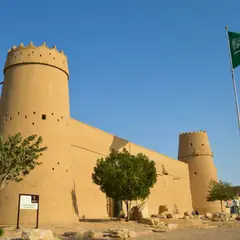
The visit starts before the Diwan facade, a block of plastered adobe on which a commemorative plaque placed in 1358 of the Hijri calendar, the year 1939, dates the palace’s foundation. What is seen today is only one piece of something much larger. The Murabba complex brought together the royal Diwan, the family’s residential compound and a mosque, all enclosed by a 7 m high wall with 16 towers.
It was so imposing that newcomers took it for the city. The British traveller Dickson, in his book “Kuwait and her Neighbors”, tells how he made out a large fortress with many towers in the distance and thought he was looking at Riyadh, until the real city appeared among the palm groves on his left and he understood that this was the king’s new palace, still under construction.
Two towers and a stretch of the north wall remain of that compound. The second palace, where the king lived, was demolished for structural problems, and the Darah’s headquarters stands in its place today. How a compound mistaken for a capital was reduced to an office is the first thread the narration pulls in front of these walls.
The columns a boy slid down
Central courtyard of the Diwan
Summary of this stop
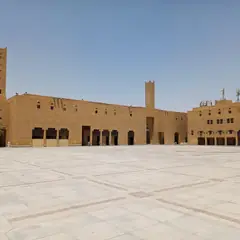
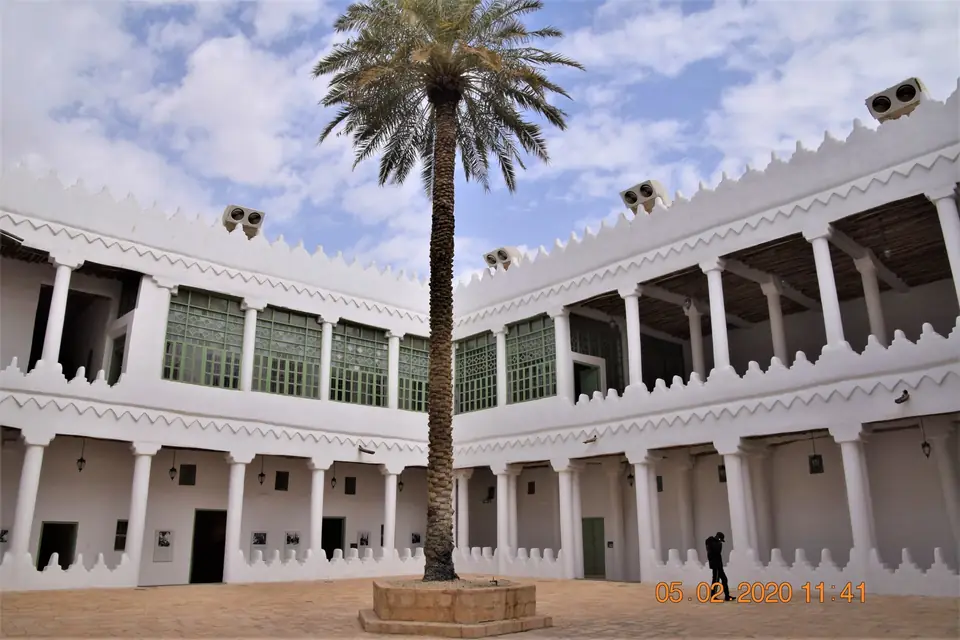
Past the entrance opens the central courtyard, ringed on all four sides by halls of one and two floors. Here the craft of its builders can be read: stone foundations, walls of mud and straw dried in the sun, plaster with Najdi geometric incisions, semicylindrical and square small windows to let the air flow, and rear gargoyles to drain rainwater from the rooftops. The plan came from Abdulaziz’s own head and was carried out by his master builder, Hamad bin Qabba’.
What is seen is also a reconstruction from memory. After 1953 the compound fell into disuse, and for the 1999 centenary the Al-Turath foundation returned it to the look of the king’s last days: it tore out the steel beams added later and restored the tamarisk ones, recovered the battlements over the courtyard and replaced damaged tiles with pieces made in Egypt. The work was guided by Abdulla Bin Hamid, a 65-year-old plaster master raised beside the palace, who remembered its interiors and who as a youth, when in a hurry, went down to the ground floor sliding down these very columns.
According to a documented tradition, among these rooms there was also a very different one. Abdulaziz kept close watch over his sons’ prayers and studies, and locked up in it anyone who missed any prayer, including the dawn one. One of those who passed through there is today the king of Saudi Arabia. Who was the only person able to free them from the punishment is one of the stories the narration keeps for this courtyard.
Three columns to found a state
Great reception hall with three columns
Summary of this stop
The Diwan has two square floors of 16 rooms each: the ground floor for guards, services and administration; the upper for receiving delegations. On the upper one is the great hall, about 6 m high, with the ceiling held up by three stone columns plastered in gypsum and beams painted with yellow, red and black geometric motifs under palm-leaf mats. It was the majlis where the king received, and it keeps his telephone, his desk and his chair. To the west is the winter majlis, smaller, with room for about 50 men.
Under this ceiling the creation of the Ministry of Defence, Saudi Radio and the Saudi Arabian Monetary Agency was decided, along with the issue of the currency and the railway between Riyadh and Dammam. Getting up here ended up being a problem for the founder: in the late 1940s arthritis kept him from climbing the stairs, and the palace debuted Saudi Arabia’s first lift, with a ground-floor room, number 9, reserved for its attendant.
The king’s customs outlived him. According to a documented tradition, in 1956 Anwar al-Sadat, then Egyptian minister of state, was summoned to this majlis by King Saud to present a report, and could not finish it. What forced him into silence, and what it had to do with an hour fixed by Abdulaziz, is revealed in this room’s narration.
The summer hall under the sky
Rooftop and summer majlis
Summary of this stop
The rooftop was the other half of the palace’s life. Its north side served as the king’s summer majlis, and on it opened a room with vents to the east and north where water was cooled; on the ground floor, room number 12 served the same function with leather water skins hung from the ceiling. On this terrace Abdulaziz was photographed with his sons.
From here, what is missing is also understood. According to a documented tradition, attached to the king’s palace, separated only by a wall, stood the adobe palace of his heir, Prince Saud, who also slept on the rooftop on hot nights. One July night in 1943 a fire broke out in the storeroom that destroyed the whole building. What the prince did that midnight, and the palace that rose from the ashes, form one of the most intense episodes of the route.
The palace never stopped being a stage of power. On 7 March 1954, four months after Abdulaziz’s death, King Saud inaugurated the kingdom’s Council of Ministers here. In January 2016 King Salman received Xi Jinping at Murabba, and on 20 May 2017 he hosted a dinner there for Donald and Melania Trump. Almost eighty years after the founder’s move, the mud house still receives the world’s heads of state.