Grand Friday mosque
Imam Turki bin Abdullah Mosque Audio Guide (Imam Turki bin Abdullah Grand Mosque)
Old Riyadh's grand Friday mosque looks new, and in stone it is: 1992 limestone and two square minarets pointing to Mecca. But beneath its bridges to the Al Hukm palace the Saudi dynasty has spent two centuries praying, swearing oaths and bidding farewell to its own, a few metres from the gate beside which its founder was killed.
- 30 min of audio
- Neo-Najdi architecture
Imam Turki bin Abdullah Mosque, also called the Grand Mosque of Riyadh, was born on a plot in the city centre known as al-Na'qa during the reign of Imam Turki bin Abdullah (1824-1834), founder of the Second Saudi State, next to the Al Hukm palace. It is usually dated to around 1826 and was also an institution of learning, headed by Abdulrahman bin Hasan Al al-Sheikh. The current building is a complete reconstruction on the same site, by the architect Rasem Badran for the Riyadh Development Authority: about 16,800 m² for up to 17,000 worshippers, with local limestone walls pierced by triangular openings in the Najdi tradition.
Its history begins with a loss. Imam Turki left Friday prayer through a private door cut into the qibla wall, south of the mihrab, and on 9 May 1834, as he crossed it, he was killed by three men in the service of his second cousin Mishari bin Abdul Rahman. Since then the mosque has remained tied to power: elevated bridges stitch it to the government palace, and the funeral prayer of the Saudi kings is held here before their burial in the Al-Oud cemetery.
Highlights
- Square minarets: two 50 m limestone towers that mark the direction of Mecca on Riyadh's skyline
- Elevated bridges: two walkways from the first floor to the Al Hukm palace over Al Safat Square
- Najdi walls: local limestone pierced by series of small triangular openings that cut the sun
- Prayer hall: 14.8 m high, white marble and a concrete ceiling that imitates the wood of the old mosque
- Qibla wall: where Imam Turki's door opened, before he was killed leaving through it in 1834
In the heart of the Deera district, between Al Safat Square and the Al Hukm palace, Imam Turki bin Abdullah Mosque looks so spotless that it is hard to believe it is the most history-laden in Riyadh. The history of Imam Turki bin Abdullah Mosque begins in the reign of the imam who gives it its name, between 1824 and 1834. The exact date of its founding is not unanimous: some sources give 1826 as the start and 1830 as the end of the original work, others place it between 1826 and 1834, and others simply frame it within that reign.
What is documented is its role. It was the capital’s grand Friday mosque, born also as a school of learning and neighbour to power. In 1844 Faisal bin Turki, the founder’s son, rebuilt it, extended it to the east and west, introduced an Islamic decoration unknown in Najd until then and laid an elevated passage to the palace. Until the reign of King Saud (1953-1964) it remained a mosque of mud, sun-dried adobe and palm-trunk roofs, and Saud enlarged it by annexing plots such as the wells of Suwailma, Faisala, Shadiya and Sultana.
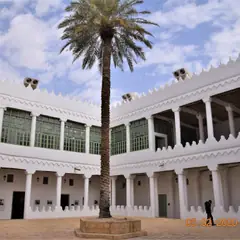
The architecture of Imam Turki bin Abdullah Mosque is today that of Rasem Badran: precast concrete clad in Riyadh stone outside and white marble inside, a courtyard of about 4,800 m² ringed by porticoes and two square towers in place of the old minarets. The complex, together with the redevelopment of the old centre around it, received the Aga Khan Award for Architecture of the 1993-1995 cycle. Sources do not agree on the date of its opening: the award jury gives it as finished in 1992, while others date its inauguration to January 1993.
What to see at Imam Turki bin Abdullah Mosque is covered in four stops, from the square to the qibla wall, with a documented narration checked against historical sources that reserves for each point what happened right there, from an oath sworn on a sword to a murder on leaving prayer.
The mosque shares the heart of Deera with Souq Al Zal, a few steps away, and with Masmak Fortress, the scene of the taking of Riyadh in 1902.
The new stone of an old mosque
Alsafat Square
Summary of this stop
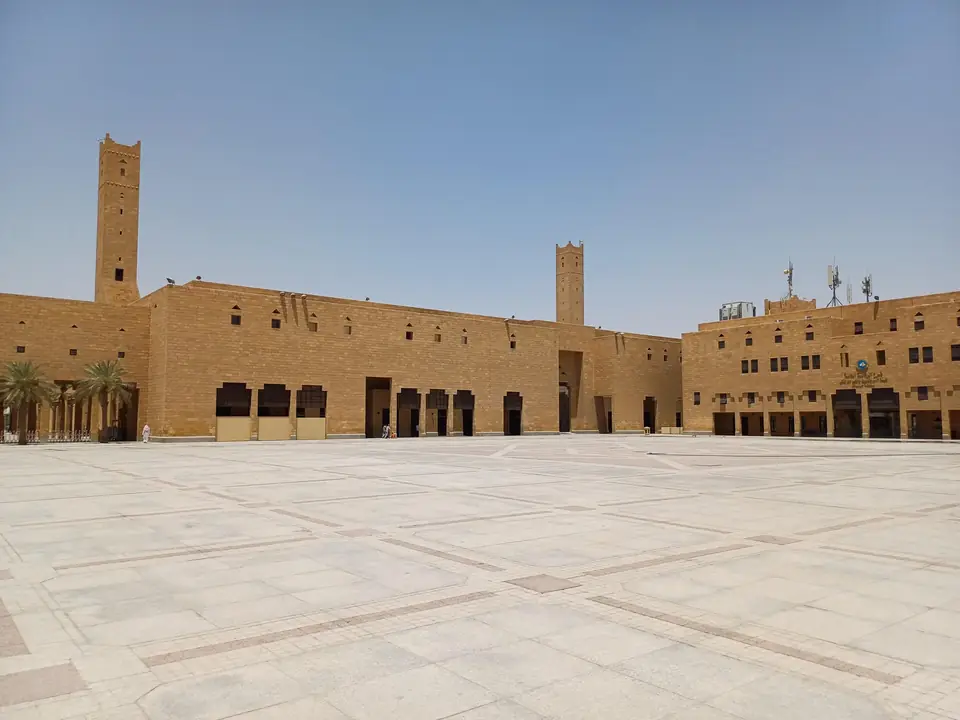
The visit starts in Al Safat Square, in front of the facade. From here the building can be read at a glance: local limestone walls pierced by series of small triangular openings, the device of traditional Najdi construction for filtering light and cutting the sun’s glare, and two minarets of square section that rise 50 metres above the esplanade.
The surprise is that all this tradition dates from 1992. Before the reconstruction, the minarets mixed Ottoman and Egyptian styles, with two rectangular tiers, three rounded tiers and a pointed top; Badran replaced them with neo-Najdi rectangular towers and the courtyard was completely repaved. The building raised by the Riyadh Development Authority, within the Qasr al-Hukm plan, occupies the same site as the old one, but it is a complete reconstruction, not a restoration.
The two towers are not placed at random: on the city’s skyline they work as an arrow pointing to the qibla, the direction of Mecca. What that arrow says about the way Badran read old Riyadh is what the narration keeps for this square.
Bridges over the Friday square
Elevated bridges to the Al Hukm palace
Summary of this stop
Across the square run two covered walkways that leave the mosque’s first floor and reach the Al Hukm palace. They are the modern version of an old idea: in 1844 Faisal bin Turki had already laid an elevated passage and a long covered corridor on columns between the two buildings, and later King Abdulaziz joined them with a bridge so he could attend the daily prayers and the Friday one. The exact origin of those passages is disputed: one chronicle maintains that the first was built after the 1834 murder so the ruler could reach prayer safely, and that Abdulaziz rebuilt it in 1909.
The esplanade below was for a long time the Friday stage of power. According to a documented tradition, in 1902, months after Abdulaziz recovered Riyadh, his father, Imam Abdulrahman bin Faisal, gathered the city’s ulema and notables here after prayer, renounced before them his rights to the emirate in favour of his eldest son and gave him the sword of Saud the Great. It was the first bay’a, the first oath of allegiance to the future king; the exact day is not known and the scene is usually placed between May and June of that year.
The square, also known as Deera, has a darker memory. It was the place of public beheadings, which drew larger crowds when held on Fridays after the midday prayer; by around 2019 it had stopped hosting them. Today it is an esplanade with palm trees, granite benches and fountains, and how that past coexists with today’s square is part of this stop’s story.
A concrete ceiling that recalls wood
Flat-roofed prayer hall
Summary of this stop
Inside awaits a hypostyle hall with a flat roof 14.8 metres high, with columns and the lower part of the walls in white marble. Its finest detail is overhead: the concrete slabs of the ceiling imitate the wooden panels of the old mosque, the one of mud and palm trunks that stood until the mid-20th century. The building, moreover, has one foot in the present: remote-controlled television cameras broadcast its prayers live.
The hall also holds the memory of its imams. Abdullah bin Muhammad bin Nasban, a blind imam, led prayer here for some 62 years, so long that the mosque came to be known as the “al-Nusaybi mosque”; he died in 1992, the year the new building was finished. Later, according to a documented tradition, Abdulaziz bin Baz, imam since 1969 and blind since the age of twenty, gave his hadith lessons here around 1990 at dawn, seated on a chair facing the qibla.
Around that chair an invisible geography was drawn every dawn: prayer mats that students unrolled before sunrise to save their place, because the distance to the scholar marked each one’s rank. What the rules of that map were, and which seat nobody contested, the narration tells in this hall.
The imam’s door beside the mihrab
Qibla wall and mihrab
Summary of this stop
The route ends before the qibla wall, the front facing Mecca. In it, south of the mihrab, opened the private door by which Imam Turki came and went without crossing the rows of worshippers, a door used only by him and the mosque’s imam. Through it he left on Friday 9 May 1834, 30 Dhu al-Hijjah 1249 of the Hijri calendar, when three men in the service of Mishari bin Abdul Rahman killed him. The cousin proclaimed himself imam and was executed weeks later by Faisal, the dead man’s son.
That same space is today the place of farewells. The funeral prayer of many members of the Saud family is held here, often after the afternoon prayer, before the coffin leaves on shoulders for the nearby Al-Oud cemetery, where Abdulaziz and his sons Saud, Faisal, Khalid and Fahd rest. Here King Fahd was bid farewell in 2005, Crown Prince Sultan in 2011 and, on 23 January 2015, King Abdullah, with Recep Tayyip Erdogan, Nawaz Sharif, Omar al-Bashir and the Gulf leaders among the attendees. The ritual is still alive.
The mihrab has its own lineage too. After Muhammad bin Ibrahim Al al-Sheikh, imam between 1954 and 1969, and Bin Baz, it was occupied by the Grand Mufti Abdulaziz Al al-Sheikh, bid farewell in this same mosque in September 2025; today one of his sons leads prayer here. The two-century thread that links that imam to the school of 1826 is the last twist of the route.