1999 centenary museum
National Museum of Saudi Arabia Audio Guide
A limestone wall that curves like a red dune, in a crescent towards Mecca, facing the adobe palace of the kingdom's founder. Inside, the history of the Arabian Peninsula told as a journey from darkness to light, from a meteorite of the Rub al-Khali to the Hajj.
- 120 min of audio
- Contemporary architecture
The National Museum of Saudi Arabia was built against the clock: building, collection and displays were created from scratch to open on 23 January 1999, the Hijri-calendar centenary of Abdulaziz's taking of Riyadh in 1902. It was designed by Moriyama & Teshima, the Toronto firm that won the 1996 competition over names such as Richard Meier, author of the Getty. Its west facade, of local limestone, runs along Murabba Square like the wall of a wadi and embraces the palace Abdulaziz had built in 1932.
In 1999 there were not enough original pieces to tell the whole of Saudi history, so the museum was filled with architectural replicas, recreated regional facades and life-size dioramas; the foundations were poured before it was known which gallery would go on top. Between the two wings, a dark tunnel leads to a white room with a single manuscript Quran and to a bridge that separates the before and after of Islam.
Highlights
- Dune-shaped west wall: local limestone curved in a crescent towards Mecca
- “Camel's Hump” meteorite: the largest fragment of the Wabar meteorite, in the lobby
- Jahiliyyah tunnel and Hijra bridge: from darkness to a room with a single Quran
- Gold mask of Thaj: found in 1998 in the tomb of a nameless girl
- Model of Diriyah: seen from above through a glass floor
The history of the National Museum of Saudi Arabia is longer than that of its building. The museum was born of a decision of the Council of Ministers in the year 1383 of the Hijri calendar, around 1964, and first opened in 1398, between 1977 and 1978, in an old building in the al-Shumaisi district. In parallel, from 1983, the planners of the Riyadh Development Authority had been studying how to open to the public the surroundings of the Murabba palace, built in adobe in 1932 for King Abdulaziz: in 1989 a “cultural precinct” was laid out there and in 1994 it was renamed the King Abdulaziz Historical Centre. That is why the founding date depends on what is counted, and sources range between 1964, 1978 and 1999.
The current building is the answer to a deadline. It had to be ready for January 1999, the Hijri centenary of Abdulaziz’s taking of Riyadh in 1902, and building, collection and displays were made from scratch in about 26 months, according to the opening-day report; the records of the exhibition designer and the architecture firm speak of 28 and of 30. The official opening came on 23 January 1999, with King Fahd. The architecture of the National Museum of Saudi Arabia tells the story on two floors with four permanent halls each, from the Man and the Universe hall to that of the Hajj and the Two Holy Mosques, with about 4,413 pieces according to one source; others lower the figure to about 3,700.
What to see at the National Museum of Saudi Arabia goes well beyond the display cases: the route itself is a staging, with a dark tunnel, a symbolic bridge and whole rooms of replicas. In June 2018 the Tourism and National Heritage Commission also announced an expansion with a new exhibition hall, a theatre, a hotel, a glass roof and three underground floors.
The audio guide covers the museum in four stops, with a documented narration checked against historical sources: from the facade born of an outing to the dunes to the hall that tells of the founding of the kingdom.
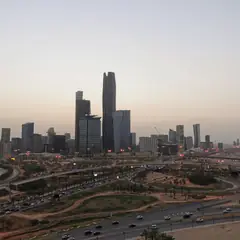
The museum shares its grounds with Al Murabba Palace, Abdulaziz’s adobe residence; the adobe walls of the first Saudi state can be walked at At-Turaif District, in Diriyah, and the glass Riyadh that came afterwards at King Abdullah Financial District.
A limestone dune facing Murabba
National Museum of Saudi Arabia
Summary of this stop
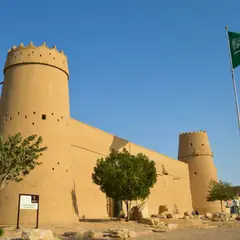
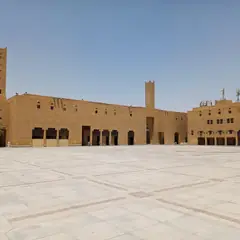
The route starts outside, in the square, because the facade reads like a landscape. The west wall, of local limestone, runs along Murabba Square and the palace garden forming a crescent oriented towards Mecca, with the look of a wadi’s canyon wall. Across the square are Abdulaziz’s adobe palace and the Darat al-Malik Abd al-Aziz, with their Najdi-style towers, which at sunset cast their shadow over the stone curve. Between the wall and the building, a narrow, tall passage covered by a lattice of wooden beams leads to the entrance.
The shape has a precise origin. Weeks after winning the competition, Raymond Moriyama made his first trip to the red dunes west of Riyadh and came back with the palette of colours, the textures and the idea of a dune-shaped facade. By the end of 1996 his firm, Moriyama & Teshima, the least known of the four invited, had beaten SITE, Hellmuth, Obata + Kassabaum and Richard Meier & Partners.
The architect brought his own story. Born in Vancouver, after Pearl Harbor he was interned with his family in a camp for Japanese Canadians; at 13, with his father in another camp, he supported his mother and siblings working for five cents an hour. What he built there, his first work, is the detail with which the narration closes this stop.
Philby’s volcano was a meteorite
Camel's Hump meteorite
Summary of this stop
The museum’s first piece did not come from an excavation, but from the sky. In the entrance lobby waits the “Camel’s Hump”, the largest fragment of the Wabar meteorite: an iron block of 2,045 kilos according to the 1966 recovery, although other records round it to 2.2 tonnes or raise it to 3.5. It was the wind that unearthed it in the Rub al-Khali, and in October 1966 an Aramco team led by James Mandaville recovered it; it passed through Dhahran and King Saud University before arriving here. The date of the impact is also disputed, from some 6,400 years ago to less than 250, depending on the method.
The impact site has its own novel. On 2 February 1932 Harry St John Philby reached Wabar looking for Ubar, the Quranic city, and believed he had found the mouth of a volcano; his guides took the little black glass beads for pearls of the ladies of ‘Ad. It was the British Museum that later identified a meteorite impact.
The lobby around it, of polished granite and a high ceiling with coloured banners, was conceived in 1999 as Riyadh’s first covered urban square, open 24 hours even when the galleries were closed, and as a prayer space for special occasions. In the adjoining geology hall, the museum lets stones coexist with a legend: that of Mahd adh-Dhahab, “the cradle of gold”, the Hejaz mine that popular tradition points to as the source of King Solomon’s riches. What is proven history about that mine is what the narration separates from the myth.
A dark tunnel towards a single Quran
Jahiliyyah tunnel and Hijra bridge
Summary of this stop
Between the two wings, the museum is told with the body. A dark, winding tunnel, representing the jahiliyyah, the age before Islam, ends in an escalator up to a white landing where a case holds a single manuscript Quran. From there a bridge of about 40 metres, symbolising the Hijra, joins the pre-Islamic wing with the Islamic one. In the halls of the Arab kingdoms you leave behind the gold funerary mask of Thaj, 17.5 by 13.5 centimetres, found in 1998 in the tomb of a nameless girl at Tell al-Zayer and exhibited at the Louvre in 2010; its exact provenance and its date, around 100 BC or the 1st century, vary by source.
The border between darkness and light, however, becomes less sharp with a stone. Around 2010, according to the account of its discovery, the camel herder Mutlaq ibn Gublan stopped at the last moment a bulldozer about to dig a pond near al-Maqar when he saw a very old object in the ground, and donated to the museum what turned up: a fragment of about 135 kilos that looks like the head, neck and chest of a horse, together with other carved animals.
Presented in 2011, it was argued that it might push back the domestication of the horse by some 2,000 years, with organic material dated to about 9,000 years ago. The debate remains open: the British Museum catalogued it with two question marks and a specialist in ancient draught vehicles maintained it might represent another species. What is true about Arabia’s first horse is the question the narration leaves posed on the bridge.
Diriyah under a glass floor
Unification Hall
Summary of this stop
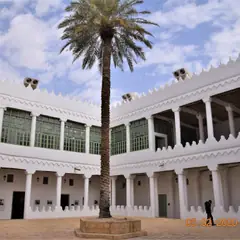
The route culminates under the Unification drum, the wide cylinder that rises above the flat roof and holds the hall dedicated to Abdulaziz’s founding of the kingdom. Before reaching it come recreated facades of the vernacular architecture of Hejaz, Asir, Najd and the Eastern Province, and in the hall of the first and second Saudi states a large model of Diriyah is viewed from above through a glass floor.
A good part of what is seen here is scenography, and for a reason. In 1999 the collection of original pieces was not enough to tell the whole of Saudi history, and the designer Anthony Reich, of Reich + Petch, turned to architectural and archaeological replicas and life-size dioramas. Everything was built against the clock for the centenary of the taking of Riyadh, to the point that the foundations were poured before the use of the galleries had been decided.
That a national museum is largely made of reconstructions says as much about the country that commissioned it as any original piece. What this hall reveals about that constructed narrative, facing the founder’s palace, is the close of the narration.