Riyadh's historic souq
Souq Al Zal Audio Guide
The carpet souq that once financed the government palace, right beside Masmak Fortress: narrow aisles of bishts, oud and Najdi antiques that lead to the haraj, the daily auction where the objects of the Riyadh of the grandparents are called out.
- 45 min of audio
- Traditional souq
Souq Al Zal sits wedged between Masmak Fortress, Al Thumairi Street and Imam Turki bin Abdullah Mosque, next to the old Dakhna district. The most cited sources date it to 1319 of the Hijri calendar, 1901, and describe it as the main economic resource of Qasr al-Hukm, the government palace next door. It was Riyadh's general market, where almost anything could be bought, and its star product ended up giving it its name: zal comes from zūlīya, the floor carpet in Gulf Arabic.
The liveliest part of the souq is the haraj, a daily auction of heirloom pieces in which the auctioneer calls out the virtues of each dallah, the copper-and-brass coffee pot, amid proverbs and verses. Bids range from a few riyals to enormous sums: the rarest objects reach 200,000 Saudi riyals, about 53,000 dollars, and in July 2023 an old teapot went for 5,500 riyals with a “Congratulations, Abu Saleh!”.
Highlights
- Haraj: the daily auction of heirloom pieces, with rare objects reaching 200,000 riyals
- Carpet stalls: the zal that gave its name to Riyadh's general market
- Shops selling bishts and ardah swords: from 50 riyals to gold and silver pieces worth 200,000
- Najdi antiques: 120-year-old coffee pots, trays and pottery at the stall of a former art teacher
- Oud and incense: the souq where Riyadh buys its scents before Eid al-Fitr
A few steps from Masmak Fortress, Souq Al Zal is the oldest market in Riyadh and one of the few places in the capital where the past is still bought at the top of one’s voice. The history of Souq Al Zal begins, according to Asharq Al-Awsat and Wikipedia, in 1319 of the Hijri calendar, 1901, although the date is far from unanimous: a merchant interviewed by Al-Eqtisadiah in 2014 gave it more than 150 years and remembered an adobe souq from before Abdulaziz’s arrival, and the same paper, in 2017, spoke of a souq on Al Thumairi Street founded about forty years earlier.
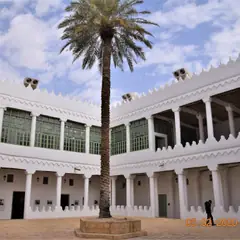
Whatever its origin, its role is documented: the shops were the main economic resource of Qasr al-Hukm, the neighbouring government palace. The souq area measures 38,580 m² and is bounded by Tariq bin Ziyad Street to the south, Sheikh Mohammed bin Abdulwahab to the west and Sheikh Mohammed bin Ibrahim to the east; in its southwest sector stands the rebuilt Sheikh Mohammed bin Ibrahim Mosque, with courtyards and a men’s hall for about 1,800 worshippers.
What to see at Souq Al Zal almost arranges itself: the walls facing Masmak, the aisles of carpets and bishts, the stalls of Najdi antiques and, at the end, the haraj circle. The audio guide covers those four stops with a documented narration checked against historical sources, from the cash register of old Riyadh to the auction where a coffee pot is sold amid verses.
The souq is best understood alongside its neighbours: Masmak Fortress, whose walls peek out at the end of the aisles, and Imam Turki bin Abdullah Mosque, a few metres away in the same Deera district.
The souq that paid for Masmak
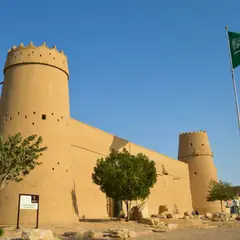
Adobe walls facing Masmak
Summary of this stop
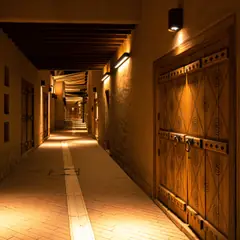
The route starts at the edge of the souq that faces Masmak Fortress, with the old buildings of traditional look in the foreground and the fort’s silhouette a few steps away. Here you grasp the relationship that defines the place: the souq and power grew side by side, and the shops were the main economic resource of Qasr al-Hukm, the government palace next door. The businesses sustained the authority that watched over them.
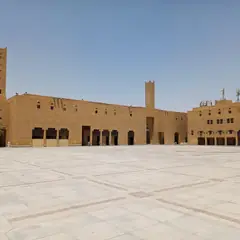
What looks clean, shaded and lit today is the result of a renovation. The High Commission for the Development of Riyadh closed an improvement project in 2009 that demolished the remains of ruined adobe houses around the souq, buried the installations that had been left in view, and paved, shaded and lit the inner aisles. English Wikipedia gives that renovation as finished in 2005; Al-Eqtisadiah announced the end of the project on 1 May 2009.
How an adobe market came to pay a palace’s bills is what the narration tells in front of the walls, with Masmak in the background.
The carpet that named the souq
Carpet and bisht stalls
Summary of this stop
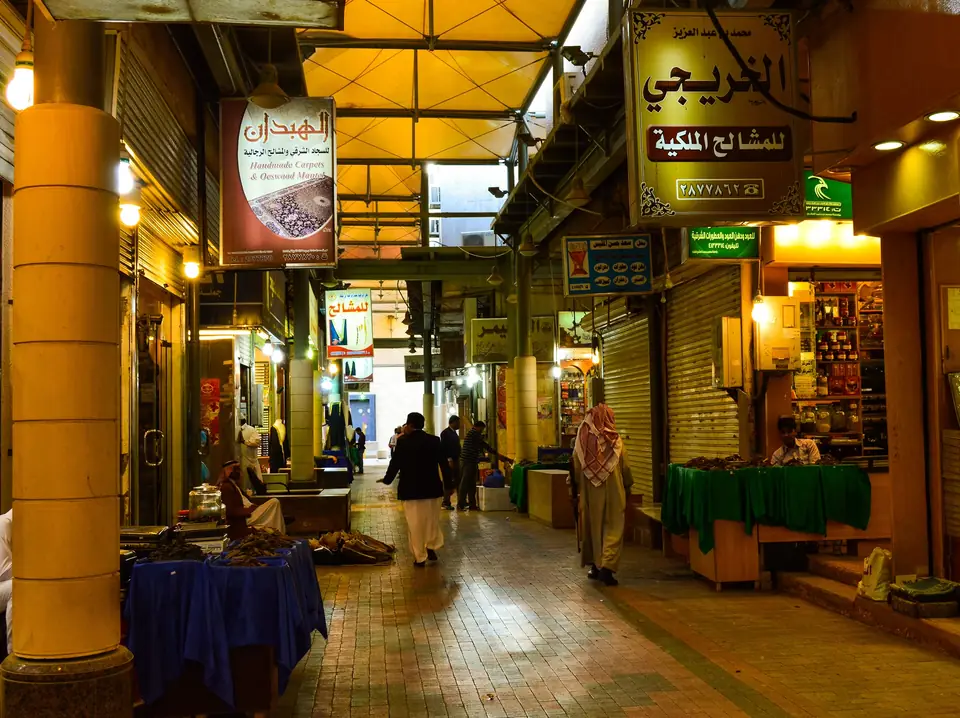
In the aisle of the carpet stalls the souq’s name explains itself. Zal comes from zūlīya, the Gulf Arabic word for a floor carpet. Before it was called that, this was Riyadh’s general market, where almost anything was bought, and the carpet was already its star product: hence the name that ended up sticking.
The architecture of Souq Al Zal is that of a human-scale market: small cubicles facing each other, separated by aisles no more than three metres wide, with almost no sale signs or modern come-ons at the doors. In the windows hang bishts, the men’s cloaks also called mishlah, next to embroidered shemaghs and agals.
Among the cloaks there are also swords for the ardah, the traditional dance. In the bisht shop of Musaed bin Migrin Al-Mujahid they sell from 50 riyals, and those in gold and silver cost between 50,000 and 200,000. What separates one sword from the other is left to the narration in the aisle.
120-year-old coffee pots and a kingdom without a name
Najdi antique stalls
Summary of this stop
The Najdi antique stalls hold the region’s material memory: old coffee pots, trays, pottery, radios and cassettes. According to the tradition the traders themselves relate, before Abdulaziz entered Riyadh the souq was made of adobe and sold goods brought from the Levant, Iraq, Iran and Pakistan alongside local crafts. Rashid Abu Hamid, a former art teacher, has spent more than sixty years safeguarding Najdi pieces at his stall, among them 120-year-old coffee pots.
In Riyadh Season 2022, the General Entertainment Authority chose the souq as one of its 15 zones, opened on 11 December with the start of winter. In that square, a seller of books and old coins known as Abu Turki showed a coin from the year 1346 of the Hijri calendar bearing the legend “Kingdom of Hejaz and Nejd and its Dependencies”, the country’s name before it was called Saudi Arabia. Beside him, Hizam al-Qahtani, with forty years at a stall in the same square, displayed a stone ladle that he dated to hundreds of years ago.
What a coin can tell about a kingdom that did not yet know what it would be called is the story the audio guide reserves for these stalls.
The haraj, where a coffee pot is recited
Souq Al Zal haraj
Summary of this stop
The route ends in the haraj circle, the daily auction of heirloom pieces. The auctioneer does not merely call out figures: he proclaims at the top of his voice the virtues and price of each dallah so the whole souq can hear, and slips in short proverbs and verses of poetry for the collectors and traders seated around him. In the same square, first-edition magazines and Arabic newspapers from decades ago are piled up, with headlines about “the great war”.
Bids can climb high. The rarest objects reach 200,000 Saudi riyals, about 53,000 dollars, and in July 2023 an old teapot closed at 5,500 riyals with a “Congratulations, Abu Saleh!” from the auctioneer. The souq also has its calendar: in Ramadan it fills up before Eid al-Fitr, because Riyadh’s residents are in the habit of buying their oud and incense precisely here and nowhere else.
How the price of a coffee pot rises between a saying and a verse is something the narration lets sound in the circle itself, with the smoke of oud in the background.