1895 adobe fortress
Masmak Fortress Audio Guide (Qasr Al Masmak)
A fortress of mud and straw in the heart of the Deera district, with watchtowers and a palm-wood gate that still carries the story of a spear. Before its wicket door, at dawn in January 1902, Abdulaziz recovered Riyadh and set modern Saudi Arabia in motion.
- 60 min of audio
- Najdi adobe architecture
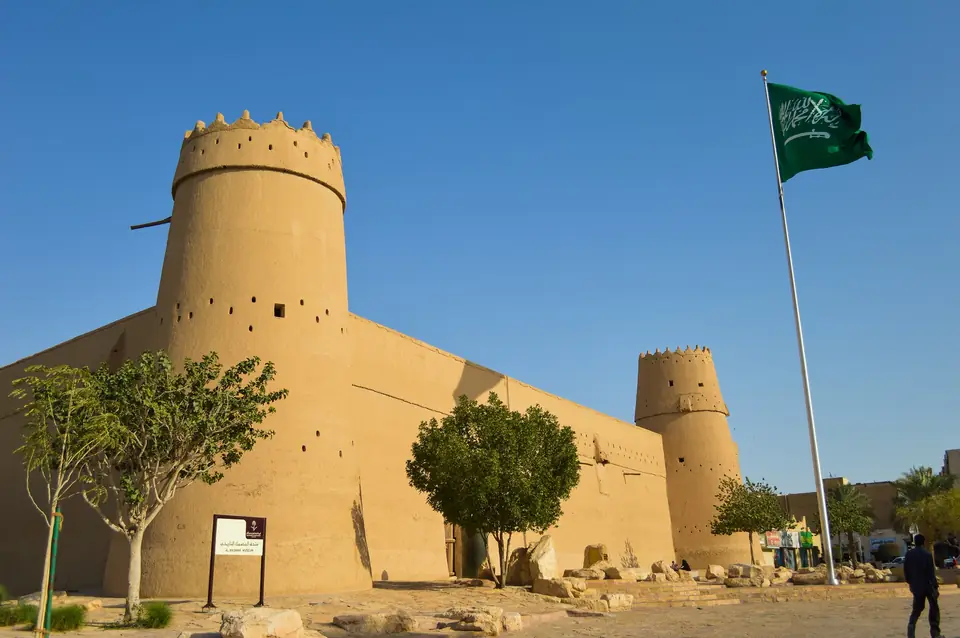
Masmak Fortress began to rise in 1865 under Abdullah bin Faisal, the Saudi emir of Najd, and was finished in 1895 by the emir of Riyadh, Abdurrahman ibn Dabaan, when the city was held by Muhammad bin Abdullah Al Rashid, the rival who had driven out the Al Saud. Its original name, al-Musammak, alludes to the thickness of its walls, about 125 cm: mud mixed with straw on stone foundations, four cylindrical corner towers of about 18 m and a square tower, al-Murabba, in the middle of a 3,885 m² compound.
The history of Saudi Arabia turned on a gap that only one person can pass through, bent over. In January 1902 the governor Ajlan, wounded, tried to take refuge through al-Khokha, the wicket in the main gate: Abdulaziz held him by the legs while the men inside pulled at his arms. After serving as arsenal and prison, the fort opened on 11 June 1995 as a museum of the founding of the kingdom.
Highlights
- Western gate: palm and tamarisk trunks measuring 3.60 by 2.65 m, scene of the 1902 fight
- Al-Khokha: the central wicket that only one person can pass through, bent over
- Spear mark: the metal fragment lodged in the wood, to the right of the entrance
- Mud towers: four cylindrical towers of about 18 m and the square al-Murabba tower
- Pioneers Hall: the plaque with the names of Abdulaziz's 63 men
In the heart of Deera, the oldest district of Riyadh, stands a cube of mud with corner towers that Saudis know even if they have never set foot inside: the kingdom’s first banknote issue, put into circulation on 14 June 1961, included a blue 5-riyal note with the fortress at its centre, and in 1999 it appeared again on the 200-riyal note beside Abdulaziz’s portrait. The history of Masmak Fortress explains that fame: here, at dawn on a January day in 1902, an exile who had come from Kuwait with 63 men recovered his ancestors’ city and laid the first stone of modern Saudi Arabia.
The building’s origin has two versions. The more widespread starts it in 1865, the year 1282 of the Hijri calendar, under the Saudi imam Abdullah bin Faisal, and ends it in 1895 under Rashid rule; another presents it as a work of 1895 raised on the orders of Abdurrahman ibn Dabaan to house Ibn Rashid’s garrison. Either way, the fort that Abdulaziz took was the seat of his enemies.
The architecture of Masmak Fortress is that of Najd: walls of mud and straw 1.25 m thick, loopholes in the towers, three boxes projecting over the gate to fire at whoever knocked and, inside, a courtyard ringed by dwellings, a mosque, a majlis with its hearth and a well. What to see at Masmak Fortress follows the order of the assault: the square and the blind facade, the palm-wood gate with its wicket, the courtyard and its towers and, last, the hall dedicated to the men of 1902.
The route has four stops and a documented narration checked against historical sources, which tells at each one what happened right there, from a first failed siege to the proclamation that told Riyadh it had changed hands.
A few steps away, Souq Al Zal and Imam Turki bin Abdullah Mosque complete the historic core of Deera; Abdulaziz’s story continues two kilometres north, at Al Murabba Palace, from which he ruled the kingdom until 1953.
A mud fort finished by its enemies
Masmak Fortress
Summary of this stop
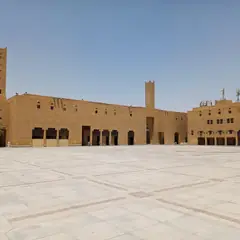
The visit starts in Masmak Square, a 4,500 m² esplanade with rows of palm trees to the south and stands to the east, used for folklore events. From here you can read the whole facade: a mud wall in which the straw of the mix shows through, raised on stone foundations, with the corner towers and, above the gate, the three tarmat, the rectangular boxes projecting from the wall from which the entrance was watched and rifles were fired at whoever stood before it.
The name already speaks of the wall. The original was al-Musammak, for the thickness of its floors and walls; popular speech swapped one “s” for another, the plain sin for the emphatic sad, and it became al-Masmak. And the paradox lies in its builders: a fort begun by a Saudi emir and finished by the Rashid governor, the rivals who had driven the Al Saud out of Riyadh.
Before the famous assault there was another attempt, according to a documented tradition. In 1901 Abdulaziz got ahead of Sheikh Mubarak of Kuwait’s campaign, defeated the garrison that came out to meet him and forced it to shut itself inside Masmak. He besieged the fortress for about 40 days and began digging a tunnel towards its interior, until Mubarak’s defeat at al-Sarif, in March of that year, forced him to withdraw. What became of that half-dug tunnel is something the narration saves for this square.
The spear and the wicket at dawn in 1902
Palm-wood gate with the al-Khokha wicket
Summary of this stop
In the west wall opens the main gate: 3.60 m high, 2.65 m wide and 10 cm thick, made of palm and tamarisk trunks with three crossbars. At its centre is al-Khokha, a wicket raised above the ground that only one person can pass through, bent over. It is the entrance through which the museum is reached today, and the setting of the scene that founded a kingdom.
The evening before, according to the traditional account, Abdulaziz’s men arrived hopping from house to house to the governor Ajlan’s, opposite the fortress, and there learned that he slept inside Masmak. They waited for dawn, when the gate opened. Ajlan came out escorted by 10 guards, recognised Abdulaziz by his famous height and lunged at him with his sword; in Abdulaziz’s own words, “its edge was not good”. Shot and wounded, the governor tried to take refuge through the wicket: Abdulaziz held him by the legs while the men inside pulled at his arms, until a kick left him almost senseless and Ajlan managed to get in. The exact date varies between sources, from 13 to 16 January; the most repeated is the 15th, 5 Shawwal 1319 of the Hijri calendar.
In the thick of the fray, amid shouts of “Ahl al-Awja!”, the old Saud war cry, a spear thrown at Ajlan missed and stuck in the wood. Some accounts attribute it to Fahad ibn Jiluwi and others to his brother Abdullah. Today a small metal fragment to the right of the entrance is identified as its tip, although its survival is disputed: a 1999 Aramco World article states that the tip was removed in the 1970s. What is known about that mark is part of what the narration tells at the gate.
A proclamation from the al-Murabba tower
Main courtyard and al-Murabba tower
Summary of this stop
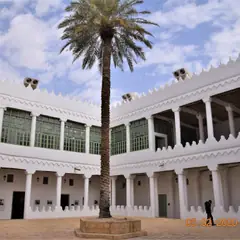
Past the wicket opens the main courtyard, ringed by halls with columns and with a staircase to the east. Around it are the three residential units: the ruler’s dwelling, the bayt al-mal or treasury, and the guest quarters. To the left of the entrance is the mosque, with its mihrab and niches for Qurans in the walls; opposite, the majlis with its wijar, the traditional Najdi hearth; in the northeast corner, the well with its wooden pulley, now surrounded by tools and cannons. And at the centre, the square al-Murabba tower dominates the whole from its high terrace.
Here the fight of 1902 ended. After Ajlan, Abdullah ibn Jiluwi crossed the wicket under the bullets, followed by 10 others; they flung the gate wide open and 40 attackers faced 80 defenders. Who killed Ajlan remains open: Abdulaziz’s account attributes it to Ibn Jiluwi, and in one of the versions he reached him, already wounded, in the fort’s own mosque. The last survivors, barricaded in a tower, surrendered in exchange for safe conduct.
The ending, according to tradition, was not a massacre but a change of sides: many of the defenders had served the Al Saud before and quickly did so again. One of Abdulaziz’s men climbed a tower and proclaimed the news to a city that, for the most part, had not even noticed the fight. The paradox came afterwards: the victor did not rule from Masmak, but from the old Al-Safat palace, which he rebuilt around 1912. The words of that proclamation are what the narration reserves for this courtyard.
Sixty-three names on a plaque
Plaque of the 63 in the Pioneers Hall
Summary of this stop
The last stop is the Pioneers Hall, dedicated to the men of the assault. A simple metal plaque lists the names of the 63 who accompanied Abdulaziz from his exile in Kuwait. The venture had an exact roster: 23 stayed behind in reserve guarding the camels and 40 stormed the fort, ten of them from Abdulaziz’s own family.
After 1902 the building changed trade. Abdulaziz used it as a depot for weapons and ammunition, for two years according to one version and until 1938 according to another, and turned it into a prison. In 1979 the then governor of Riyadh, Salman bin Abdulaziz, ordered it preserved and restored; in 1983 it passed to the General Directorate of Antiquities and Museums, and on 11 June 1995 it opened as a museum of the founding of the kingdom.
The wall that witnessed the assault is still a stage: logos of the Noor Riyadh light festival have been projected on its facade and, on Founding Day 2026, a visual show. Its anniversary also holds a calendar oddity, and how the centenary of 1902 ended up being celebrated in 1999 is the last twist of the route.