Contemporary architecture
King Abdullah Financial District Audio Guide
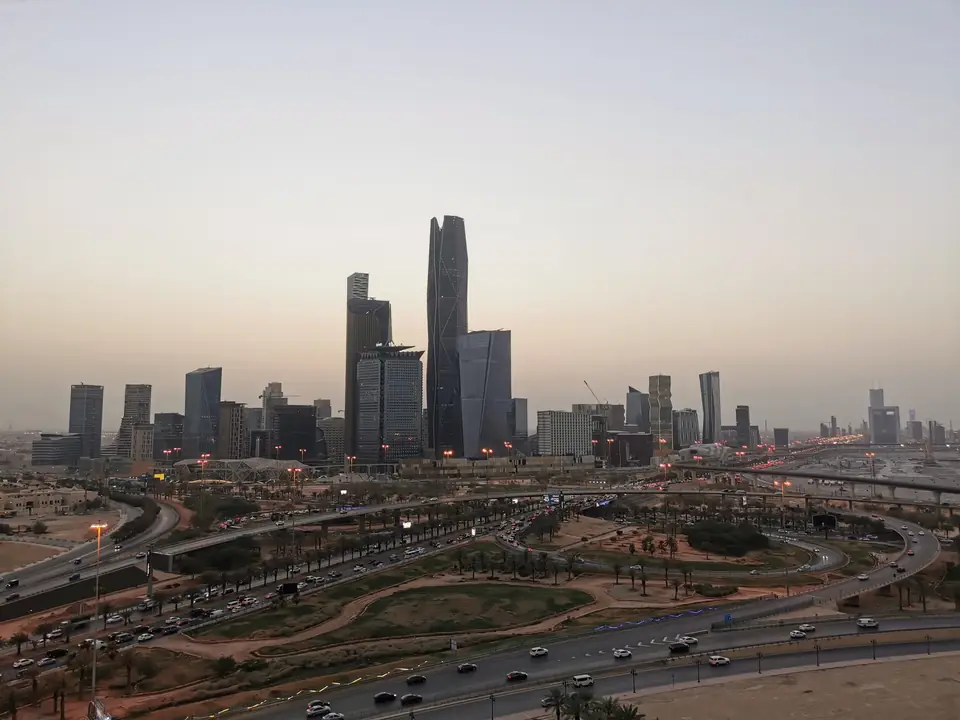
A district of glass towers built from scratch in the desert north of Riyadh, which spent years as a forest of idle cranes. Today it stitches its buildings together with the world's largest network of elevated pedestrian walkways, a shaded valley and a Zaha Hadid station.
- 60 min of audio
- Contemporary architecture
King Abdullah Financial District, KAFD, was born of an international competition won in 2006 by the Danish firm Henning Larsen: a master plan for a teardrop-shaped site of 1.6 million m² north of Riyadh. Work began in 2008 with an unusual requirement for the region, that every building be certifiable LEED silver or gold. At its heart, the Wadi, a sunken, tree-lined pedestrian promenade, seeks the same shade and coolness that the mud streets of old Riyadh pursued.
In 2010 the finance minister assured on the building site itself that there was no delay and that the second phase would be ready in March 2012. In 2016 no company had moved in yet and in the Gulf the district was talked about as a white elephant; in 2018 the cranes had been motionless for three years. In 2026 it hosts more than 140 companies with offices and more than 75 regional headquarters of multinationals, and is the country's financial centre.
Highlights
- KAFD metro station: Zaha Hadid's wave-patterned concrete lattice, evoking dunes combed by the wind
- KAFD Grand Mosque: a desert rose without columns, with two 60 m minarets, where three wadis meet
- PIF Tower: 385 m and 80 floors, the tallest in Riyadh, topped out in 2014 and finished in 2021
- Conference centre: the hall designed for music where cinema returned to the kingdom in 2018 with “Black Panther”
- Elevated walkways: 15.46 km and 42 climate-controlled steel-and-glass tubes, Guinness record since 2025
It bears a king’s name, but in Riyadh almost nobody calls it that. In Arabic the district is shortened to “al-Maliyya”, “the financial one”, the same word used for the Ministry of Finance. The history of King Abdullah Financial District is not that of a glass showcase that sprouted overnight, either. Its birth date already admits several answers: 2006, the year Henning Larsen won the master plan competition; 8 March 2007, when that plan was approved; or 2008, when work began.
What came after was more than a decade of promises and waiting. In October 2010 the finance minister, Ibrahim al-Assaf, gathered the board of the pension agency on the building site and assured that the second phase would be ready in March 2012, with some 13,000 workers on the job 24 hours a day. In 2016 almost the whole district was still a building site and no company had moved in. Today, with more than 140 companies installed, it is Saudi Arabia’s financial centre, and its architecture tells both stories at once: that of money and that of shade.
What to see at King Abdullah Financial District follows the order of the natural arrival: Zaha Hadid’s metro station, the Wadi and the Grand Mosque, the PIF tower, the conference centre where cinema returned and, to finish, the inside of one of the elevated walkways. The audio guide covers it in five stops, with a documented narration checked against historical sources, from the idle cranes to the world record.
The counterpoint to these towers lies in the adobe of At-Turaif District, in Diriyah; and another architecture born of an international competition, that of the National Museum of Saudi Arabia, awaits in the city centre.
A concrete dune that arrived seven years late
KAFD metro station
Summary of this stop
The route starts in the concourse of KAFD metro station. Zaha Hadid Architects won its competition in 2013, with the opening planned for 2017; it opened on 1 December 2024 as a major interchange for lines 1, 4 and 6. Its undulating volume is wrapped in a lattice of concrete panels perforated in sinusoidal waves that evokes dunes combed by the wind, and inside it spreads six platforms across four public levels.
The station is also an art hall. With the metro’s launch, the Riyadh Art programme placed here a monumental mobile by Alexander Calder, “Janey Waney”, in bright colours, and very close by Robert Indiana’s “LOVE (Red Outside Blue Inside)”, one of the most recognisable public artworks in the world. They are permanent pieces, and during the Noor Riyadh festival of 2025 they served as an anchor for its installations.
Between platforms and turnstiles, thousands of travellers pass a Calder every day on their way to the office. Why this building is the first key to reading the whole district is what the narration reveals in the concourse.
A shaded valley and a desert rose
KAFD Grand Mosque
Summary of this stop
The second stop is on the Grand Mosque plaza, a mid-height platform between the Wadi and the level of the towers that serves as an open-air prayer space on Fridays and holidays. From here Henning Larsen’s master plan is understood: the teardrop-shaped site is organised around the Wadi, a pedestrian promenade sunk beneath the street, with vegetation, water, shops and cafés. The towers shade it, and between the light stone facades, the trees and the water the air temperature drops by 6 to 8 °C next to them.
The mosque, by Omrania, imitates the desert rose, the crystal formed by sand. It has no columns: its 2.8 m structural skin supports a hanging mezzanine, and its roof, conceived as a “fifth facade”, is seen from the towers like an open rose. It stands where three wadis meet and is announced by two 60 m minarets. Sources do not agree on its completion, which some place in 2017 and its architect in 2019, nor on its capacity, put at about 1,500 worshippers.
What links this valley of offices to the Najdi adobe streets of old Riyadh is the thread the narration lays out in this plaza.
The tower that was topped out and waited seven years
PIF Tower
Summary of this stop
At the foot of the PIF Tower, the tallest in Riyadh, at 385 m and 80 floors, the district’s wound is told. It was born as the Capital Market Authority’s tower, started in 2010, reached its height in 2014 and was not finished until 2021, seven years after being topped out. During that time it was the most visible skeleton of a halted project.
In 2016 the main contractor, Saudi Binladin Group, was accumulating delays and the site saw worker protests over months of unpaid wages. The government then announced a rescue with the plan to transfer the district from the Public Pension Agency to the Public Investment Fund. How that transfer ended is told in two ways: the trade press took it as done in 2016, whereas a 2018 Reuters report holds that the negotiations failed in 2017 and that the final split left legal ownership with the Ministry of Finance and operation with the Fund.
The tower also holds a recent episode. On 2 April 2026, amid fear that the area might be a target for Iranian missiles or drones, the district’s management ordered the office towers evacuated immediately and no staff sent until at least 6 April. Ten years after standing empty because nobody wanted to move in, the district emptied again, this time by order. The details of those days are left for the narration beside the tower.
The symphony hall where cinema returned
KAFD Conference Centre
Summary of this stop
Before the conference centre, a building of about 28,000 m², the story takes a luminous turn. In 2016 it was almost finished amid the halted building site, and in 2018, with the cranes still motionless, the government closed the transfer, planned to allocate 2.3 billion riyals to finish the district and Binladin called hundreds of workers back, with an eye on the 2020 G20 summit.
On 18 April 2018 a part of this building, conceived as a symphony hall and converted into a 620-seat auditorium, hosted the first major film screening in Saudi Arabia in decades: an AMC gala with “Black Panther”, attended by the Minister of Culture and Information, Awwad Alawwad, and AMC’s chief executive, Adam Aron. Most reports put the ban at 35 years; Reuters’ speaks of almost 40.
Three years later, on 18 March 2021, with the world in lockdown, the centre, rebuilt to a design by Skidmore, Owings & Merrill, opened “Light Upon Light: Light Art since the 1960s”, the anchor exhibition of the first edition of Noor Riyadh: thirty artists, from Dan Flavin, James Turrell, Lucio Fontana or Robert Irwin to Yayoi Kusama and the Saudis Manal Al-Dowayan and Ahmed Mater, under a ceiling lined by Daniel Buren with coloured triangles. What became of that first cinema hall is what the narration tells in front of its facade.
Fifteen kilometres of glass above the street
Elevated glass-and-steel walkway
Summary of this stop
The route ends inside one of the elevated walkways. They are steel-and-glass tubes of twisted octagonal section, with large triangular windows, laid out like the veins of a leaf; in all there are 30,000 m² of glass and more than 3,000 tonnes of steel. They cross between the towers several floors up.
On 5 February 2025 Guinness measured them and recognised them as the world’s largest continuous elevated pedestrian network: 15.46 km and 42 climate-controlled walkways linking 95 buildings, a record Minneapolis had held since 2016. The number of buildings changes by source, from the operator’s 95 to the more than 59 skyscrapers counted by Arabic Wikipedia.
Along these walkways today moves the staff of a district that in 2016 had not a single tenant and that in 2026 totals more than 75 regional headquarters of multinationals. What joins that desert of cranes with this glass corridor designed so as not to step in the sun is the idea with which the narration closes.