Monument to Peter I
Bronze Horseman Audio Guide (Medny vsadnik)
A tsar on horseback atop a rock that crossed frozen ground on copper balls. Catherine II commissioned it, a Frenchman who was not invited to the unveiling modelled it, and the city believes it must never be moved.
- 30 min of audio
- 18th-century sculpture
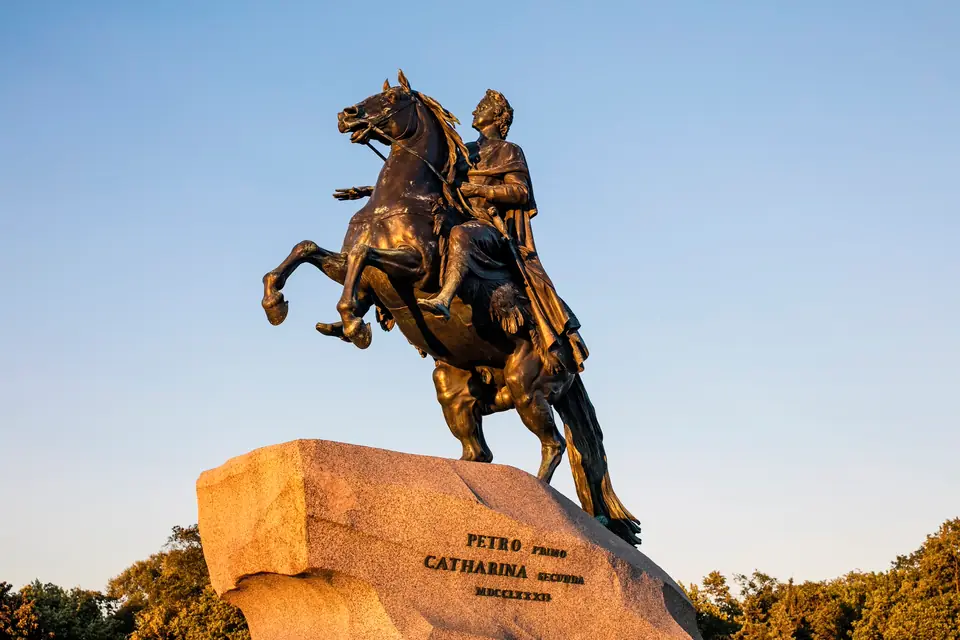
The Bronze Horseman is the monument to Peter the Great that presides over Senate Square, on the banks of the Neva. Catherine II commissioned it from Étienne Maurice Falconet, a Sèvres porcelain sculptor with no monumental experience, and unveiled it in 1782, on the centenary of Peter's accession to the throne, with a dedication presenting her as his heir.
Its name is not exact: the statue is bronze, but Pushkin's poem called it the copper horseman and the name stuck. Beneath the hooves a serpent serves as a third support, Peter's head was modelled by an 18-year-old pupil and the wild rock of the pedestal is in fact a puzzle of granite blocks.
Highlights
- Thunder Stone — dragged from Lakhta between 1769 and 1770 on 30 balls of copper alloy
- Peter's head — modelled by Marie-Anne Collot, Falconet's pupil, from his death mask
- Serpent beneath the hooves — Fyodor Gordeyev's third support for a rearing horse
- Inscription of 1782 — in Russian and Latin, from Catherine II to Peter I
- Senate Square — setting of the Decembrist revolt of 1825
The history of the Bronze Horseman begins on 15 (26) October 1766, when Étienne Maurice Falconet arrived in Saint Petersburg recommended by Diderot, with his assistant Fontaine and his pupil Marie-Anne Collot. Catherine II wanted a monument to Peter I and entrusted it to a sculptor from the Sèvres porcelain manufactory who had never made a monumental work. Sixteen years later, on 7 (18) August 1782, a canvas fence painted with mountain landscapes fell before the guard and the city discovered its founder on horseback atop a granite crag. Falconet was not there: he had left Russia in 1778 and no one invited him.
Since then the monument has never stopped carrying history. At its feet the Decembrists rose in 1825, Pushkin gave it in 1833 the name by which it is known, and during the siege of Leningrad it stayed on its pedestal, protected with sandbags. What to see at the Bronze Horseman, its history and the secrets of its construction are covered in five stops around the statue, with a documented narration, checked against historical sources, that saves its best twists for when it is heard in front of the rock.
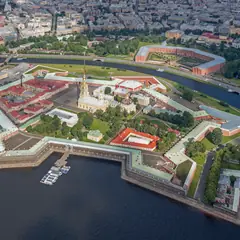
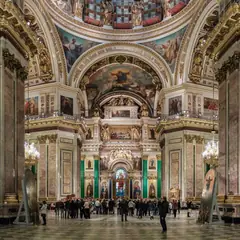
About 400 metres away stands St. Isaac’s Cathedral, and along the embankment one reaches the Winter Palace of the Hermitage Museum. Across the Neva, the Peter and Paul Fortress marks the place where the city began.
The face modelled by a pupil
The Bronze Horseman
Summary of this stop
With its back to the Neva, the horseman looms head-on: Peter rides without stirrups or imperial saddle, with a bearskin over the horse’s back, a laurel crown, a sword at his belt and the simple robes of a hero. His hand stretches towards the river, which in the 18th century was crossed right in front by a pontoon bridge now vanished. It is the image of a founder, not of a courtier.
Behind it lies a paradox. The man Catherine II commissioned had come from modelling porcelain figures, and the tsar’s head resisted him. It was solved by his pupil Marie-Anne Collot, who had arrived in Russia at 18, from Peter’s death mask made by Rastrelli; some sources speak, instead, of a mask taken in life. Her original plaster model, from around 1773, is kept in the Russian Museum. How that head fitted into the master’s work is told in the narration before the face itself.
A rock dragged on copper balls
Thunder Stone
Summary of this stop
On the flank facing the Admiralty, the pedestal shows its wave-like or sheer-cut crag shape. It is the Thunder Stone, and its journey is an epic. In 1768 it was offered by the peasant Semyon Vishnyakov, a stone supplier who had tried to split it to sell it without success; it lay near the village of Konnaya Lakhta, and for the tip-off he received 100 roubles.
From 15 (26) November 1769 to 27 March (7 April) 1770, with the ground frozen, the block advanced overland on a platform that rolled along two channels on 30 balls of copper alloy, moved by two capstans, at 20 to 30 paces a day. Five times it came off the machine and sank into the ground. The final stretch it made by water, on a vessel designed by the master Grigory Korchebnikov and escorted by two sailing ships, until reaching the square on 26 September 1770. A medal commemorated the feat with the legend Like unto daring.
Up close, the crag reveals something else: joints and different tones, pinkish or grey. According to a study of 2021, it is formed by four granite blocks of complex configuration, plus a small fifth at the base, turned to simulate a single rock, and a 3D model estimates that only a third of the original boulder was used. Its exact weight is still debated among the sources.
A serpent that holds up the horse
Serpent beneath the hooves
Summary of this stop
Behind the horse, on the St. Isaac’s side, the engineering trick is understood. A rearing horse resting only on its hind legs raised concerns about its stability, so a third point of support was added: the trampled serpent modelled by the Russian sculptor Fyodor Gordeyev, which incidentally turned Peter into a new Saint George victorious over the dragon. When cracks were found in 1976 and the monument was restored, X-rays showed that the tail serves only as a counterweight and that the internal frame passes only through the hind legs.
Getting there cost fire. The statue was cast in parts between 1775 and 1777: in the first pour, in the summer of 1775, the mould broke and the molten bronze started several fires. The lower part was saved, and the failed upper parts were recast in 1777. Who directed that casting is still a matter of debate among the sources.
Oral tradition has its own explanation of the scene. Legend has it that Peter wanted to leap the Neva on horseback from this very rock and that a serpent coiled around the hind legs and left him rooted to the spot; another version speaks of a tsar petrified mid-leap for placing himself above God. The end of both tales is left for the narration on the spot.
Catherine signs what Falconet made
Pedestal inscription
Summary of this stop
On the Senate side the dedication can be read: ПЕТРУ перьвому ЕКАТЕРИНА вторая лѣта 1782, and on the opposite side, in Latin, PETRO primo CATHARINA secunda MDCCLXXXII. It came from a proposal by Falconet of 1770, from which Catherine II struck the word erected. Having come to the throne by a palace coup, the empress thus presented herself as Peter’s heir.
The author of the work was left out of it. At odds for years with Ivan Betskoy, director of the works, and no longer in the empress’s favour, Falconet left Russia in 1778 taking plans and calculations with him. The architect Yuri Felten finished the monument, and at the unveiling of 1782 Catherine II arrived by launch, gave the signal from the Senate balcony and the guard regiments paraded along the embankment.
A ghostly tale also weighs on this place. According to the memoirs of the Baroness d’Oberkirch, the young Grand Duke Paul told how a stranger wrapped in a cloak, with the face of Peter I, had pointed out to him at night the centre of the square where the statue would rise. The same baroness records that Paul later confessed it was all a tale, so the story remains in doubt. What happened when news of the unveiling arrived is revealed when listening here.
From the ice of 1825 to the sandbags
Senate Square
Summary of this stop
In front of the arch joining the Senate and Synod buildings, the square reveals itself as a stage. On 14 (26) December 1825, some 3,000 rebel soldiers formed up at the foot of the monument, refusing to swear allegiance to Nicholas I. Pyotr Kakhovsky mortally wounded the governor-general Mikhail Miloradovich, loyal artillery dispersed them with grapeshot and many fled onto the ice of the Neva. Between 1925 and 2008 this was Decembrists’ Square.
Eight years after the revolt, in the autumn of 1833 at Boldino, Pushkin wrote the poem that gave the statue its name of copper horseman. Nicholas I did not authorise printing it, and it appeared posthumously in 1837 in Sovremennik, with censorship changes by Zhukovsky. During the siege of Leningrad (1941–1944) the statue was not taken down from its pedestal: it was covered with sandbags and a wooden hut, and came out practically intact. In October 2021 its second restoration began.
That permanence has its legend, a tradition documented since the 19th century: in 1812, with Napoleon advancing, there was talk of evacuating the monument, until the dream of a major named Baturin, in which the horseman came down from his rock, reached Alexander I’s ears. What the bronze tsar said in that dream, and why Saint Petersburg considers him its sentinel, is heard at the last stop.