Imperial palace
Hermitage Museum Audio Guide (Gosudarstvenny Ermitazh)
The green and white façade of the Winter Palace survived a fire, a bomb hidden in the cellar and two revolutions. Its most famous episodes, however, happened very differently from the way legend tells them.
- 90 min of audio
- Imperial Baroque
The Winter Palace, built by Francesco Bartolomeo Rastrelli between 1754 and 1762, was the residence of the tsars and is today the heart of the Hermitage Museum, founded in 1764 by Catherine II. In front of its façade on Palace Square, Bloody Sunday of 1905 and the fall of the Provisional Government in October 1917 took place.
The most repeated image of its history, the epic storming of the palace, did not come from 1917 but from a mass spectacle staged in this same square in 1920 before 100,000 spectators. A retouched photo of that performance circulated for decades as an authentic document.
Highlights
- Rastrelli façade — 215 metres of Baroque frontage on Palace Square
- Alexander Column — 600 tonnes of granite held up with no anchoring
- Fire of 1837 — the palace burned for about three days and was rebuilt in iron and brick
- October 1917 — 35 cannon shots, only 2 grazed the roof, and doors nobody locked
- The Hermitage cats — a tradition going back to a decree of 1745
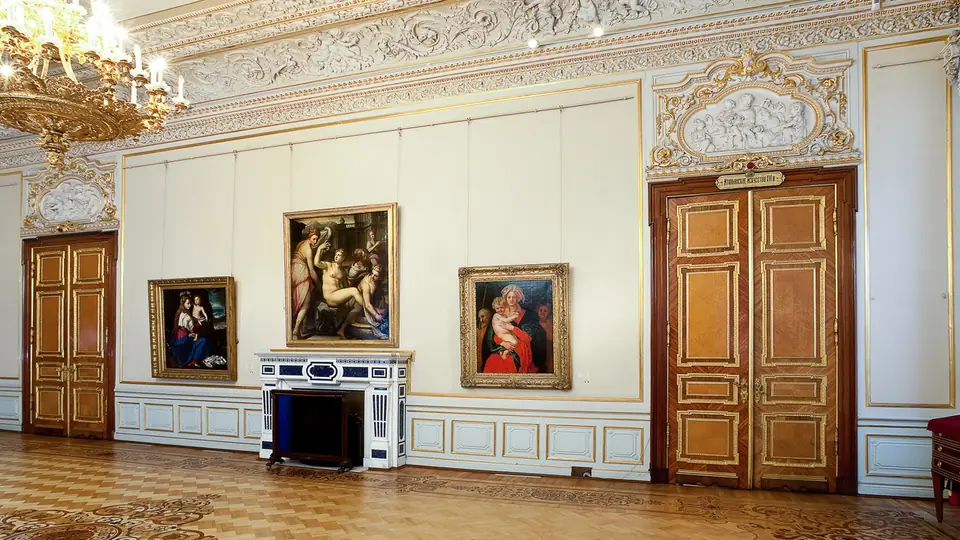
The history of the Hermitage Museum begins with someone else’s debt. In 1764 Catherine II bought from the Berlin merchant Johann Ernst Gotzkowsky a collection of paintings, mostly Flemish and Dutch, assembled for Frederick II of Prussia, who did not pay for it after the Seven Years’ War. Among those canvases was Frans Hals’s Portrait of a Man with a Glove, and the museum still celebrates its foundation every 7 December, Saint Catherine’s Day. The building that now houses it, the Winter Palace, had been designed by Rastrelli for Empress Elizabeth Petrovna, who died before seeing it finished.
Since then the palace has been an imperial residence, a military hospital, the seat of the Provisional Government and an air-raid shelter. In 1941, before the siege of Leningrad closed in, two trains evacuated much of the collections to Sverdlovsk; twelve shelters were fitted out in the cellars, where some two thousand people lived, and during the siege the building was hit by seventeen shells and two aerial bombs. Between 1930 and 1934 the Soviet government secretly sold more than two thousand works, among them Raphael’s Alba Madonna and Jan van Eyck’s Annunciation: in 1931 Andrew W. Mellon bought 21 of them, which formed the core of the National Gallery of Art in Washington.
The route is on foot and from the outside, without entering the museum: from Palace Square to the Neva embankment, in five stops that tell what to see around the Hermitage and the history its architecture holds. A documented narration, checked against historical sources, that saves its best twists for when it is heard in front of the façade.
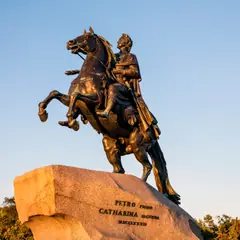
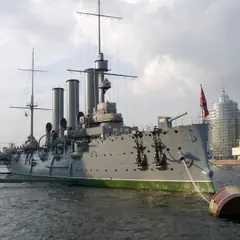
The night of 1917 that ended in this palace has its other half in the Cruiser Aurora, moored across the Neva. Less than a kilometre away on foot are the Bronze Horseman, the statue of Peter the Great commissioned by Catherine II, and the Church of Spilled Blood, built where Alexander II was mortally wounded.
A palace no one could rise above
General Staff Arch
Summary of this stop
Beneath the General Staff Arch, Carlo Rossi’s arched building that closes the square to the south, the space suddenly opens up and the whole palace appears. The main façade is 215 metres long and 30 high, although the figures vary depending on what is measured. And no civil building nearby rises above its cornice: in 1844 Nicholas I ordered that private houses in the city be at least one sazhen, 2.13 metres, lower than the Winter Palace, a rule that stayed in force until 1905.
The emerald green is not the colour it has always been, either. In the 18th century the palace was pale ochre with white decoration; in 1897 Nicholas II approved a terracotta red that was also extended to the General Staff and the Guards barracks, so that in 1917 the whole square was brick red. There were trials in grey and orange, a camouflage grey during the war and, finally, a commission of 1945–1947 that fixed the green with white columns and cornices.
This square also holds the memory of 9 (22) January 1905, Bloody Sunday. Several thousand people had gathered to hand a petition to the tsar, who did not even live in the palace but at Tsarskoye Selo, when a company of the Preobrazhensky regiment fired two volleys. The casualty figures are still disputed; on the square itself some 30 dead and wounded are mentioned. What exactly happened that afternoon is unravelled when listening on the spot.
Six hundred tonnes that stand by themselves
Alexander Column
Summary of this stop
In the centre of the square rises the Alexander Column, built between 1830 and 1834 by Auguste de Montferrand. Its shaft is a monolith of red Virolahti granite 25.45 metres tall and weighing about 600 tonnes, and it is not anchored to the base: it stays up by its own weight. On 30 August 1832 it was raised by 2,000 soldiers and 400 workers in 1 hour and 45 minutes. With the angel by Boris Orlovsky that crowns it, it reaches 47.5 metres.
Not everyone trusted it. According to a documented tradition, many Petersburgers feared the block would eventually fall and avoided going near it: Countess Tolstaya forbade her coachman to pass by the column and Lermontov’s grandmother would not cross the square. A last-minute change fed the fear, because the abacus on which the angel rests, planned in granite, had to be made of brick with lime mortar. It is said that Montferrand, perhaps to reassure the city, walked around it every afternoon with his little dog until his death.
Today the most repeated gesture at the foot of the granite is far more intimate: popular belief holds that newlyweds will have as many children as the number of times the groom circles the column with the bride in his arms. How the monolith was raised in under two hours is left for the narration beside its pedestal.
The façade that survived fire and dynamite
Rastrelli's south façade
Summary of this stop
Facing the south façade appears Rastrelli’s Baroque skin: grouped columns at the corners, mouldings and, cut against the sky, a balustrade of statues and vases running along the whole roof. The palace, with more than a thousand rooms depending on which figure is taken, was built between 1754 and 1762 for Elizabeth Petrovna. The person who received the work on 6 April 1762 was Peter III, overthrown that same summer, and the building was completed under Catherine II.
In December 1837 (sources give the 17th or the 13th) a fire burned virtually all the interiors. It blazed for about three days, its glow could be seen from 50–70 versts away and thirty guards died. The rescued objects were piled up on the snow of the square and Nicholas I ordered the three passages joining the palace to the Hermitage demolished to stop the fire, which saved the collection. Vasily Stasov, Alexander Briullov and A. E. Shtaubert rebuilt it in 1838–1839 with iron, cast iron and brick instead of wood, without touching the façade.
Behind these walls a dark episode was also written. According to a documented tradition, in 1879 Stepan Khalturin, of Narodnaya Volya, took a job with false papers as a carpenter and kept carrying dynamite up to his little room in the cellar. On 5 (17) February 1880 he set it off at the time planned for Alexander II’s dinner: the floor of the guardroom collapsed and eleven soldiers died. Why the tsar was not in the dining room is one of the twists revealed in front of the façade.
The storming that never was
Courtyard gate with double-headed eagles
Summary of this stop
In front of the gate of the central arch, with its restored gilded double-headed eagles, the less epic version of October 1917 is told. Since July, Kerensky’s Provisional Government had shared the building with the military hospital of Tsarevich Alexei, which had operated there since 1915. On the night of 25 to 26 October, the palace was defended only on this side, by cadets, invalids and 137 women of the 1st Petrograd Women’s Battalion. The back doors on the Neva side were left unlocked, and through them came sailors, workers and the curious.
The guns of the Peter and Paul Fortress fired 35 shots with live shells and only 2 grazed the roof; the cruiser Aurora, because of its position, could not hit the palace and limited itself to one blank shot. Vladimir Antonov-Ovseyenko arrested the ministers at 2:10 on 26 October. About six soldiers and one woman of the battalion died.
The canonical image of the storming was born three years later: on 7 November 1920 Nikolai Evreinov staged The Storming of the Winter Palace in this square, before 100,000 spectators, with searchlights, lorries and armoured cars. That staging inspired the sequence in Sergei Eisenstein’s October. How a theatre photo ended up in the history books is heard beside the gate.
Catherine’s retreat by the Neva
Neva façade and Small Hermitage
Summary of this stop
On the embankment, facing the north façade, the route changes tone. The name Hermitage, a place of retreat, was given by Catherine II to the wing she commissioned from Jean-Baptiste Vallin de la Mothe as a refuge from court etiquette, reviving the word Elizabeth used for her private rooms. About 150 years later the name came to designate the whole complex, Winter Palace included. The exact number of paintings in the founding purchase of 1764 varies according to the sources.
The evenings of that retreat had their own rules, written by the empress and hung at the entrance: ranks, hats and swords were left outside, yawning and standing up when she entered were forbidden, and what was heard inside was not to leave through the door. Whoever broke a rule drank a glass of cold water and read a page of Trediakovsky’s Tilemakhida, regarded as a model of bad poetry.
Beneath these walls another tradition is still alive: the Hermitage cats. In 1745 Elizabeth Petrovna signed a decree to bring thirty mouse-hunting cats from Kazan, although other versions speak of five given by the city. Their heirs still live in the cellars, numbered 74 in 2013, and each spring they have their own Cat Day. The punishment reserved for the most indiscreet guest is revealed at the end, on the banks of the Neva.