Orthodox cathedral
Kazan Cathedral Audio Guide (Kazansky sobor)
A cathedral that turns its flank to Nevsky Prospect and embraces it with 96 columns. Inside, Kutuzov's tomb, the keys of cities taken from Napoleon and the memory of the years when it was a museum of atheism.
- 40 min of audio
- Russian Neoclassicism
Kazan Cathedral was born of an imperial wish: Paul I wanted on Nevsky Prospect a church worthy of St. Peter's in the Vatican. It was built between 1801 and 1811 by Andrey Voronikhin, a former serf of the Stroganov family, and when consecrated it was the tallest building in Saint Petersburg, at 71.5 metres, with the first great wrought-iron dome in Russia.
Few churches have changed roles so many times. It was Kutuzov's pantheon and a depot for the trophies of 1812, the setting of Russia's first political demonstration, the Museum of the History of Religion and Atheism from 1932 and, from 1991, a church again. For a time the morning mass had to end before ten so that the museum could open.
Highlights
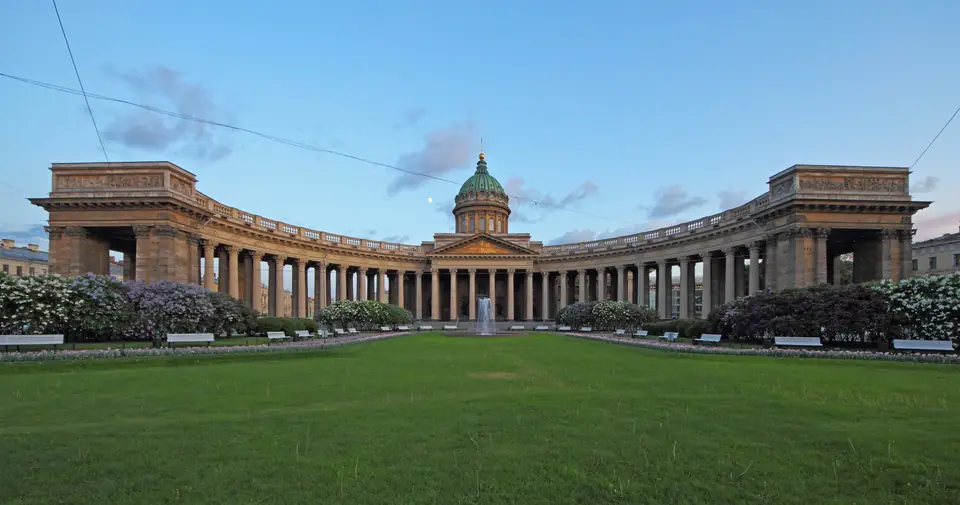
- Semicircular colonnade — 96 Corinthian columns in four rows opening onto Nevsky Prospect
- Bronze doors of the north portico — a copy of Ghiberti's Gates of Paradise, with the scenes in a different order
- Dome of 1811 — the first great wrought-iron dome in Russia, at a height of 71.5 metres
- Pink granite nave — 56 Finnish granite columns with gilded Corinthian capitals
- Kutuzov's tomb — buried in 1813 in the north aisle, among keys of cities and trophies of 1812
The history of Kazan Cathedral begins with a small church, that of the Nativity of the Virgin, which had stood on Nevsky Prospect since 1733. Paul I wanted to replace it with an enormous church inspired by St. Peter’s in the Vatican, and the competition of 1799, entered by Charles Cameron, Pietro Gonzaga, Giacomo Trombara and Thomas de Thomon, ended with no project approved. The commission ended up in the hands of Andrey Voronikhin, a protégé of Count Alexander Stroganov. The first stone was laid in 1801, the old church was demolished in 1811 and that same year Alexander I attended the consecration. Two plaques still sum it up: begun by Paul, finished by Alexander.
What came next explains why this church weighs so heavily in the city’s memory. The following year came the war of 1812, and the cathedral became the place where Russia kept its marshal and the trophies taken from Napoleon. In the 20th century it was a museum of atheism, took shells during the siege of Leningrad and in 1994 recovered the cross of its dome. What to see at Kazan Cathedral, its history and its architecture are covered in five stops, from the square open to Nevsky to Kutuzov’s tomb, with a documented narration that saves its best twists for when it is heard right there.
Following the Griboyedov Canal to the north, some 700 metres on, the domes of the Church of Spilled Blood appear, and a kilometre to the west stands the other great imperial cathedral, St. Isaac’s Cathedral.
A cathedral that looks sideways
Kazan Square
Summary of this stop
From Nevsky Prospect the problem Voronikhin had to solve becomes clear. Canon demanded the main entrance on the west, but the plot faced the avenue to the north, that is, the flank of the church. The solution was to open towards the street a semicircular colonnade of 96 Corinthian columns in four rows, of Pudozh travertine, ending in two great passage porticoes at either end. Each column weighs some 30 tonnes and, even so, from afar the whole looks light.
The comparison with Rome is inevitable, and not new. Bernini’s colonnade before St. Peter’s totals 284 columns, and popular opinion takes this cathedral for a copy of the Vatican; already in its day Filipp Vigel accused the architect of transcribing Michelangelo in the worst handwriting. Voronikhin, on the other hand, cited other references, from St Paul’s in London to Sainte-Geneviève in Paris, and architectural historians see in Rome only the motif of the colonnade, which here opens to the street instead of closing off a square.
The project, moreover, was left half done. A plan signed in 1810 includes a second, twin colonnade for the south façade that was never built: the plot ended up occupied by rental apartment blocks. At the ends, two empty pedestals recall another absence, that of some bronze statues that never arrived. What that asymmetry says about the church Paul I imagined is revealed when listening to the narration in front of the colonnade.
Bronze marshals and the first red flag
Monument to Mikhail Kutuzov
Summary of this stop
In the semicircular square two bronze marshals stand guard on tall granite pedestals: Kutuzov to the east and Barclay de Tolly to the west. They were modelled by Boris Orlovsky, the pedestals are by Vasily Stasov and they were unveiled in 1837, on the 25th anniversary of the defeat of Napoleon. It is the stage set of a square of heroes of 1812.
The same square holds another memory. On 6 (18) December 1876, some 400 people from Land and Liberty and workers’ circles held here the first political demonstration in Russia: Georgy Plekhanov spoke against autocracy, the worker Yakov Potapov raised a red flag and 31 were arrested.
Two decades later came a darker episode. In February 1897, the teacher Maria Vetrova, jailed for anti-tsarist propaganda in the Peter and Paul Fortress, set herself on fire in her cell and died of her burns. On 4 March, thousands of students went to the cathedral for a forbidden requiem, and on leaving the police surrounded them and took them to the Kazan police station; counts speak of some 1,200 people registered, or 850 detained according to another source. How that Vetrova demonstration is remembered today is told in front of Kutuzov’s statue.
Gates of Paradise with the Bible out of order
Bronze doors of the north portico
Summary of this stop
In the central portico of six columns open enormous bronze doors with biblical reliefs in panels. They are a copy of Lorenzo Ghiberti’s Gates of Paradise, in the Baptistery of Florence, one of its four replicas in the world, and were cast and chiselled when the building was already finished. Around them, in niches, four bronze statues: Saint Vladimir, Alexander Nevsky, John the Baptist and Saint Andrew.
Their history has a curious twist. According to the documented tradition, the model was not taken in Florence, but from a plaster cast of the Baptistery doors that Nikolai Demidov gave to the Academy of Fine Arts in 1774. The founder Vasily Yekimov confused the sequence of the scenes and placed them in an order different from Ghiberti’s, so that anyone who knows the original can look for the reliefs moved to other places.
This portico is also the place to understand the rise of its architect. Count Stroganov, president of the Imperial Academy of Fine Arts, managed to have the work commissioned from Voronikhin, a former serf of his family. Popular belief has it that the count was in fact his father, although no document confirms it. The first stone was laid on 27 August (8 September) 1801; what separates the former serf from the architect of the great cathedral of the Nevsky is revealed when listening at the stop.
Pink granite and the silver that was melted down
Silver iconostasis and pink granite columns
Summary of this stop
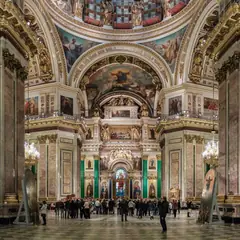
Inside, 56 columns of pink Finnish granite with gilded Corinthian capitals form a three-aisled hall; the central one is 69 metres long. It is said that Voronikhin came across the stone on his honeymoon, travelling the Karelian Isthmus, near Vyborg. At the far end gleams the main iconostasis, and its gleam hides a loss.
Between 1834 and 1836, to a design by Konstantin Thon, the iconostasis was clad with the silver of church objects looted by the French and recovered by the Cossacks of the Don ataman Matvey Platov; 40 of its nearly 100 poods were a gift from those Cossacks. In the requisition of 1922, the Soviet State took some 2 tonnes of silver from the cathedral and melted down the iconostasis. The one seen today is a recreation of the early 2000s.
In 1932 the cathedral closed and reopened as the Museum of the History of Religion and Atheism: the books went for recycling, the objects of worship to the Russian Museum and the brocade chasubles ended up sewn into tubeteikas, caps then in fashion. According to the documented tradition, at the end of 1990 a bundle wrapped in matting turned up in its storerooms and proved to hold some much-venerated relics. What detail made it possible to recognise them is told in front of the iconostasis.
Kutuzov’s tomb and the keys of Europe
Tomb of Mikhail Kutuzov
Summary of this stop
In the north aisle, behind an openwork railing designed by Voronikhin, rests Mikhail Kutuzov. In the summer of 1812 the marshal prayed in this cathedral before the icon of Our Lady of Kazan before leaving for the front; he died in Bunzlau, in Prussia, in April 1813, and in June his coffin arrived here to be buried. A widespread tradition places his heart buried far away, near Bunzlau, although other accounts dispute it.
In 1813 and 1814 the cathedral displayed 107 French flags and standards, 97 keys of captured fortresses and cities and Marshal Davout’s baton. The figures vary according to the source, and in 1912 most of the trophies passed to the State Historical Museum in Moscow, so that only a part is kept on the wall beside the tomb.
In the same cathedral, worship returned before the museum left. On 25 May 1991 services resumed in the left aisle while the museum was still inside; the cross regained its place on the dome on 30 April 1994, the church became a cathedral again in 2000 and the Kazan icon returned in 2001. How the circle of 1812 closes before the marshal’s railing is left for the narration on the spot.