Cradle of Saint Petersburg
Peter and Paul Fortress Audio Guide (Petropavlovskaya krepost)
The fortress where Saint Petersburg was born never fought a battle. Instead, beneath a golden spire 122.5 metres high, it became both the Romanovs' pantheon and the prison of those who wanted to bring them down.
- 75 min of audio
- Bastioned fortress
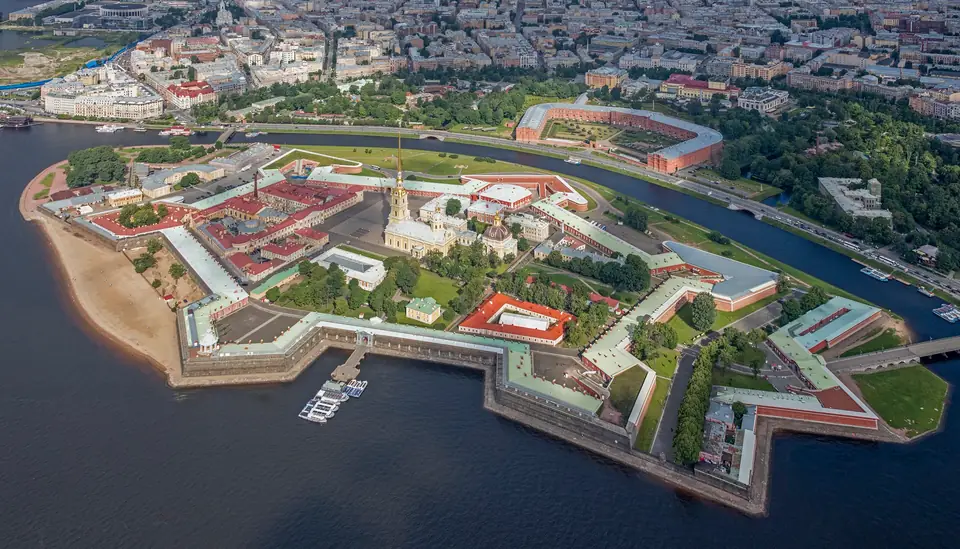
The Peter and Paul Fortress was founded on 16 (27) May 1703 on Hare Island, a marshy islet of 28 hectares at the widest point of the Neva, and that date is taken as the birth of the city. It began as earth and logs, was rebuilt in brick from 1706 and its front facing the Winter Palace was clad in granite between 1779 and 1785. At its centre, Domenico Trezzini's cathedral holds almost all the Russian emperors since Peter I.
Its sharpest contrast lies in the use it was given: built as a fortress, with more than 120 cannon already in its first autumn, it never took direct part in a military action and ended up as the Empire's main political prison. One of its first prisoners was Peter I's own son, Tsarevich Alexei, who died locked up here in 1718; a few steps from his cell the tsars now rest.
Highlights
- Golden spire of the cathedral — 122.5 metres topped by an angel with a cross
- Imperial tombs — the emperors from Peter I, except Peter II and Ivan VI, and Nicholas II since 1998
- Ivan Zarudny's iconostasis — almost 20 gilded metres in the form of an open triumphal arch
- Trubetskoy Bastion prison — 71 isolation cells and more than 1,500 political prisoners until 1917
- Noon gun — a daily signal fired from the fortress since 1873
The history of the Peter and Paul Fortress is the history of Saint Petersburg from its first day. On 16 (27) May 1703 it was founded on Hare Island, a marshy islet at the widest point of the Neva, and that date is celebrated as the birth of the city. The founding legend adds the perfect scene: Peter cutting two turfs of grass with a soldier’s bayonet, laying them in a cross and announcing that a city would stand there, while an eagle hovered above him. The problem is that the campaign diary of his bombardier company places him that day on the way to Lodeynoye Pole, and his presence at the laying of the first stone is still disputed among historians.
What came next was stranger than any legend. The fortress never fought, but it served as a state prison for two centuries. Here in 1775 the impostor known as Princess Tarakanova was held; tradition had her drown in her cell during the flood of 1777, the scene painted by Konstantin Flavitsky in 1864, although she actually died of tuberculosis in December 1775. At the kronwerk, facing its walls, the five Decembrist ringleaders were hanged in 1826, an execution so clumsy that three of them had to be hanged twice; an obelisk of pink granite has marked the spot since 1975. In 1756 a fire brought down the cathedral’s wooden spire, in 1924 the complex became a museum and in 1925 the Leningrad Soviet even approved its demolition to build a stadium, a decision that was soon annulled.
The history of the fortress, its architecture and what to see in it are covered in five stops, from the wooden bridge of the hare to the granite bank facing the Winter Palace, with a documented narration that saves its best twists for when it is heard inside the walls.
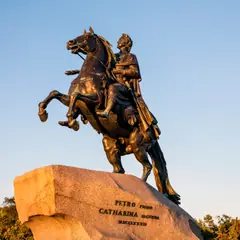
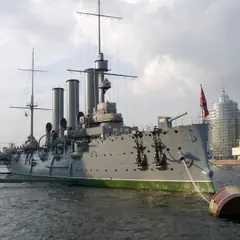
Peter the Great, whose city began on this island, has his monument on the other bank of the Neva: the Bronze Horseman. And a little over a kilometre to the east, at the Petrogradskaya embankment, the Cruiser Aurora is still moored.
The hare that founded a capital
Ioannovsky Bridge
Summary of this stop
The main entrance comes from Troitskaya Square over the Ioannovsky Bridge, a 75-metre wooden footbridge. Beside it, on a group of icebreaker piles, sits a metal hare 58 centimetres tall, placed there in 2003, at which visitors throw coins. It is a nod to the name of the island, Zayachy, Hare’s, and to a popular legend: it tells that, in the middle of a Neva flood, a hare fleeing the water leapt onto Peter the Great’s boot just as the tsar was stepping from his boat. In another version, the tsar arrived furious to punish the workers for their slowness, the hare made him laugh and the punishments were forgiven.
Ahead stretches the star-shaped plan of 1703. Its six bastions bear the names of those who supervised the work alongside Peter I: Menshikov, Naryshkin, Trubetskoy, Golovkin and Zotov, plus the Sovereign Bastion, the tsar’s own. By the autumn of that same year they already mounted more than 120 cannon. How a marshy islet became the starting point of an imperial capital is told on the bridge itself, with the hare in sight.
The spire everyone had to climb
Peter and Paul Cathedral
Summary of this stop
At the centre of the grounds rises the Peter and Paul Cathedral, with a bell tower meant to eclipse Moscow. In 1722, with the tower already at 112 metres, 32 more than the Ivan the Great Bell Tower of the Kremlin, Peter I had foreign ministers climb to its top level to show them his paradise. After the spire was remade in metal in 1857–1858, the whole now stands 122.5 metres tall and is topped by an angel with a cross, one of the city’s historic symbols. How long it kept the height record is told in different ways: some sources keep it as the tallest building in Saint Petersburg until 1962 and others until 2017, although they agree that it was the tallest in Russia until 1952.
The history of this spire has been written by climbing it. In 1830 the roofer Pyotr Telushkin repaired the damaged angel by climbing up without raising scaffolding. During the siege of Leningrad, a team of climbers, with Second Lieutenant Mikhail Bobrov the first to reach the tip, covered the gold with camouflage paint so that it would stop serving as a guide for the enemy, while the top swayed a metre and a half. The details of those climbs are left for the narration beneath the spire.
A triumphal arch above the imperial tombs
Iconostasis and imperial tombs
Summary of this stop
Inside the cathedral, built by Trezzini between 1712 and 1733, the iconostasis breaks expectations. Instead of a closed wall of icons, its almost 20 gilded metres form an open Roman triumphal arch, with the Royal Doors and statues of Saint Peter with the keys and Saint Paul with the sword. It was carved in Moscow in 1722–1727 under the direction of Ivan Zarudny, as a gift from Peter I and Catherine I.
Around it and in the aisles are spread the tombs of all the Russian emperors from Peter I, except Peter II and Ivan VI. In 1998 Nicholas II, his family and their servants were buried in the Saint Catherine Chapel. It is the centre of dynastic power, a short walk from the prison where that same power locked up its enemies, and what that proximity reveals is heard in front of the iconostasis.
The cells of a fortress with no battles
Trubetskoy Bastion prison
Summary of this stop
The fortress’s true trade was confinement. One of its first prisoners was Tsarevich Alexei, son of Peter I, who died here in 1718; his end is given as death in prison or as a secret murder, and the debate has not been closed. The Trubetskoy Bastion prison, a two-storey pentagonal building raised in 1870–1872, had 71 cells of total isolation. More than 1,500 political prisoners passed through them until 1917, among them Kropotkin, Gorky and Trotsky, and its last inmates, in 1921, were Kronstadt rebels. Today the corridor and the cells are shown restored according to different periods, with the prison library and chapel.
After the revolution, the fortress changed jailers but not trade. In January 1919 the Cheka shot four Romanov grand dukes inside its walls, and next to the Golovkin Bastion mass graves of the Red Terror have been found with at least 160 victims. The stop also holds a documented episode: in a cell of the Alexeyevsky Ravelin, Nikolai Chernyshevsky wrote, with his jailers’ permission, the novel What Is to Be Done?, which passed two censors as a simple love story. What happened to its only manuscript on the way to the printer is revealed in the corridor of cells.
Granite, cannon shot and bathers facing the Palace
Neva Gate
Summary of this stop
The Neva Gate opens onto the river and onto the granite front that, between 1779 and 1785, was added to the brick wall so that the fortress would form a single ensemble with the Winter Palace and the Admiralty. From here that same palace was fired upon on the night of 25 October 1917: after the blank salvo of the cruiser Aurora, the fortress’s guns launched some 30 shells and only two hit the target, with minor damage. The ministers of the Provisional Government ended up imprisoned in the Trubetskoy Bastion.
Since 24 September 1873, a cannon shot has marked every noon from the Naryshkin Bastion, although the origin of the custom goes back, in disputed fashion, to Peter I’s firings. Kirov abolished it in 1934, it returned in 1957 and since 2008 it appears in the Charter of Saint Petersburg; while the granite is being restored, it sounds from the Sovereign Bastion, with a return planned for the end of 2026. At the foot of the wall lies the only beach in the historic centre, where, as soon as the winter sun appears, a row of Petersburgers in swimsuits sunbathe at temperatures around zero. How that bank became the territory of the Neva’s walruses is told facing the river.