Museum ship
Cruiser Aurora Audio Guide (Kreyser Avrora)
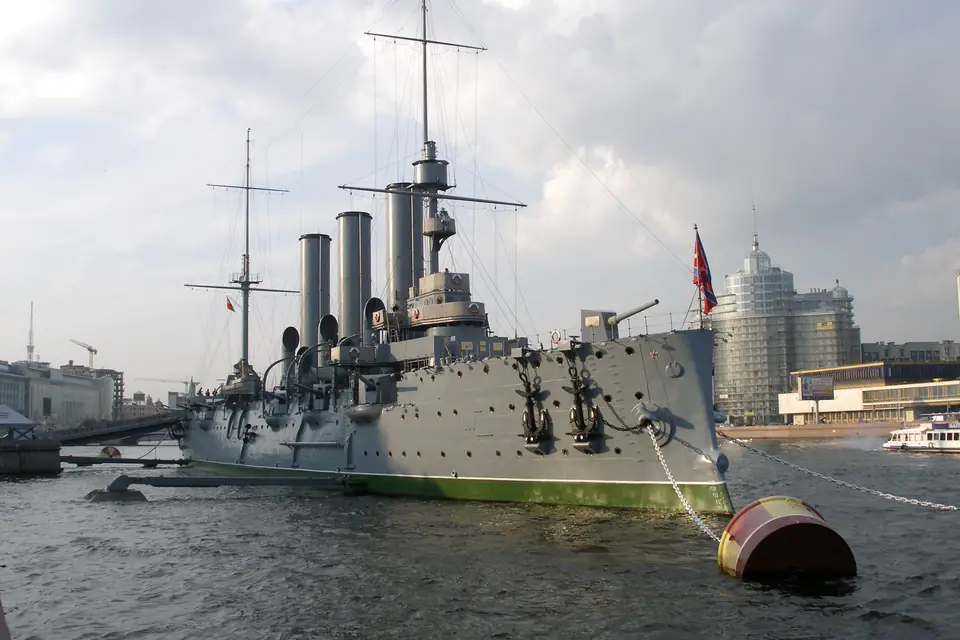
A grey three-funnelled cruiser that owes its fame to a single shot with no shell. It survived Tsushima and the siege of Leningrad, and much of what is walked on aboard today is a copy.
- 45 min of audio
- Naval history
The Aurora has been moored since 1948 on the Bolshaya Nevka, beside the Petrogradskaya embankment and facing the Nakhimov Naval School. Christened in 1897 by Nicholas II, it fought at Tsushima, fired in 1917 the blank round that Soviet propaganda turned into the start of the revolution and lent its guns to the defence of Leningrad in 1941. Today it is a museum ship, a branch of the Central Naval Museum.
Its legend rests on a shot that carried no projectile, and its hull on a replacement: between 1984 and 1987 almost the whole underwater hull was cut away and swapped for a copy in modern steel. The original part did not end up in a museum, but sunk off the coast of the Gulf of Finland.
Highlights
- 152 mm bow gun — the single blank shot of 25 October 1917, at 21:40
- Tsushima survivor — in 1905 a shell killed Captain Yevgeny Yegoryev in the conning tower
- Battery A of 1941 — nine 130 mm guns of the cruiser facing the German advance on Leningrad
- USSR emblem and red stars — preserved after the repair of 2014-2016 in Kronstadt
- Underwater hull replaced in 1984-1987 — the original hull was left sunk at Ruchi, in the Gulf of Finland
The history of the cruiser Aurora begins in March 1897, when Nicholas II chose its name from among eleven proposals, and runs through almost the whole Russian 20th century. In 1905 it came out of Tsushima with its captain dead and ended up interned in Manila under American protection; on that voyage, the ship’s doctor took the first X-rays after a battle in Russian naval history. In February 1917 its commander died on the quay from a shot fired from the crowd, and in October of that year the ship entered the Soviet textbooks for a blank cannon shot. In 1941 it ended up settled on the bottom of Oranienbaum harbour, and in 1968 it became the only Soviet ship with two orders.
Between one episode and the next there is room for lesser-known stories: according to a documented tradition, in 1910 the city of Messina paid its crew with 1,800 oranges and as many lemons for putting out a fire, and after Tsushima the officers stopped eating in the great cabin where they had kept vigil over their commander. What to see on the cruiser Aurora, how its silhouette is read and how much of the original ship remains are covered in four stops, from the quay to the engine room, with a documented narration that saves its best twists for when it is heard aboard.
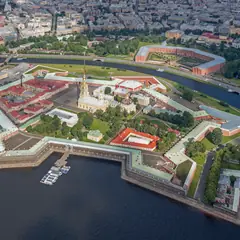
A little over a kilometre to the west, on Hare Island, lies the Peter and Paul Fortress, and across the Neva rises the Winter Palace of the Hermitage Museum, the palace whose storming in 1917 became forever linked to the cruiser’s name.
Three funnels facing the cadets
Cruiser Aurora
Summary of this stop
From the quay the full silhouette can be taken in: grey hull, three tall funnels and the bow pointing at the city. The name, chosen by Nicholas II on 31 March (12 April) 1897, is that of the Roman goddess of dawn, and among the other ten proposals was Variag. It also repeated that of a sailing frigate that had distinguished itself in the defence of Petropavlovsk-Kamchatsky during the Crimean War.
That discarded Variag ended up coming back. Refloated on 20 July 1944, from October 1945 the Aurora passed to the Gorky studios to play the cruiser Variag in a film of 1946, and for the role it received a fourth false funnel, a bow ornament and a commander’s balcony on the stern.
The location is no accident either. On 17 November 1948 the cruiser took up its final mooring, right in front of the Nakhimov Naval School building, to serve as a training ship for its cadets; in 1956 it became a branch of the Central Naval Museum, although sources do not entirely agree on the museum dates. What that location says about the ship is discovered when listening to the narration right there.
The gun of the shot with no shell
152 mm bow gun
Summary of this stop
On the forecastle, always surrounded by visitors, stands the most famous 6-inch (152 mm) gun in Russia. On the night of 25 October 1917 the Military Revolutionary Committee ordered the cruiser to reopen passage over the Nikolayevsky Bridge, which the cadets had raised. The elected commander, Nikolai Erikson, refused, claiming the channel of the Neva had not been sounded, and only brought the ship up to the bridge after threats from the crew.
At 21:40, on the order of the commissar Alexander Belyshev, the gunner Yevdokim Ognev fired a single blank round with this piece. Two days later, when it was rumoured that the Aurora had shelled the Winter Palace with live ammunition, Pravda published a denial signed by the commissar: a single shot, with no projectile, as a warning signal to the ships on the Neva. In 1967, for the 50th anniversary, the same gun repeated the blank salvo at 21:45 sharp.
What role that shot played remains in dispute: the Soviet version presented it as the signal for the storming of the palace, while some historians place the signal at the Peter and Paul Fortress or deny there was one, and the journalist John Reed even wrote that two shells damaged the cornice. How a shot with no shell became revolutionary thunder is left for the narration in front of the gun.
A Soviet emblem no one removed
Soviet emblem on the stern
Summary of this stop
On the stern shines the emblem of the USSR, and on the sides, red stars. On 22 February 1968 the Aurora received the Order of the October Revolution, whose badge reproduces the silhouette of the cruiser itself, and became the only Soviet ship with two orders; the honorary stern flag flown since 2016 carries both decorations.
Between September 2014 and July 2016 the ship was repaired in the Kronstadt dock for about 840 million roubles. It came back with the Soviet emblem and the red stars intact, an exception to the rule on Russian Navy symbols, and without the double-headed eagle of the imperial ship, whose restoration was debated and ruled out.
That relic status explains the scandal of June 2009, when a magazine owned by the billionaire Mikhail Prokhorov celebrated its anniversary aboard with some 150 guests, loud music from an illuminated pontoon and jumps into the water from the deck. The Main Military Prosecutor’s Office declared the party illegal and the local press links it with the cruiser’s removal from the Navy in 2010. The outcome of that night is told at the stop.
Mock-up boilers, spare hull
Engine room and boilers
Summary of this stop
Below deck, the original steam engines sit alongside boilers that since 1984-87 have been mock-ups. The ship’s wounds pile up on this route: at Tsushima, on 14 May 1905, splinters of a 75 mm shell entered through the conning tower’s slit and killed Captain Yevgeny Yegoryev. In September 1941, under daily bombardment at Oranienbaum, the commander Ivan Sakov housed the crew ashore and was shot for panic and abandoning the ship; days later, several hits settled the cruiser on the bottom with a 3° list.
The deepest wound came in peacetime. Between 1984 and 1987, at the Zhdanov shipyard, almost the whole underwater hull was cut away and replaced with a copy in modern steel, hence some speak of a replica; the repair of 2014-16, on the other hand, confirmed that the bronze stem and sternpost are those of the original construction. The cut-away part was towed to Ruchi, in the Gulf of Finland, where according to local accounts it was to be buried beneath a new quay and ended up sunk off the coast, without a legal owner and broken up for years for scrap and souvenirs.
How much of the authentic Aurora remains is the question with which the visit ends, and the answer is heard in the engine room itself.