Neo-Russian memorial church
Church of Spilled Blood Audio Guide (Spas na Krovi)
A church of enamelled domes built to enclose a piece of street: the cobblestones where a bomb mortally wounded Alexander II in 1881. Outside, Moscow in the middle of a Baroque capital; inside, a sea of mosaic.
- 45 min of audio
- Neo-Russian architecture
The Church of the Savior on Spilled Blood, the Spas na Krovi of the Petersburgers, stands beside the Griboyedov Canal at the exact spot of the 1881 assassination. Alexander III wanted a church and not a mere monument, imposed the style of the 17th-century churches of Yaroslavl and approved the design of Alfred Parland and Archimandrite Ignaty. After 24 years of work, it was consecrated in 1907 in the presence of Nicholas II.
To bring the site of the attack inside the church, the building was pushed out over the canal bed, which is why it has no door on its west façade. Beneath the bell tower, seven steps down, the cobblestones, paving slabs and railing of 1881 remain. The 20th century closed it, condemned it to demolition and used it as a morgue and warehouse; in its central dome an unexploded German shell slept for 18 years.
Highlights
- Cobblestones of the 1881 attack — roadway, slabs and canal railing beneath a jasper canopy
- Bell tower over the canal — the building was pushed out over the water to enclose the exact spot
- Mosaic interior — about 7,065 m² from Frolov's workshop, according to the most cited source, from sketches by Vasnetsov and Nesterov
- Nine enamelled domes — a central structure of 81 metres, a figure that recalls 1881
- 240 mm German shell — hidden for 18 years among the beams of the central dome, removed in 1961
The history of the Church of the Savior on Spilled Blood begins with two explosions. On 1 March 1881, 13 March in the Gregorian calendar, a bomb went off under Alexander II’s carriage on the embankment of the Yekaterininsky Canal, today the Griboyedov; when the tsar stepped out to see the place, a second one fell at his feet. He died that same afternoon in the Winter Palace. His son, Alexander III, decided that a church would be built on that stretch of street, and that the street would remain inside.
Between 1907 and 1917 the church was not a parish: it depended on the Ministry of the Interior, entry was by pass and only services in memory of the murdered tsar were held, with no baptisms, weddings or funerals. It was, with St. Isaac’s, one of the two churches in the city maintained by the State. Then came closure, decades of neglect and a restoration so long that the church became a synonym for scaffolding: in 1986 Alexander Rosenbaum sang that he dreamed of taking it down. Legend has it that in Leningrad people said that when it fell, the Soviet Union would fall; it came down in 1991, shortly before the August coup in Moscow, and many Petersburgers still tell it as something more than a coincidence. Since 2024 the bell tower has been under works again, with the removal of its scaffolding planned before 2027.
What to see at the Spas na Krovi, its history and its architecture are covered in five stops, from the canal parapet to the marble iconostasis, with a documented narration that saves its best twists for when it is heard in front of the domes and the cobblestones.
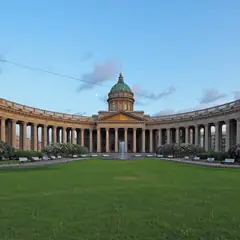
Following the Griboyedov Canal towards Nevsky Prospect, some 700 metres on, the colonnade of the Kazan Cathedral appears, and at a similar distance lies the Winter Palace of the Hermitage Museum, the residence of the tsars.
A bell tower that stepped into the canal
Church of the Savior on Spilled Blood
Summary of this stop
In front of the bell tower, beside the canal railing, the oddity of the building becomes clear. Its west end does not stop at the bank: it advances over the bed of the old Yekaterininsky Canal to take in the exact stretch of embankment where Nikolai Rysakov threw the first bomb, wrapped in a handkerchief, and Ignaty Grinevitsky the second. That first explosion mortally wounded a Cossack of the escort and Nikolai Zakharov, a 14-year-old butcher’s delivery boy.
Building over water required unusual solutions for the city: concrete foundations instead of wooden piles, with a layer of clay against damp. And since the west façade stood over the canal, no door could be opened there: entry is through two porches, north and south of the bell tower, with gospel mosaic panels above the doors.
The water running beside the parapet also has its legend. It is said that in the revolutionary years some neighbours sank the church’s crosses in the canal to save them, and that decades later a passer-by told the restorers where to look. What, according to tradition, the divers found is told in the narration, facing that same canal.
Enamelled Moscow by a son’s command
Enamelled domes and granite plaques
Summary of this stop
From the north side, beside the porch, the church looks torn from another city. It is no accident. The day after the attack the Duma proposed a chapel or a monument, and Alexander III replied that he preferred a church. Meanwhile, a provisional wooden chapel by Leonty Benois was consecrated on the spot in April 1881, and in 1883 it was moved to Konyushennaya Square.
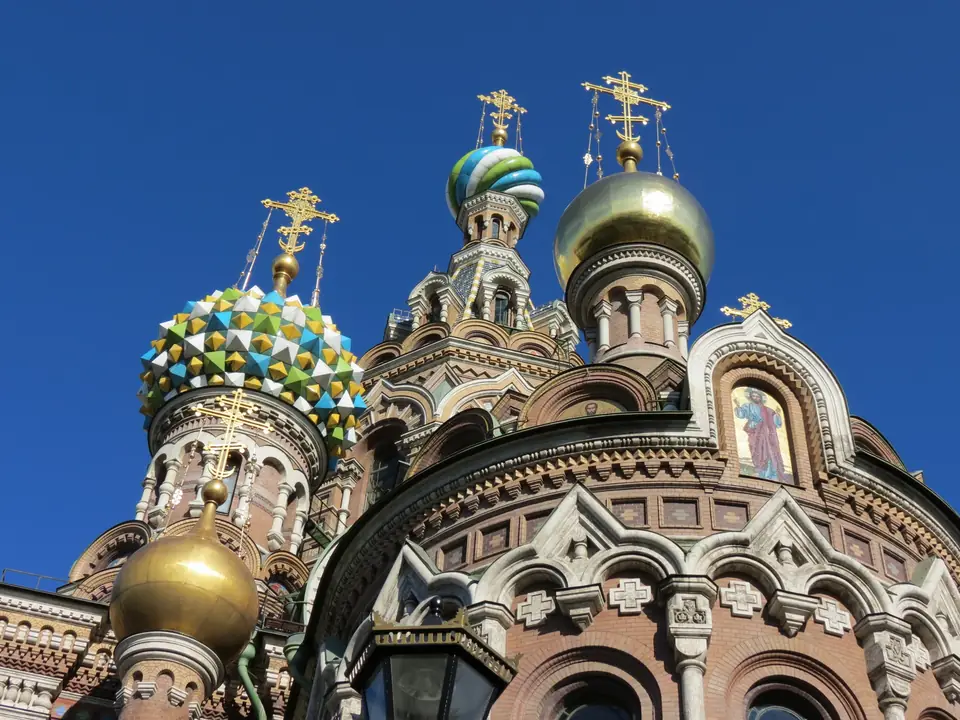
In 1882 the tsar rejected the entries of two competitions and demanded the style of the 17th-century churches of Yaroslavl, with the site of the attack inside the church. On 29 June 1883 he approved the design of Alfred Parland, a Petersburg architect of Scottish and German descent, and of Archimandrite Ignaty (Malyshev); the final project did not arrive until 1887. The result is nine onion domes: the central one, on an octagonal spire in white, green and blue spirals; four around it, each with a different pattern, and three small gilded ones over the apses.
The height also has a reading. The central structure measures 81 metres, a figure that recalls 1881, although one source attributes that measurement to the bell tower; the second tallest dome reaches 63. On the lower part of the walls, granite plaques review the biography of Alexander II and his reforms, beginning with his birth, with verses by Zhukovsky.
The cobblestones of 1881 beneath the jasper
Jasper canopy over the cobblestones
Summary of this stop
At the far end of the church, beneath the bell tower and facing the altar, the scale changes suddenly. Beneath an immense vault, a baldachin of jasper columns carved in the lapidary works of Yekaterinburg and Peterhof covers something very small: seven steps down, behind glass, the cobblestones of the roadway, the paving slabs of the pavement and a stretch of the canal railing where Alexander II fell wounded.
Around that spot a documented tradition survives, one of those hard to forget. That afternoon there was a third thrower, Ivan Emelyanov, stationed some twenty paces away to act only if the first two bombs failed. After the second explosion he approached the wounded tsar and helped to hold him, with his own bomb wrapped in a newspaper under his other arm. How that day ended for him, and the rest of his life, is left for the narration before the canopy.
Among believers there is also a belief that whoever prays at that spot with pure thoughts obtains healing and inner peace: the exact site of an attack turned into a corner of prayer.
Seven thousand metres of tesserae and a shell
Christ Pantocrator of the central dome
Summary of this stop
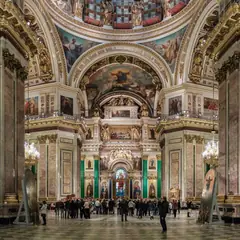
Beneath the central dome not a hand’s breadth is left undecorated. Walls, vaults and pillars are lined with mosaic made in Vladimir Frolov’s workshop from sketches by more than 30 painters, among them Viktor Vasnetsov and Mikhail Nesterov; at the top, Nikolai Kharlamov’s Christ Pantocrator. The most cited figure is 7,065 m², although sources do not agree and the idea that it is the largest mosaic collection in the world does not hold up: quality sources place it among the largest in Europe. That work delayed the consecration by some ten years.
The ceremony came on 19 August 1907, 1 September in the Gregorian calendar, in the presence of Nicholas II, after 24 years of work and a cost put at around 4.6 million roubles. The valet of the murdered tsar carried the cross in the procession, and each worker received a silver pocket watch bearing the Imperial coat of arms.
This same dome hid an unexpected guest for 18 years. In 1961 restoration climbers found among its beams a German 240 mm shell weighing some 150 kilos that had never exploded. How they brought it down is told at the stop, with eyes on that same vault.
From potato warehouse to the crosses of 2026
Marble iconostasis
Summary of this stop
In front of the iconostasis of Italian marbles, openwork like lace, the fall and the return of the church are summed up. It was closed in 1930, according to most sources, and the following year a regional commission agreed to demolish it as a building without artistic value; the plan was taken up again in 1938 and only the war left it suspended. During the siege of Leningrad it was the district morgue, and afterwards workshops and a warehouse: hence the nickname Spas na kartoshke, the Savior on Potatoes, although sources disagree on the order in which those uses followed. After 1945 the Maly Opera Theatre stored its sets here.
In 1970 it was decided to turn it into a branch of the St. Isaac’s museum, and the museum-monument opened in 1997, 90 years after the consecration. The first liturgy in more than 70 years was held in 2004 and today there are masses before and after visiting hours. The Holy Doors, lost in the 1920s, returned recreated in enamel in 2012, and in June 2026 the topaz crosses came back to the iconostasis, rebuilt from archive photographs, among them one by Karl Bulla of 1917.
The recovery keeps arriving by unexpected paths. According to the museum, in 2023 an antiques dealer in Rybinsk held an embroidered shroud that turned out to bear a hidden seal with the year of the consecration. What that seal said, and the other piece that returned to the church in 2024, is revealed when listening to the narration in front of the iconostasis.