Imperial cathedral
St. Isaac's Cathedral Audio Guide (Isaakievsky sobor)
Forty years of building on a swamp, single-piece granite columns and a dome gilded with mercury that cost lives. Then a 20th century of atheist pendulum, domes painted grey and a dispute that is not over yet.
- 60 min of audio
- Neoclassical architecture
St. Isaac's Cathedral is the great imperial church of Saint Petersburg and the fourth raised in the city to honour the birthday of Peter the Great, born on the feast day of Saint Isaac of Dalmatia. Auguste de Montferrand built it between 1818 and 1858 on thousands of wooden piles driven into marshy ground, with 48 monolithic columns of red granite and an entirely metal dome, the third in the world with a metal structure.
Its history does not end with the consecration. In 1931 an antireligious museum opened inside with a Foucault pendulum hanging from the dome; in 1941 climbers painted the gold grey so that it would not guide the German artillery, and during the blockade it stored the treasures of the suburban palaces. Today it hosts daily services while remaining a state museum.
Highlights
- 48 monolithic columns — red granite, 17 m and 114 tonnes, raised before the walls
- 25.8 m metal dome — fire-gilded with mercury between 1838 and 1841
- Ivan Vitali's west pediment — Montferrand portrayed with the model of the cathedral
- Foucault pendulum — hung from the dome from 1931 to 1986, in the antireligious museum
- Stained glass of the Risen Christ — 9.5 m high, made in Munich, in an Orthodox church
The history of St. Isaac’s Cathedral begins with a birthday. Peter I was born on the feast day of Saint Isaac of Dalmatia, 30 May in the Julian calendar, and the city he founded dedicated to the saint a wooden church consecrated in 1707. In it, according to the campaign diary, the tsar married Catherine Alexeyevna, the future Catherine I, in February 1712: a provisional church set up in a former plan warehouse facing the Admiralty, from which the newlyweds emerged amid salvoes from the Peter and Paul Fortress. Two more churches followed. The third, by Antonio Rinaldi, was hurriedly finished by Vincenzo Brenna on the orders of Paul I from 1798: with no money, a reduced dome and the marble of the upper part diverted to the Mikhailovsky Castle, it was consecrated in 1802 with a marble plinth and brick walls.
That mixture gave rise to a famous epigram, the monument of two reigns, marble below and brick above. Its authorship is disputed: it was attributed to Alexei Kopiev, exiled in 1797, and some memoirs blame a naval officer whose tongue and ears, according to that version, the emperor had cut off. The present building, the fourth, is the work of Auguste de Montferrand and took forty years to raise, until its consecration on 30 May 1858. What to see at St. Isaac’s Cathedral, its architecture and its history are covered in five stops, from the square to the iconostasis, with a documented narration that saves its best twists for when it is heard beneath the dome.
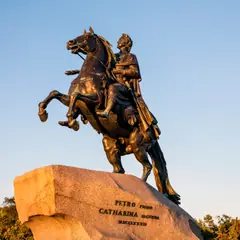
About 400 metres away, on Senate Square, stands the Bronze Horseman, and a kilometre towards Nevsky Prospect waits the other great cathedral of the centre, the Kazan Cathedral.
A golden dome gilded with mercury
St. Isaac's Square
Summary of this stop
From the south side of St. Isaac’s Square the whole ensemble can be read: the great gilded dome above a drum ringed by 24 columns and, at 43 metres, the colonnade that now serves as a viewing platform open to the public. That dome, 25.8 metres in outer diameter, is entirely metal. At Charles Baird’s foundry 490 tonnes of iron, 990 of cast iron, 49 of copper and 30 of bronze were cast, and the result was the third dome in the world with a metal structure and shells, after the Nevyansk tower and Mainz Cathedral.
The shine has a less luminous history. Between 1838 and 1841 the domes were fire-gilded with mercury amalgam, and 60 craftsmen died of poisoning from the fumes; some testimonies of the period raise the figure, although the count is disputed. Afterwards, the smaller pieces came to be gilded by electroplating. What that outsize building means as the fourth attempt to honour an imperial birthday is better understood when listening in the square itself.
114-tonne columns on a swamp
South portico of granite columns
Summary of this stop
Beneath the south portico, each red granite column is a single piece 17 metres tall and weighing 114 tonnes. The monoliths were quarried by hand at Pyterlahti, near Vyborg, with the method of the stonemason Samson Sukhanov, and travelled on barges towed by the first tugboats in Russia; the first arrived in September 1820. The 48 columns of the four porticoes were raised before the walls: with wooden scaffolding, pulleys and 16 capstans, 128 workers stood one upright in 40 or 45 minutes. The first was set in place on 20 March 1828 before Nicholas I and his family.
Below, invisible, lies the hardest part. To bear such weight on marshy ground a foundation of solid masonry 7.5 metres high was built, tied with metal pieces and seated on some 24,000 wooden piles, according to the museum; other sources give very different figures. They were driven with iron mallets moved by horses.
The work was so long that it left its mark on speech: building Isaac remained in Russian a synonym for a never-ending task, and in Finnish people still say building like Isaac’s church. A Petersburg tradition went further and tied the scaffolding to the Romanovs’ fate: as long as it stood, the dynasty would reign. It was removed entirely in 1916. What happened months later is told at the stop.
Montferrand hidden in his own pediment
West portico pediment
Summary of this stop
The pediment of the west portico shows Ivan Vitali’s relief, made between 1842 and 1845, with the meeting of Isaac of Dalmatia and the Emperor Theodosius. In the left corner, a small half-naked figure holds a model of the cathedral: it is the portrait of Montferrand, the architect who devoted forty years to this building. They were not easy years. In 1821 the architect Antoine Modui reported to the Academy of Fine Arts flaws in the foundations, the settling and the dome, and asked for the works to stop; a committee reviewed the design and Alexander I did not approve the corrected project until 13 April 1825.
Montferrand died in 1858, less than a month after the consecration. He had asked to rest in a crypt of the cathedral, but Alexander II refused because he was Catholic: after the funeral at Saint Catherine’s on Nevsky Prospect, the procession circled the church three times and his remains ended up in Montmartre Cemetery.
Legend has it that on the day of the consecration someone pointed out to the tsar that little figure holding the model with head held high, among saints who bow, and that the emperor’s offended expression precipitated the architect’s end. It is a disputed story, like that of the ghost some say they see by the colonnade. What truth there is in it is revealed in front of the pediment.
The dove that replaced the atheist pendulum
Dove beneath the dome
Summary of this stop
In the centre of the nave, beneath the dome, hangs a white dove of the Holy Spirit. It occupies the exact point from which, between 1931 and 1986, a Foucault pendulum of 54 kilos and 98 metres of wire hung. It was installed for the opening of the State Antireligious Museum, held on the Easter night of 11 to 12 April 1931, when services had been suppressed since 1927.
A decade later came the war. Around the beginning of July 1941 four climbers, lowering themselves on ropes from the upper lantern, painted the gilded domes grey in oil so that they would not guide German artillery and aviation. During the blockade, the cathedral stored the treasures of the palaces of Pushkin, Pavlovsk, Peterhof, Gatchina and Oranienbaum, and in January 1942 its interior reached 20 degrees below zero.
That the most visible church in Leningrad emerged from the siege without a direct hit is told as a miracle, and legend offers more than one explanation, from the cunning of a former gunner to the 24 bronze angels of the dome. Shrapnel did leave marks on the stairs and columns of the west portico. Why no one destroyed it is heard beneath the dove itself.
A Catholic-style stained-glass Christ in an Orthodox church
Malachite and lapis lazuli iconostasis
Summary of this stop
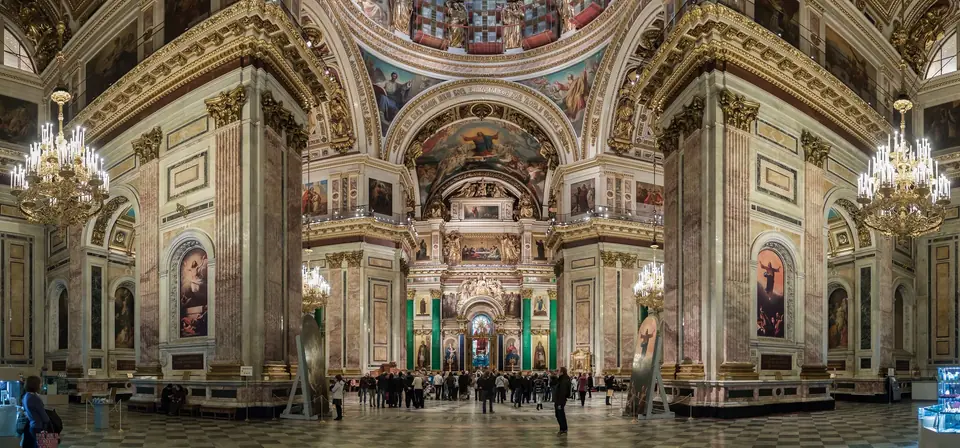
The iconostasis is framed by six malachite columns and two of lapis lazuli, and instead of painted icons it carries mosaics. It is no whim: cold, damp and lack of ventilation spoiled the paintings, and from 1851 Nicholas I ordered them replaced with mosaic. The cathedral’s 62 mosaics, with more than 12,000 shades of enamel, were worked on until the First World War.
Behind the Holy Doors comes a surprise: a stained-glass window of the Risen Christ of 28.5 square metres and 9.5 high, made in Munich under the direction of Max Ainmiller from a sketch by Heinrich Maria von Hess and definitively installed in 1847. An element of Catholic tradition in the Empire’s main Orthodox church, which was later imitated in churches across Russia.
Services resumed in 1990 and are now held daily in a building that remains a state museum. In 2017 the announcement of its transfer to the Russian Orthodox Church brought thousands of citizens onto the streets; the order lapsed at the end of 2018 without being carried out. How church and museum coexist today beneath the same dome is left for the narration in front of the iconostasis.