Modern art museum
Solar do Unhão Audio Guide
A colonial estate set over the water that survived four centuries of uses, an avenue that would have cut it in two and its own dark past, and that Lina Bo Bardi turned into a museum without freezing it.
- 60 min of audio
- Colonial and modern architecture
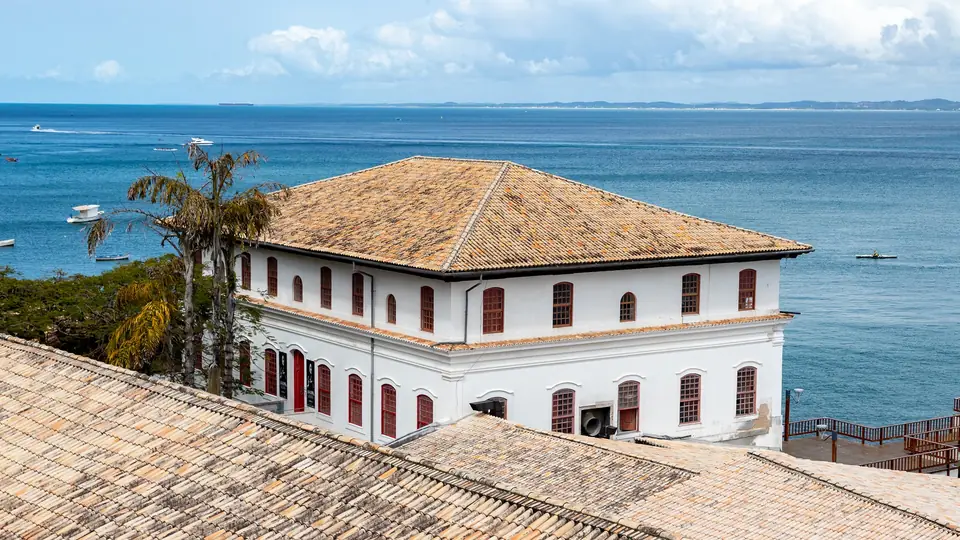
The Solar do Unhão brings together a casa grande, chapel, quay, aqueduct and warehouses on the edge of All Saints Bay. Its name comes from the desembargador Pedro de Unhão Castelo Branco, a judge who lived there in 1690; in the 18th century it was the entailed estate of the Pires de Carvalho e Albuquerque family, who left Portuguese azulejos, a chafariz and a chapel rebuilt in 1794. Protected by the national heritage service in 1943, it now houses the Museu de Arte Moderna da Bahia.
In 1960 the route of the Avenida do Contorno was to pass between the mansion and the chapel and over the aqueduct; a press campaign and an alternative design by Diógenes Rebouças diverted it onto arches resting on the rock. Soon after, Lina Bo Bardi emptied the interior of the mansion and stitched it together with a wooden staircase assembled without a single screw, fitted like an ox cart.
Highlights
- Arches by Diógenes Rebouças: the Avenida do Contorno was rerouted in 1960 so as not to split the complex
- Chapel of Nossa Senhora da Conceição, rebuilt in 1794 with nave and chancel of equal width and height
- Helical staircase by Lina Bo Bardi, wooden and screwless, assembled like an ox cart
- Quay with rails, wagons and pulley of the old trapiche, and a snuff factory that ran from 1816 to 1926
- Museu de Arte Moderna da Bahia: about 1,200 works and a Sculpture Park facing the sea
The story of the Solar do Unhão begins with a will. In 1584 the settler and chronicler Gabriel Soares de Souza bequeathed to the Benedictines the Unhão land, where the spring flowed that would perpetuate the name of the place. A century later the desembargador Pedro de Unhão Castelo Branco, a judge of the Tribunal da Relação da Bahia, lived there, and his surname ended up naming the complex. When and by whom the casarão was built remains a matter of debate: some sources attribute the work to the judge himself in 1690, others only record that he resided there, and datings of the complex range between the 16th and 18th centuries.
What is not disputed is its capacity to change skin. A family estate turned entailed property, a port warehouse facing the bay, a snuff factory for 110 years, a trapiche, a protected monument since 1943 and, finally, a museum. According to tradition, around 1798 it even served as a hideout linked to the Revolta dos Búzios, the Bahian tailors’ conspiracy. Nor is there agreement on whether it ever worked as a sugar mill: the IPAC says so, while other voices maintain it was never more than a goods trapiche.
The history of the Solar do Unhão reads from top to bottom, from the arches of the avenue to the quay, passing the chapel and the casarão where Lina Bo Bardi planted her staircase. The audio guide follows that descent toward the water with documented narration checked against historical sources, and keeps its most unexpected episodes for the place itself.
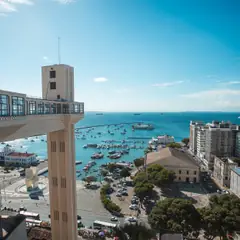
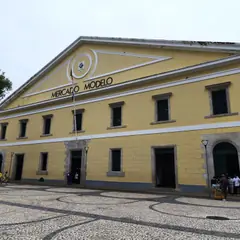
Following the bay to the north, the Mercado Modelo occupies the old port customs house, opposite the Lacerda Elevator, which rises in seconds to the Cidade Alta.
The arches that diverted an avenue
Solar do Unhão
Summary of this stop
The route starts at the top of the cobbled ramp, the same access slope that the national heritage service protected on 16 September 1943 together with the old gate, the park, the aqueduct, the chapel and two freshwater springs. Above run the arches of the Avenida do Contorno, and they are not a mere overpass: they are the proof that the complex came close to disappearing.
When work on the avenue began in 1960, the project ran one roadway between the casarão and the chapel and another over the aqueduct and the spring. The newspaper A Tarde launched a campaign on 26 and 27 May of that year, and the architect Diógenes Rebouças proposed an alternative route that skirts the estate by resting on the rock. Beneath those arches the Galeria de Arcos now opens.
Those same arches starred in 2019 in a clash between festivity and conservation: a concert overflowed the museum and some of the audience leaned over them above the stage. The Iphan reported that there was no damage, but also that those concerts did not have its authorisation. What one of Salvador’s great bands replied after the controversy is something revealed when you listen to the narration on the spot.
A chapel as wide as its altar
Chapel of Nossa Senhora da Conceição
Summary of this stop
In the largo that opens in front of the chapel appears the 18th-century family estate. At the beginning of that century José Pires de Carvalho e Albuquerque bought the property and entailed it for his family; from that time date the Portuguese azulejo panels that decorate the entrance passage and the chafariz of drinking water that still stands beside the path.
The chapel of Nossa Senhora da Conceição appears in documents in 1740, with the baptism of a granddaughter of the owner, and was rebuilt in 1794 with an unusual plan: the nave and the chancel have the same width and the same height. Its façade, in a late 19th-century Rococo, is topped by two towers with Mansard-style roofs and faces west.
Deconsecrated, it now works as an exhibition hall, with the rough plaster that Lina Bo Bardi also gave to other pavilions of the complex. What that singular plan says about those who prayed inside is left to the audio guide.
Lina’s screwless staircase
Museu de Arte Moderna da Bahia
Summary of this stop
Inside the casarão, the architecture of the Solar do Unhão makes its boldest turn. In the 1962-1963 restoration Lina Bo Bardi emptied the interior of the building and inserted a wooden helical staircase between the floors, assembled without screws using the joinery technique of ox carts. Up close you can make out the removable locking pieces that hold each step.
The architect refused to return the complex to a supposed original state. She kept rails, hoists and cranes from its industrial past alongside the colonial azulejos, demolished secondary buildings to open an esplanade to the sea and unified the buildings with white walls and red joinery.
In November 1963 the Museu de Arte Popular opened here with the exhibitions “Artistas do Nordeste” and “Civilização do Nordeste”. After the military coup of 1964 she was dismissed, and the popular-art museum ended up merged with the Museu de Arte Moderna da Bahia; sources do not agree on whether the MAM moved into the estate in 1963 or in 1969. How exactly each step fits, and why that rural technique mattered so much to its author, is explained at the foot of the staircase.
Rails, snuff and darkened galleries
Quay rails and pulley
Summary of this stop
On the quay, beside the great pulley fixed on a concrete platform lashed by the waves, the estate reveals itself as a machine of commerce. The rails and wagons that run through the lower galleries, the long quay and the warehouses point to the collection and export of the production of the Recôncavo sugar mills; as late as 1853 an inventory of the Visconde da Torre de Garcia D’Ávila recorded a large still in operation.
In 1816 the Swiss Meuron installed a snuff factory here, powdered tobacco for sniffing, which ran for 110 years, until 1926, and was one of Salvador’s first factory productions. Its brand gave rise to a famous lawsuit: in 1874 a 24-year-old Ruy Barbosa defended Meuron & Cia. against an imitator and more than 2,300 forged tins were seized. The court acquitted the competitor for lack of a law, and that defeat spurred the first Brazilian trademark law, Lei nº 2.682 of 23 October 1875.
A few metres away lie the lower galleries, closed behind sturdy grilles, where in its port-warehouse stage enslaved Africans were held awaiting sale. Legend says the Unhão is haunted by those who died there. What names the two rival snuff brands facing each other in court had is one of the details revealed beside the water.
The sunset of a living museum
Sculpture Park by the sea
Summary of this stop
The route ends at the Sculpture Park, opened in 1998 by the sea, with works by Mário Cravo Júnior, Mestre Didi or Bel Borba and the railing and panel by Carybé. The MAM holds about 1,200 modern and contemporary works, by Tarsila do Amaral, Portinari, Di Cavalcanti or Rubem Valentim, and around 2014 it received some 200,000 people a year, drawn also by the Saturday “Jam no MAM” jazz concerts facing the bay.
The life of the complex does not end at the gate. Every summer, on the eve of 2 February, Iemanjá’s day, the neighbouring community of the Solar do Unhão celebrates the Presente Ecológico de Iemanjá: the gift to the goddess of the sea is made only with biodegradable materials and goes down in procession to the water with the afoxé Filhas de Gandhy. The 13th edition was held on 1 February 2026.
From the quay, turned into a balcony over All Saints Bay, a route closes that runs from a chronicler’s will to a museum that is still in motion. Why this corner is still alive precisely because nobody wanted to freeze it is the idea with which the audio guide takes its leave in front of the sunset.